Footstep Measuring Around the Room
Quick Activity Snapshot
- Age Range
- Ages 4–5
- Prep Time
- 5 minutes
- Skills Practiced
- Non-standard measurement
- Materials
- One paper shoe outline prepared by an adult, The printable record sheet and a whole crayon, A long piece of scrap paper for endpoint marks, A clear tabletop edge or short level floor distance
Age ranges are suggestions, not developmental milestones or standards. Choose the setup for this child, and stop whenever needed.
How many shoe-lengths long is this space? A paper shoe outline gives you one unit you can place again and again. An adult’s larger outline may produce a different count over the same distance. The interesting question is what was repeated, not whose number is right.
Materials You’ll Need
- One paper shoe outline prepared by an adult
- The printable record sheet and a whole crayon
- A long piece of scrap paper for endpoint marks
- A clear tabletop edge or short level floor distance
Choose one short, straight distance, such as part of a tabletop edge. The PDF supplies three recording sections, not a footprint template. An adult traces one shoe and cuts that single broad outline, or draws a rectangular paper unit of the same length. Use that same piece throughout one measurement. Indicate fixed start and finish points on paper beside the route; do not write on a floor or climb onto furniture.
Step-by-Step How to Play
-
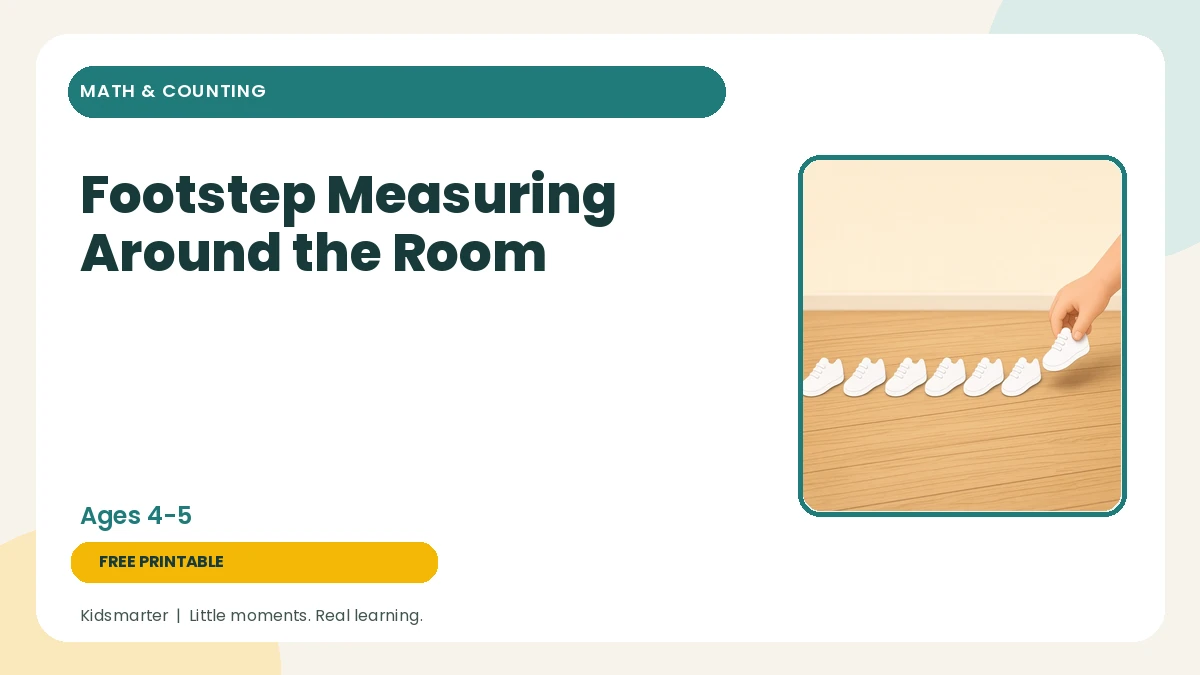
Show how one footprint begins at the starting line. Place the next directly after it, heel meeting toe, with no gap or overlap. Model two placements slowly before asking your child to count.
-
Measure together by placing the paper heel at the start, then moving it so the next heel begins exactly where the toe ended. Keep the outline pointing the same way. An adult can mark each endpoint on the paper record strip while the child counts placements. Do not substitute ordinary walking steps: changing stride length would change the unit.
-
Record the route and the unit, not just a number. If four complete placements fit and part of a fifth reaches the finish, say, “Four whole shoe-lengths and part of another.” In the count box, an adult can write that description after “about.” Do not count the partial placement as a complete fifth unit without saying it is an estimate.
-
Measure again using the same footprint. Investigate a different answer by checking gaps, overlaps, and the starting point. Repeating the process is a chance to improve the method, not proof of a mistake.
-
Try a larger adult paper shoe outline over exactly the same marked distance. Record it in “Another unit,” keeping its count separate. Compare the actual outlines and the unfilled end sections. A larger unit covers more distance each time, but two rounded “about” counts can coincide on a short route; that is a reason to inspect the units, not to insist a child’s answer must differ.
Small Details That Make This Activity Work
Choose a first route ending at a whole number of paper units if you want an uncomplicated start. Later extend the finish partway through a unit and compare the leftover section. The three recording sections are for three routes, not three attempts you must finish. Label which outline was used each time; a bare “six” cannot tell another person the length without its unit.
Why This Activity Helps
Measurement requires repeating a unit while preserving its size and position. Counting steps alone is insufficient if the steps vary. Comparing adult and child units makes the relationship between unit size and numerical result tangible without formal formulas.
Easy Ways to Adapt by Age
Make It Simpler
Measure a tabletop edge with a short paper footprint instead of balancing on the floor. An adult places it while the child counts each move aloud or taps a tally.
Ready for a Challenge
Predict which of two distances needs more identical footprints, then test. Older children can mark partial units informally, or compare the paper-footprint measure with a ruler.
Parent Tip & Safety Note
Clear trip hazards and do not measure along stairs or narrow furniture edges. Avoid heel-to-toe balancing if it feels unsafe; a paper unit preserves the mathematical idea. Adults handle cutting and check tape removal on delicate floors.
Explore more activities in this category or free printable games.