Living-Room Treasure Hunt: Left and Right
Quick Activity Snapshot
- Age Range
- Ages 4–5
- Prep Time
- 8 minutes
- Skills Practiced
- Left-right and positional language
- Materials
- A large soft cloth toy as treasure, Printed positional clue cards
Age ranges are suggestions, not developmental milestones or standards. Choose the setup for this child, and stop whenever needed.
A treasure hunt can make position words useful instead of abstract. Your child follows a clue to find something under, behind, or beside a familiar object. Introduce left and right gently, always agreeing whose viewpoint the clue uses before anybody starts searching.
Materials You’ll Need
- A large soft cloth toy as treasure
- Printed positional clue cards
Choose an intact cloth toy appropriate for the child, without loose eyes, fasteners, or stuffing. Use one printed clue at a time while an adult keeps the page. Prepare a few reachable positions beside furniture or near its open edge; no tight space, moving furniture, cupboard, electrical equipment, stairs, or climbing is part of this hunt. If loose toys are unsuitable, use the page’s dot-and-reference diagrams for pointing instead.
Step-by-Step How to Play
-
Demonstrate under with the same toy placed partly beneath the open edge of a stable chair, within easy reach without crawling into a tight space. Say, “The toy is under the chair.” Move it back into view before another example. On the PDF, the black dot is the target and the rectangle is a simplified reference object, not a detailed furniture picture.
-
For the next turn an adult places the toy in one of the checked positions, then reads one clue, such as “Look behind the cushion.” Keep it partly visible if helpful. Find that one toy before placing it for another turn; no hidden chain of loose cards is required. Do not ask the child to pull cushions from beneath someone or move furniture.
-
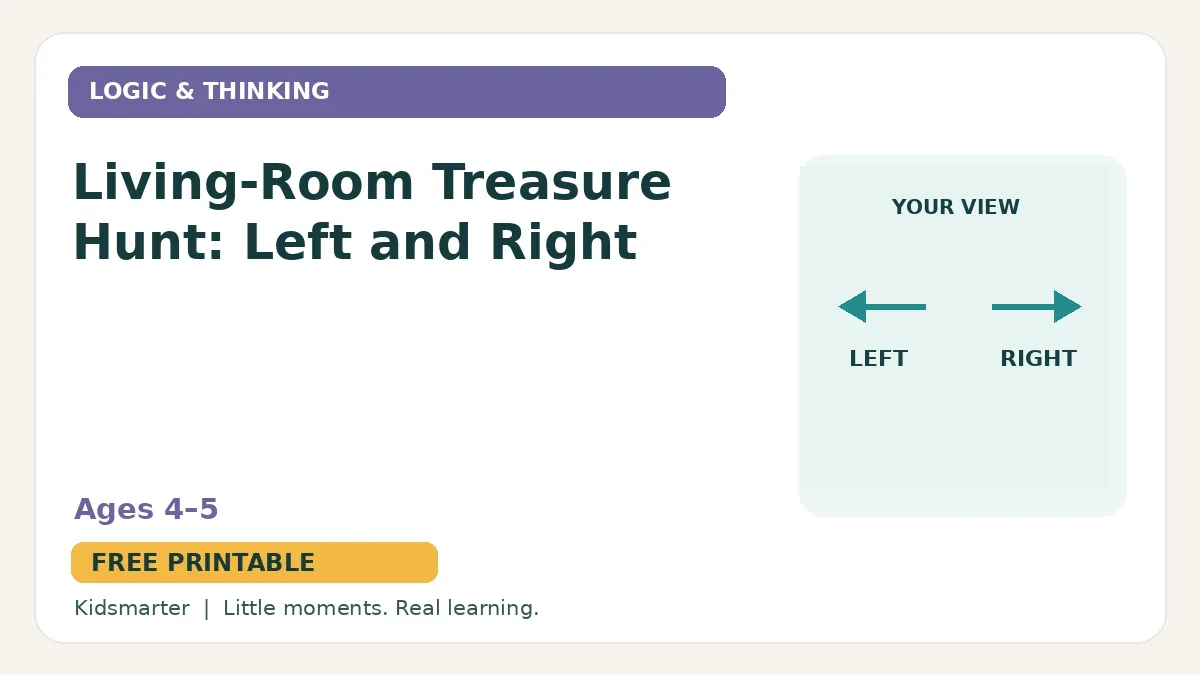
Stand shoulder to shoulder, both facing the sofa. Say, “Look to YOUR left from here,” using your shared viewpoint, not an imagined sofa’s left. Point or raise a left hand together if useful. If either person turns, return to the agreed view before applying the left/right clue.
-
Show the next printed cue and ask your child to point to a checked toy position that fits it. Accept a gesture, then offer the positional word. For a left/right cue, reset your shared facing direction before deciding. Keep the clue in view rather than adding a hidden-card chain.
-
Find the treasure together and retrace two hiding places verbally. Let your child design one safe clue for you, checking its location before you begin. A three-clue hunt is plenty for a first round.
Small Details That Make This Activity Work
Position words need a reference object. “Under” alone leaves too many possibilities, while “under the low table” gives a clear relationship to inspect. For left and right, face the same direction at first and avoid mirroring each other across the room. Point to your own left hand as a reference; no wrist tie or band is needed. When a clue fails, ask whether your instruction was clear before assuming the child misunderstood. Invite a revised clue and test it together. Good treasure hunts make information trustworthy enough that the search feels fair and safe.
Why This Activity Helps
Spatial language links words to relationships between objects and viewpoints. Acting on a clue gives immediate feedback about its meaning. Left and right are especially demanding because perspective matters; uncertainty at this age is not evidence of a problem.
Easy Ways to Adapt by Age
Make It Simpler
Use in and under with the treasure partly visible. Walk together and carry the matching picture card, keeping only one relationship in focus for each turn.
Ready for a Challenge
Use a two-part clue, such as beside the chair and under the cushion, after single clues are comfortable. Ask your child to explain the viewpoint used for any left or right instruction.
Parent Tip & Safety Note
Keep the checked toy and clues within easy reach. Choose a new location instead of climbing, crawling into a gap, moving heavy furniture, or searching near sockets, heaters, medicines, cords, or balconies. Do not use food, tiny stickers, or small counters as treasure. At the end, remove the toy and any prepared cards so there is no ongoing invitation to search.
Explore more activities in this category or free printable games.