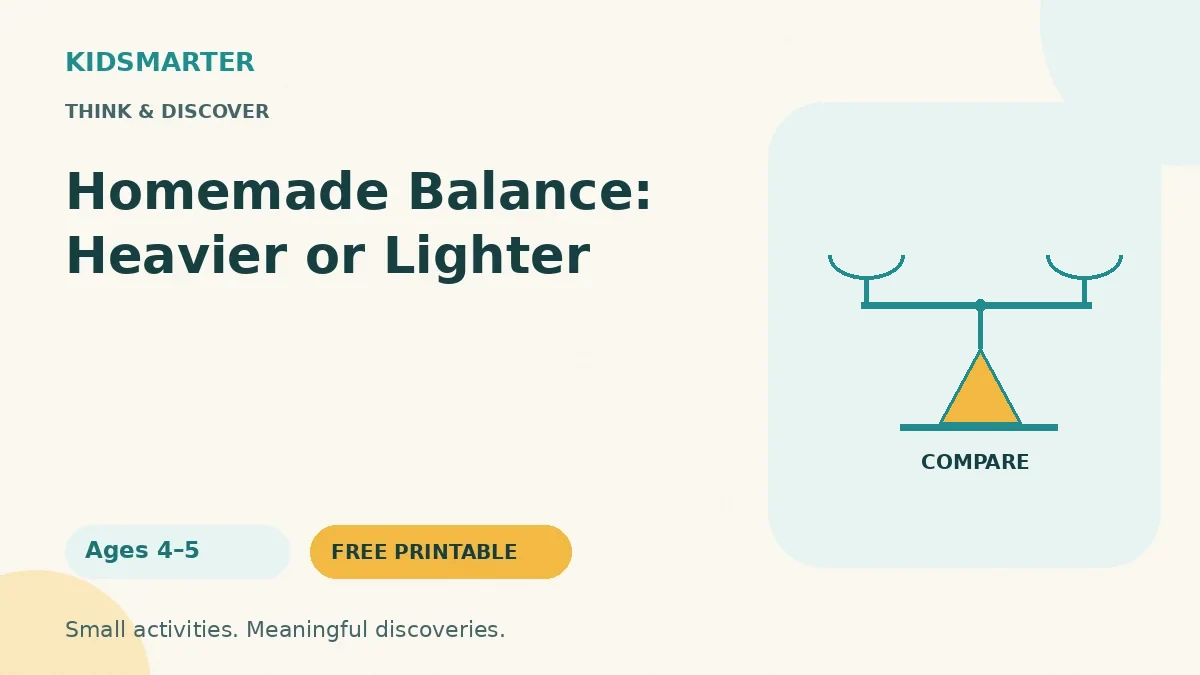
Homemade Balance: Heavier or Lighter
Quick Activity Snapshot
- Age Range: Ages 4–5
- Prep Time: 10 minutes
- Skills: Comparing weight and making predictions
- Materials: A suitable stable purpose-made tabletop balance, if available, Two intact suitable objects that fit its pans without overloading, The revised comparison sheet and a whole crayon
Age ranges are suggestions, not developmental milestones or standards. Choose the setup for this child, and stop whenever needed.
For this home weight-comparison activity, skip a string-and-hanger rig. A suitable stable tabletop balance can compare two loads without dangling cords. If you do not have one, explore which object feels heavier in your hands and call that a hand comparison, not a balance result. Predictions are ideas to check, and a close result may remain unclear.
Materials You’ll Need
- A suitable stable purpose-made tabletop balance, if available
- Two intact suitable objects that fit its pans without overloading
- The revised comparison sheet and a whole crayon
Use a stable purpose-made tabletop balance only if suitable for the child and setting, following its instructions and capacity. Choose an unpowered design without loose cords or accessible small weights; put any included small pieces away. An adult checks the empty pans are level and free to move. Select two intact light objects that fit securely; no glass, food, coins, or extra hanging equipment is needed. Without a suitable balance, use the hand-comparison option below and leave instrument-result boxes blank.
Step-by-Step How to Play
-
Place the tabletop balance on a stable low surface, away from its edge. With empty pans, check the starting level and free movement as the instructions require. Say, “We need an even start before comparing loads.” If it cannot start level or catches, do not interpret its tilt. Put it aside rather than improvising a hanging support.
-
Offer the two checked objects to compare in the hands only if handling is suitable. Ask, “Which feels heavier?” Label the left-pan choice A and the right-pan choice B on the sheet with adult drawings. A prediction can be a point. For hands-only play, record what feels heavier but do not tick a tested balance result. Size alone does not decide weight: an empty large box can be lighter than a smaller solid object.
-
An adult places A in the left pan and B in the right, within the device’s load limit. Let it settle without pushing. Ask which side is lower. With a freely moving, correctly set balance, that side carries the heavier load. If the pans catch, the pointer is unclear, or the result is close, choose “Not clear” and reset; do not force the expected result.
-
Record the observed result and compare it with the prediction. Swap the objects between pans for a separate check, noting their NEW left/right positions. The same object should still be the heavier one when the setup is working; if it is not, check the empty start and free movement before deciding. No result has to agree with the first guess.
-
Return both pans to empty before another pair. Compare only one pair at a time and stop after an interesting result. An adult clears and stores the balance and objects when finished. In the hands-only version, compare again if desired and describe the feeling without filling in an instrument result.
Why This Activity Helps
The sheet separates an idea before a comparison from what you actually observe afterward. A two-pan balance compares loads; it does not give grams unless the instrument and method are designed for that measurement. Hand feelings and a balance reading are different kinds of observations. An uncertain outcome is worth recording rather than turning it into an exact number.
Easy Ways to Adapt by Age
Make It Easier: Use one clearly different pair and skip the sheet. An adult can demonstrate the checked balance while the child points, or you can simply describe how the objects feel in the hands. Keep those versions distinct: feeling heavier is not a confirmed instrument result.
Add a Challenge: For another comparison, ask whether the result follows the same object when its pan changes. Keep the device, load limit, and empty starting check the same. If a close comparison is not clear, record that and stop rather than adding loose weights or exceeding capacity to get a dramatic tilt.
Free Printable Included
Print this activity-specific pack on Letter paper. An adult prepares any cut pieces; use the activity directions above.
Parent Tip & Safety Note
Do not build a string-and-hanger rig for this version. Use only the checked stable tabletop device and suitable intact objects; put small weights, batteries, food, cords, and damaged parts away. An adult loads and clears the pans. Choose hand comparison only, or postpone the activity, if safe equipment or comfortable handling is unavailable.