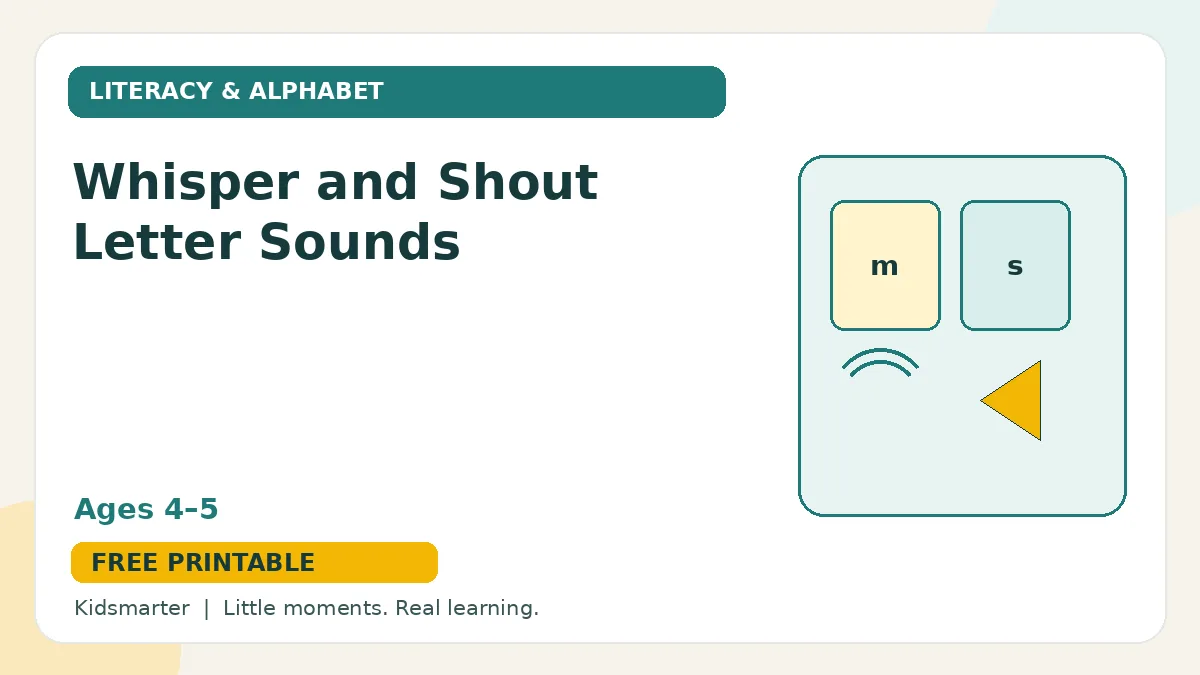
Whisper and Shout Letter Sounds
Quick Activity Snapshot
- Age Range
- Ages 4–5
- Prep Time
- 3 minutes
- Skills Built
- Letter-sound correspondence
- Materials
- The revised letter and NAME/SOUND cue sheet, A plain cover sheet
A letter can have a name and represent a sound, and those are different responses. Despite this game’s playful title, use a comfortable speaking voice for both: no shouting, forced whispering, or volume contest is needed. The revised printable uses NAME and SOUND cues so the choice is visible. Begin with two familiar letters and stop after a few turns; recognizing all eight cards is not an age requirement.
Materials You’ll Need
- The revised letter and NAME/SOUND cue sheet
- A plain cover sheet
Start with m and s. The revised sheet also offers f, a, t, n, c, and p for later use. For a, model the short vowel in at, not the letter name “ay.” The c card models /k/ as in cat; it does not mean c always has that sound in English. Keep the other letters covered with a plain sheet rather than expecting the child to scan eight options.
Step-by-Step How to Play
-
Set out m and s with the NAME and SOUND cue cards. Say, “If I point to SOUND, we say the sound. If I point to NAME, we say its name.” Model m with /m/ as in moon, then the English letter name “em,” both at a comfortable volume. If you prefer the original pointing gestures, low means SOUND and high means NAME; it never means whisper or shout.
-
Invite your child to choose one letter. First point to SOUND and give the model yourself. You can hold /m/, /s/, or /f/ briefly without inserting “uh.” For t or p, use a short sound rather than “tuh” or “puh”; do not try to stretch it. Let the child point to the cue and listen if they do not want to speak.
-
Try a NAME turn and a SOUND turn in a predictable order. Ask, “Which one did I ask for?” and let your child point to the cue before answering. If they say “em” on a SOUND turn, answer, “That is its name; here is its sound, /m/,” then continue. Do not ask for a louder or more strained performance to make an answer count.
-
Add the second card and let your child become the caller. Follow their pointing signal, including a deliberately slow response so they can check you. Say, ‘You showed s, and I said /sss/. Does that match?’ Offer a gentle disagreement to investigate together, rather than turning mistakes into tricks.
-
Finish by finding one spoken word beginning with a practiced sound: ‘Mmm, moon starts like m.’ Put the card beside a quick drawing. End after two or three successful minutes, even if some cards remain unused. Next time, repeat these letters before introducing a single new one.
Small Details That Make This Activity Work
Notice which response comes readily. A child may know ’em’ but still need your /mmm/ model; that gives you tomorrow’s starting point. Store three familiar cards in an envelope so this becomes a quick waiting-time game rather than another large activity to set up.
Why This Activity Helps
This setup makes an adult’s request visible: say a letter name, or model a selected speech sound linked to print. Those are related but distinct tasks. Short, accurate models matter more than voice effects. The cues offer practice with the requested response; neither changing volume nor completing this original game has been shown here to improve reading outcomes.
Easy Ways to Adapt by Age
Make It Simpler
Use one letter and let your child choose the NAME or SOUND cue while you provide both responses. Leave the sheet intact and point instead of cutting if loose pieces would be mouthed. Speaking in the usual comfortable voice is the default, not an easier option a child has to request.
Ready for a Challenge
Introduce a known short vowel and alternate requests in an unpredictable order. Ask for a word containing the target sound, then return to the card. Avoid presenting every possible sound for a letter in the same first session.
Parent Tip & Safety Note
Use comfortable voices; do not shout near faces or ears and do not ask for prolonged whispering. If speaking feels tiring, switch to pointing while the adult models, or stop. Adults cut cards away from children and collect scraps. With a mouthing child or younger sibling at the table, leave the sheet whole and adult-held instead of handing out cut cards.
The age range above is a suggested starting point for this setup, not a developmental milestone or a standard your child must meet. Keep today’s cards to letters your child already recognizes, and treat a mixed-up name or sound as a cue to model again rather than to push for a longer list.
Find another small invitation to play in Literacy & Alphabet, or explore our free printable games. Choose one that fits your child’s interests, available materials, and energy today.
General voice-care background: NIDCD recommends avoiding vocal extremes. This is a calm play adaptation, not voice treatment or a tested phonics intervention.