Compound Word Picture Mix-Up
Quick Activity Snapshot
- Age Range
- Ages 5–6
- Prep Time
- 10 minutes
- Skills Built
- Compound words and vocabulary
- Materials
- Picture cards or simple drawings (sun + flower, rain + coat), A table or floor space
Sun plus flower makes sunflower: two familiar words suddenly name one new thing. This picture mix-up lets children hear that playful join while moving cards on the table. It is about spoken vocabulary first, not spelling long words. Some combinations make recognized compound words and others make wonderful nonsense. Enjoy both, but clearly name which ones people commonly use. Your child can explore the idea without being able to read any of the printed labels.
Materials You’ll Need
- Picture cards or simple drawings (sun + flower, rain + coat)
- A table or floor space
Use the matching pictures for sun and flower, rain and coat, tooth and brush, and foot and ball. Clear a small joining space between two cards. Read labels yourself, and introduce any object your child calls by a different name.
Step-by-Step How to Play
-
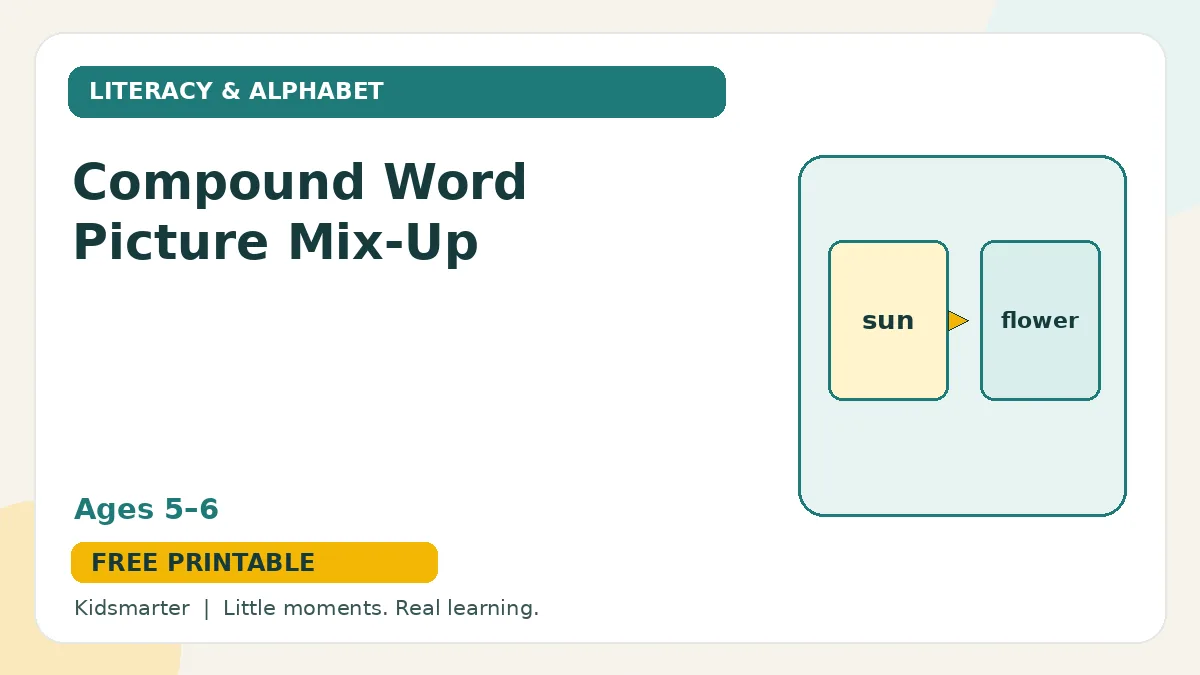
Begin with the sun and flower pictures. Name them separately with a pause: ‘Sun. Flower.’ Slide them together and say, ‘Sunflower.’ Ask your child what they notice about the new word. Explain that it names a kind of flower, rather than meaning any two pictures placed side by side.
-
Try the rain and coat pair together. Let your child move the cards while you say each part. Ask, ‘What do we call a coat that keeps rain off?’ Show or describe a raincoat. Keep the conversation about the complete meaning as well as the satisfying rhythm of joining words.
-
Spread four cards out, including a complete pair and two distractors. Say, ‘Can you find the two parts of toothbrush?’ Have your child point to tooth, then brush. Join them in that order. Switching the order is worth trying aloud, but explain that brushtooth is not the usual word.
-
Mix the remaining cards and take turns building a real compound. After each turn, use the word in a short sentence: ‘I kick a football in the park.’ Invite a sentence, an action, or a quick drawing from your child. Meaningful use matters more than matching all the cards quickly.
-
End with an invented combination, such as rainflower. Ask, ‘If that were a thing, what could it do?’ Then separate it from your real-word pairs. Review one conventional compound once more so your child leaves knowing both the word-play freedom and the everyday word you actually introduced.
Small Details That Make This Activity Work
Later, spotting the actual object gives you a natural replay: ‘There is our raincoat. Can you hear its two parts?’ Keep that invitation optional.
Why This Activity Helps
Compound-word play helps children notice that words can contain meaningful smaller words. Picture cards keep the two shorter words visible while children listen, combine them, and talk about what the new word means. Not every long word is a compound, and a compound’s meaning is not always predictable from its pieces. Stay with transparent, familiar examples here. You are building a useful language habit, not a rule for every unfamiliar word.
Easy Ways to Adapt by Age
Make It Simpler
Offer only two matching pictures and say the complete word yourself. Let your child push the pictures together or finish the second half of a familiar example. Repeat one pair in a real situation, such as finding the toothbrush after the game.
Ready for a Challenge
Hide the second picture and give a meaning clue: ‘This starts with rain and is something you wear.’ Invite your child to think of another compound at home, then check whether both spoken parts really are words before making new cards.
Parent Tip & Safety Note
Large cards are easiest to move and harder to lose. Adults should cut the set, and supervise small props or loose pieces around children under three. There is no need to bring real toothbrushes or shared mouth-contact objects into the game; pictures keep the activity simple and hygienic.
The age range above is a suggested starting point for this setup, not a developmental milestone or a standard your child must meet. Stay with the transparent picture pairs on the sheet, and let your child say the two short words aloud before naming the joined word.
Find another small invitation to play in Literacy & Alphabet, or explore our free printable games. Choose one that fits your child’s interests, available materials, and energy today.