Paper-Counter Five-Frame
Quick Activity Snapshot
- Age Range
- Ages 3–4
- Prep Time
- 8 minutes
- Skills Practiced
- Number sense to 5
- Materials
- A large printed five-frame, Broad adult-cut card counters, or thick crayon marks, Number cards 1–5
Age ranges are suggestions, not developmental milestones or standards. Choose the setup for this child, and stop whenever needed.
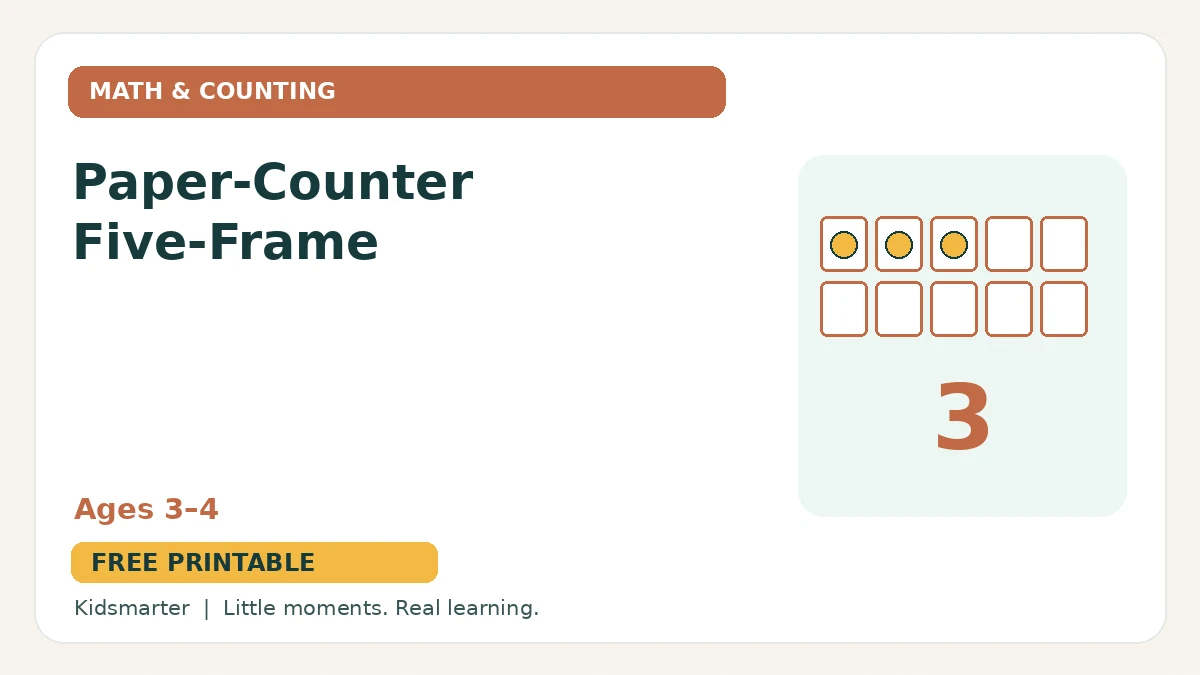
A five-frame makes a small number visible in a single tidy row. Each object gets its own home, and empty spaces become part of the conversation. You can play with a large printed row with broad card counters or crayon dots.
Materials You’ll Need
- A large printed five-frame
- Broad adult-cut card counters, or thick crayon marks
- Number cards 1–5
Print the frame at actual size or draw five adjoining boxes large enough for broad card counters. Use card pieces or crayon marks instead of buttons, coins, or pom-poms. Choose one numeral card and keep the remaining targets out of the immediate play area.
Step-by-Step How to Play
-
Show the empty row and sweep your finger across its five spaces. Put one counter in the first box. Say, “One counter, one space,” and invite your child to place the next one alongside it.
-
Choose a card such as three and count three counters into the frame from left to right. Touch each counter once, then name the total. Stop filling when the chosen amount has a home.
-
Look at the empty spaces together. Ask, “How many spaces are still waiting?” Count the gaps without filling them first. You can notice three filled and two empty without introducing written addition.
-
Clear the frame and try the same amount again, letting your child lead. If two counters land in one box, compare their arrangement with the one-per-space rule rather than simply removing one.
-
Finish by making a full row of five and then taking one away. Describe what changed in plain language. Return all counters to their bowl, checking the floor before a younger child enters.
Small Details That Make This Activity Work
The empty boxes are useful information, not defects to fill automatically. After building four, briefly cover the counters and ask what your child remembers about the spaces. You might hear “one empty,” which is a meaningful observation even without the word four. Keep the frame horizontal and begin at the same end while the layout is new. Later you can arrange the same counters differently and compare totals. If a child spreads one large counter across two boxes, enlarge the frame rather than repeatedly correcting placement; the materials should make one object per space physically straightforward and comfortable to see.
Why This Activity Helps
A fixed five-space arrangement connects counting with a visible quantity. Filled and empty spaces support noticing parts of a whole. Starting consistently at one end makes small sets easier to compare, although other arrangements can still represent the same number.
Easy Ways to Adapt by Age
Make It Simpler
Use a target of one or two, with the matching number of counters already in the bowl. An adult can point to each empty box while the child places objects.
Ready for a Challenge
Show the filled row briefly, hide it, and ask how many counters your child noticed. Reveal it for checking; avoid speed scoring and increase difficulty only when invited.
Parent Tip & Safety Note
Buttons, coins, and pom-poms are excluded from this setup rather than made acceptable by supervision. Adults cut broad paper counters and gather every scrap. Use crayon marks when loose paper is unsuitable, and supervise children under three or any child who mouths materials.
One More Useful Way to Try It
A counter should fit inside one box without covering its neighbor. Use the large paper frame and broad card pieces, or make one crayon mark in each box to remove loose pieces entirely. Choose three and compare the built row with its numeral card. Two spaces remain empty, but they do not require filling until the target changes. If the child prefers the right-hand end, count the total there too, then explain that the next demonstration will begin at the left. The layout convention is a shared choice, not what makes three be three. Keep numeral recognition separate from the physical counting check.
Explore more activities in this category or free printable games.