Complete-the-Pattern Strips
Quick Activity Snapshot
- Age Range
- Ages 3–4
- Prep Time
- 3 minutes to print
- Skills Practiced
- Pattern completion
- Materials
- Printed strips, Crayons or cut-and-paste icons, Scissors and glue if using cut pieces
Age ranges are suggestions, not developmental milestones or standards. Choose the setup for this child, and stop whenever needed.
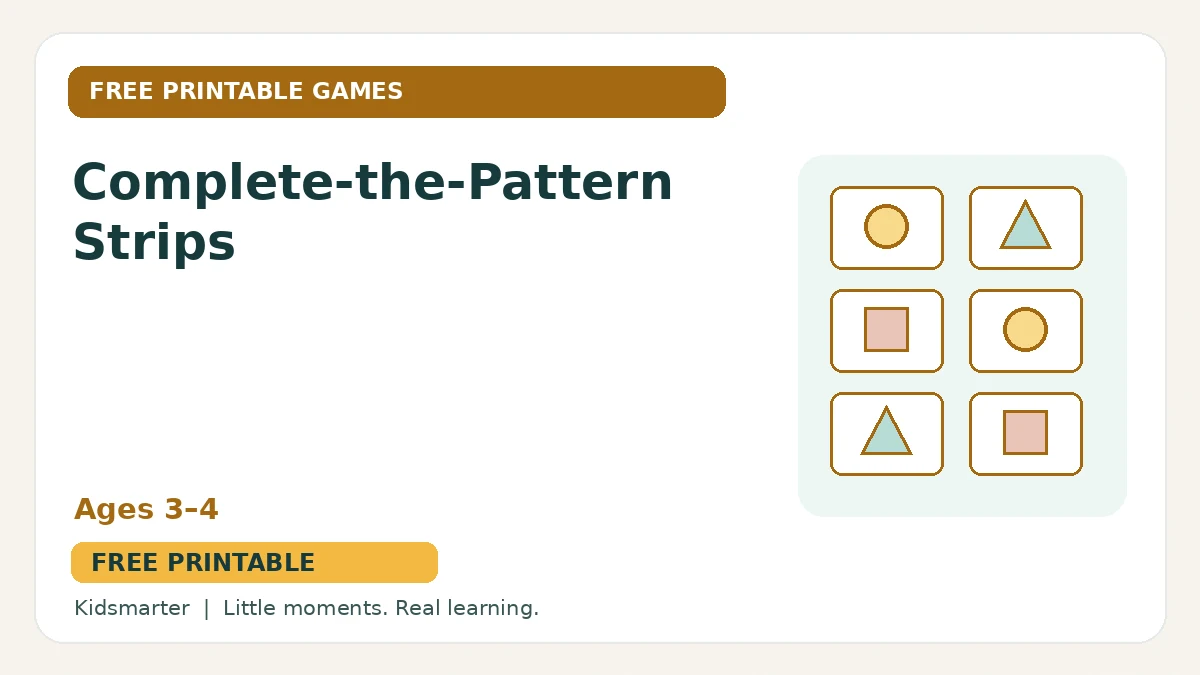
These pattern strips leave a visible job unfinished: one more shape is needed to keep the repeat going. Children can draw the missing shape or use the included cutout tiles. Begin with a single strip so the page feels like a small puzzle rather than a worksheet assignment.
Materials You’ll Need
- Printed strips
- Crayons or cut-and-paste icons
- Scissors and glue if using cut pieces
Print both pages at actual size. The first page contains AB, AAB, and ABC examples, while the second supplies matching shape tiles. An adult prepares the tiles, or your child can use a crayon instead of any cutting and gluing.
Step-by-Step How to Play
-
Cover every strip except the first AB row. Point along it and say the shapes with a steady rhythm. Name unfamiliar pictures before asking your child to infer a rule from them.
-
Group the first repeating pair with your finger. Say, “Circle, square is the part that repeats.” Trace the next identical pair, then pause at the empty space without immediately naming its answer.
-
Offer the relevant two shape tiles and invite a choice. Place the selected tile without gluing, then read the whole row together. Moving a tile for another attempt is part of solving, not an error to erase.
-
Try a second strip only if the first remains enjoyable. For AAB or ABC, show the full repeating unit explicitly. Different-looking patterns can still share a structure, but that comparison can wait.
-
Glue or draw the chosen shapes after checking, if your child wants a permanent page. Finish by inventing a short body pattern, such as clap, tap, clap, tap, using the same repeating relationship.
Small Details That Make This Activity Work
The answer tiles include more shapes than a single strip needs, allowing a real choice without requiring drawing. Place only the useful alternatives beside the current strip if the full tile sheet is visually busy. After choosing, your child can test a tile before gluing it down; a reversible action encourages checking instead of guessing and committing immediately. If the final blank is easy, cover a middle item with a tile and ask what must be underneath to preserve the rule. Keep one complete unit visible so the puzzle remains grounded in a repeating structure rather than in remembering an adult explanation.
Why This Activity Helps
Extending a pattern requires noticing the repeating unit and applying it to a new position. Looking only at the final shape is not enough for AAB or ABC. Saying the unit aloud provides a useful cue without replacing the child's comparison work.
Easy Ways to Adapt by Age
Make It Simpler
Match an entire cutout pair directly below a printed pair, or use real blocks to copy one strip. Leave only one blank visible and offer the answer alongside a clearly different option.
Ready for a Challenge
Translate an AB shape row into two sounds, or leave a missing shape in the middle rather than at the end. Ask how the surrounding repeat helps check a choice.
Parent Tip & Safety Note
Adults manage scissors and small tiles. Use drawing rather than loose pieces if mouthing or younger siblings make cutouts unsuitable. Keep glue away from mouths, and avoid requiring a child to finish every strip in one session.
One More Useful Way to Try It
Cut the companion tiles on their individual borders, not around an entire row. The revised tiles fit inside the sixty-point answer boxes when both pages are printed at the same scale. Offer a tile before glue so the child can check the whole repeating unit. Reading down the four rows, the missing shapes are square, circle, triangle, and circle. Keep that list for adult checking rather than telling the child before looking. A crayon-drawn answer works equally well and avoids loose pieces. This pack uses the same structures as the block-pattern activity; the distinction here is selecting a printable tile and checking its fit in the picture sequence.
Explore more activities in this category or free printable games.