Two-Row Ten-Frame Count
Quick Activity Snapshot
- Age Range
- Ages 4–5
- Prep Time
- 8 minutes
- Skills Practiced
- Numbers to 10
- Materials
- The revised three-page ten-frame printable, Whole crayons and fresh copies of the large page-3 frame, Optional broad paper counters only if suitable for this child
Age ranges are suggestions, not developmental milestones or standards. Choose the setup for this child, and stop whenever needed.
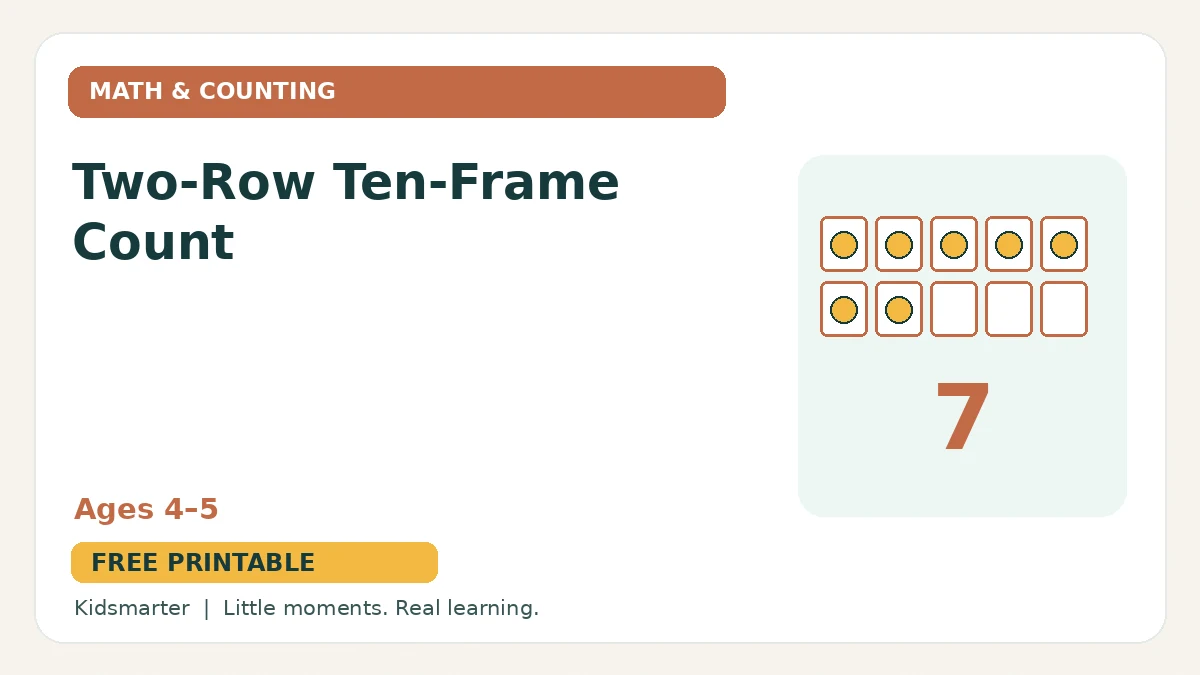
A printed frame with two rows of five spaces can show numbers in a useful arrangement. Fill the top row first and a quantity such as seven becomes five and two more. Your child can see, touch, and check the collection instead of reciting number words alone.
Materials You’ll Need
- The revised three-page ten-frame printable
- Whole crayons and fresh copies of the large page-3 frame
- Optional broad paper counters only if suitable for this child
Use the revised pack: pages 1–2 show number models from zero through ten, with small “Build it” frames for drawn marks. Page 3 adds a large blank two-by-five mat. Its boxes are 100 points across at actual-size Letter printing, about 1.39 inches. Use crayon marks on fresh copies for the default game. Keep the sheet whole if pieces would be mouthed; a broad counter is not safe merely because it fits a box. No used egg carton is needed.
Step-by-Step How to Play
-
Explore the empty spaces and count five along each row. Point to the top-left space as your usual starting place. Explain that every counter gets one space, with no stacking required.
-
Begin with an empty large frame and call that zero. Then choose the printed model for three. Make one crayon dot in each of the first three top-row boxes, counting each dot once, and say, “Three altogether.” Leave the other boxes empty; those spaces are not extra objects to count.
-
Now grow the same frame from three to seven: add two dots to finish the top row and two more at the start of the bottom row. Say, “Five on top and two underneath: seven.” Compare with the seven model on page 2. Your child can count every dot instead of identifying the group at a glance.
-
Compare the printed five model with the printed ten model. On your large seven frame, add three dots to finish the bottom row and make ten. Show a fresh blank frame for zero again. Zero describes the empty whole frame; it does not mean the child missed a turn.
-
For another round, use a fresh large-frame copy or let an adult draw a new two-row grid. Choose a number model from the intact reference pages and build that amount. There is no need to cut eleven separate cards or cover leftover cups in a twelve-cup carton. Stop after the amount your child wants to explore.
Small Details That Make This Activity Work
The small model cards and the large work mat serve different jobs. Point to the model while placing marks on the large mat; do not expect a wide counter to fit the tiny “Build it” boxes. Fill the top row left to right for these examples, then the bottom row, so your arrangement can be compared with the model. Other arrangements can still show the same total, but changing the layout and the amount at once makes the comparison harder to follow.
Why This Activity Helps
A ten-frame keeps quantities in a stable structure, making five and ten useful reference points. Children can gradually notice grouped amounts rather than counting every item. That noticing develops through repeated meaningful comparisons, not a demand to answer instantly.
Easy Ways to Adapt by Age
Make It Simpler
Choose only zero, one, two, or three from page 1. An adult can draw each dot while your child points to the next top-row box or chooses the model. Use a fresh frame for a different amount, and leave the lower row empty without asking the child to fill it.
Ready for a Challenge
On a fresh frame, make eight dots and ask how many empty boxes remain before ten. Point to the two empty boxes, then add a dot in each to check. The child can count those spaces directly; a spoken subtraction fact or a quick answer is not required.
Parent Tip & Safety Note
Keep the reference pages and work mat whole when loose pieces are unsuitable. Use no beans, coins, or pom-poms, and keep broken crayon pieces and caps put away. An adult draws the marks if your child mouths drawing tools. The grid size is for comfortable use, not proof that any counter is safe to handle or put in a mouth.
Explore more activities in this category or free printable games.