Beginning-Sound Picture Cards
Quick Activity Snapshot
- Age Range
- Ages 4–5
- Prep Time
- 5 minutes to print and cut
- Skills Practiced
- Beginning sounds
- Materials
- Printed large picture cards, A large envelope, Optional broad nonmagnetic printed letter cards
Age ranges are suggestions, not developmental milestones or standards. Choose the setup for this child, and stop whenever needed.
A picture card can start a conversation about the sound at the beginning of a word. These cards use familiar objects with relatively clear first sounds, such as sun, moon, and fish. Name each image together before sorting so unfamiliar vocabulary does not create a hidden hurdle.
Materials You’ll Need
- Printed large picture cards
- A large envelope
- Optional broad nonmagnetic printed letter cards
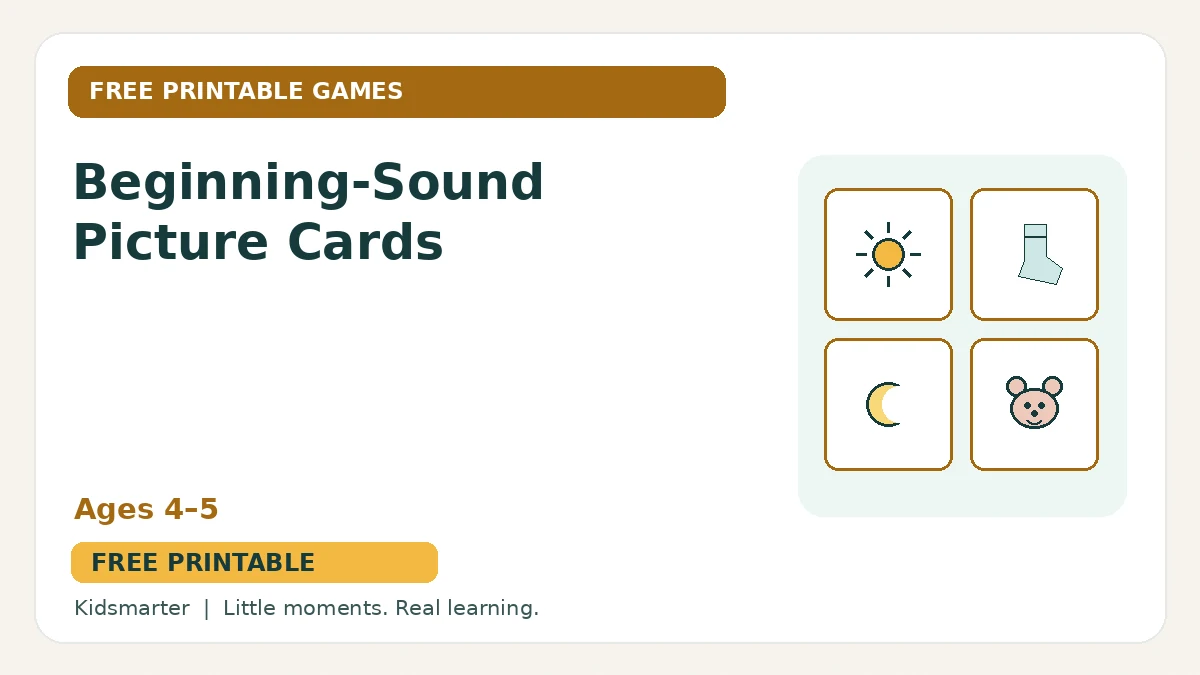
Print the eight picture cards and let an adult cut them apart. The set includes paired initial sounds for sun and sock, moon and mouse, fish and fan, and ball and bus. Keep the picture names available for adult reference.
Step-by-Step How to Play
-
Choose sun and sock. Name them slowly but naturally, then emphasize the shared first sound: “Sssun, sssock.” Avoid adding an extra “uh” after the consonant, which changes the sound being compared.
-
Place moon beside sun and ask which begins like sock. Say every word aloud rather than asking your child to decode printed labels. Accept pointing and repeat the matched words together.
-
Build two sound groups using only four cards. Say, “These begin with /s/, and these begin with /m/.” Leave letter tiles out initially so listening does not depend on recognizing printed symbols.
-
Introduce fish and fan once the routine is clear. Let your child say the names first. If they use a different accurate name for a picture, adopt it or agree on a shared label before judging a sound match.
-
Choose a picture to search for a real household object with the same beginning sound. Keep the search short and safe. Store the cards in an envelope with the original naming list for the next round.
Small Details That Make This Activity Work
The printed word labels are there to keep the adult naming consistent, not to turn the task into sight-word reading. Cover them if they draw attention away from the pictures. A mouse might be called a rat or a bus a coach; either everyday label can be reasonable but changes the sound relationship. Agree on the pictured name kindly before sorting. If your child finds matching sounds easily, add letters as a separate round with an explicit demonstration. Seeing B does not automatically explain why ball and bus belong together; hearing their first sound gives the symbol a meaningful connection.
Why This Activity Helps
Attending to initial sounds is part of phonological awareness. Pictures support vocabulary, but the relevant information comes from the spoken name, not the drawing itself. A child may need repeated models before isolating a single phoneme; that does not make the game unproductive.
Easy Ways to Adapt by Age
Make It Simpler
Offer only sun and sock and say the matching sound yourself. Your child can choose a favorite card or copy the sound without sorting several alternatives.
Ready for a Challenge
Add the matching letters S, M, F, and B once the spoken groups are familiar. Explain that the letter represents the sound in these words, while other spelling relationships will appear later.
Parent Tip & Safety Note
Adults handle cutting and supervise small cards or tiles. Avoid forcing repeated sound production if it feels uncomfortable. Honor the languages and pronunciations used at home; choose word pairs that genuinely share a beginning sound in that language.
One More Useful Way to Try It
The intended initial-sound pairs are sun and sock, moon and mouse, fish and fan, and ball and bus. Say the picture names before asking about their beginnings; the printed labels are adult prompts, not words the child must decode. Keep /b/ brief rather than turning it into an extra syllable, and let /s/, /m/, and /f/ continue only as long as comfortable. If mouse is called rat, acknowledge the reasonable name, then agree which label this round will use. The sound grouping depends on that spoken word. Keep any optional letters large and nonmagnetic, and omit loose letter tiles when younger children are present.
Explore more activities in this category or free printable games.