Find-and-Mark Alphabet Search
Quick Activity Snapshot
- Age Range: Ages 2–3
- Prep Time: 2 minutes to print
- Skills: Letter recognition
- Materials: Printed page, a whole thick washable crayon, optional dot marker operated by the adult only
Age ranges are suggestions, not developmental milestones or standards. Choose the setup for this child, and stop whenever needed.
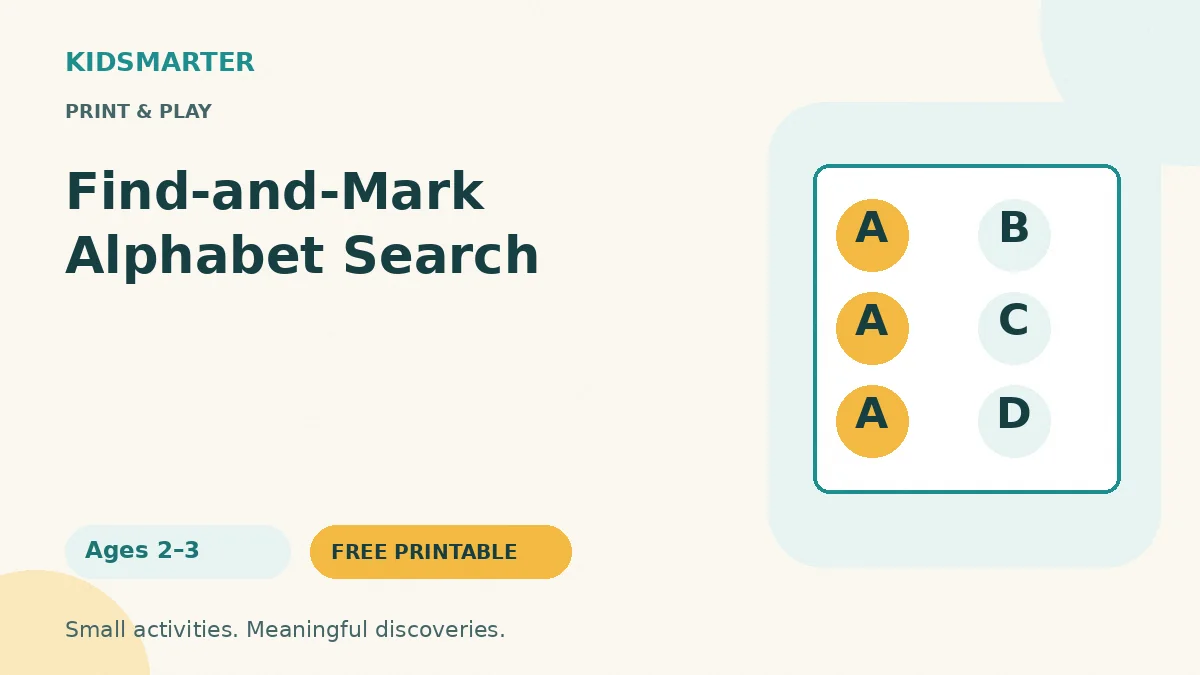
This alphabet search keeps the invitation simple: look for uppercase A and mark each discovery, or simply point. The page has generous spaces for a mark, and a chunky crayon works well. Your toddler does not need to finish the grid. A few moments of comparing letter shapes together are more useful than an independently completed sheet.
Materials You’ll Need
- Printed page
- A whole thick washable crayon
- Optional dot marker operated by the adult only
Print the uppercase A search on Letter paper and set out one whole thick washable crayon. The page contains A targets mixed with B, C, and D in large circles, plus a model A. Put scrap paper underneath. Use no loose round stickers or backing pieces for toddlers. If a dot marker is preferred, the adult operates it and retains its cap; the child can point to where a mark should go. Use the whole page; an adult may fold it to show one row. Cutting a short strip is only an optional adult simplification.
Step-by-Step How to Play
-
Point to the large model A and describe its shape: “Two sloping lines meet at the top, and one line goes across.” Trace it with your finger. Invite the child to touch it too, then choose whether to say the letter name together. Keep the focus on recognizing this printed form; there is no need to add every sound A can represent in English.
-
Fold the page so only the first row is visible. Find one A yourself and make a single dot inside its circle. Say, “I found a shape like our model.” Show how the crayon touches the page and lifts again. If a crayon mark covers the letter entirely, that is fine; the mark records a discovery rather than preserving an assessment page for an adult.
-
Invite your child to search the same row. Ask, “Which one has the pointy top like A?” Let them compare with the model whenever they want. If they select B, name it and look at the features together: “B has round bumps. Our A has sloping sides.” Avoid rubbing out the mark or insisting they restart; continue with another clear opportunity to compare.
-
Reveal the next row only if the child remains interested. Move a blank sheet underneath the active row as a visual guide if the full grid is distracting. Let the child switch from dotting to pointing or circling. The search and the marking are separate tasks, and a child may enjoy one more than the other on a particular day.
-
End by asking your child to show you one A they marked. Say, “You looked for this same shape in different places.” Put the page in a folder or recycle it together. If the child wants a repeat, print another copy later rather than making them inspect every missed target immediately. A second relaxed round can be more valuable than correcting the entire first page.
Why This Activity Helps
Searching for a target among distractors asks children to attend to visual features and compare examples. Marking adds a simple hand action with an obvious result. Seeing and hearing the letter’s name together can support alphabet familiarity over time, but finding A does not show that a child understands reading or speech sounds. Toddler interest varies, and a brief shared interaction is an appropriate outcome.
Easy Ways to Adapt by Age
Make It Easier: Cover all but three circles, with a model A immediately above them. Let the adult handle the marker while the child points. An adult may later cut a short strip from the page as a smaller activity, but the default is to use the whole sheet. If letters are not engaging yet, trace the large circle borders together and return to the A search another time.
Add a Challenge: Invite an older preschooler to count the marked As in each row, then compare two rows. Ask them to explain how A differs from another printed letter. On fresh paper, draw an A in a larger or smaller size and see whether the child recognizes it. Introduce lowercase a separately rather than assuming it looks like the uppercase target.
Free Printable Included
Print this US Letter page at actual size and use the whole sheet. Fold to show one row at a time. Cutting a short strip is optional and only for an adult.
Parent Tip & Safety Note
Use a whole age-appropriate crayon and remove broken pieces. Marker caps, loose stickers, and backing scraps are excluded from the toddler workspace; an adult-operated marker is optional. Supervise children under three and switch to pointing only if materials are mouthed. Stop at any point rather than using the sheet as a readiness test or demanding every target be marked.