Trace-the-Path Fine Motor Pages
Quick Activity Snapshot
- Age Range
- Ages 3–4
- Prep Time
- 2 minutes to print
- Skills Practiced
- Following a straight, zigzag, or curved road
- Materials
- Printed pages, a marker or crayon
Age ranges are suggestions, not developmental milestones or standards. Choose the setup for this child, and stop whenever needed.
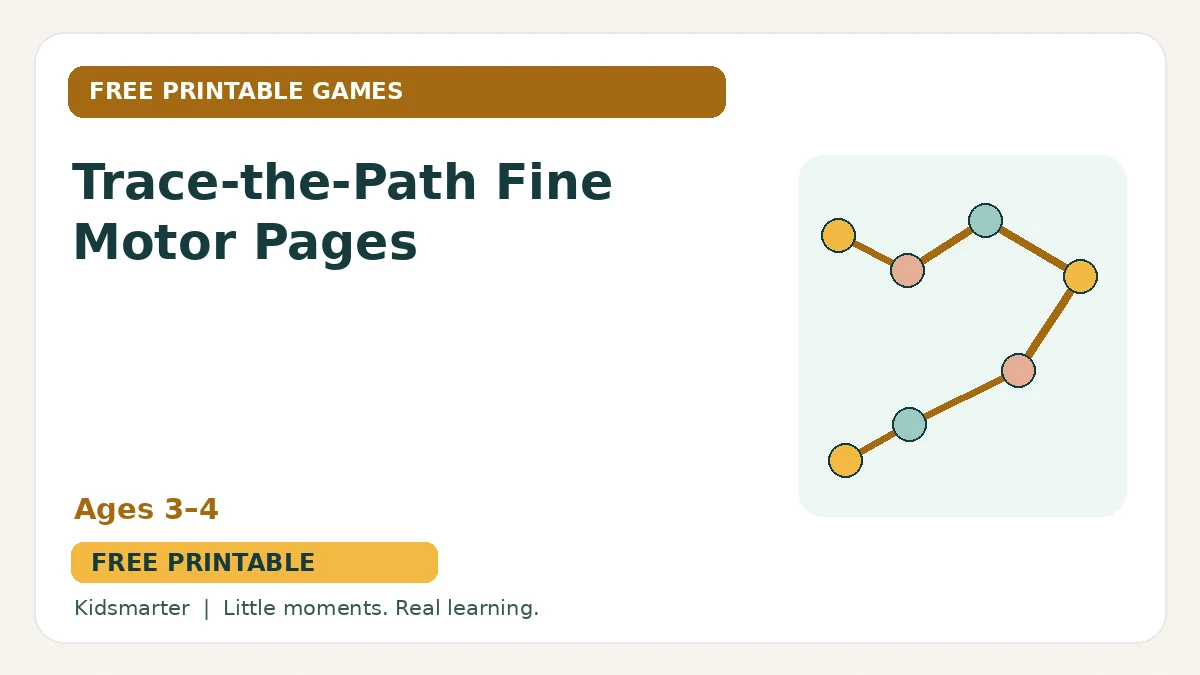
A broad road between a start dot and a finish flag invites a crayon to travel without needing to form a letter. These printable paths offer straight, zigzag, and curved journeys. Your child may first follow them with a finger, making direction visible before adding a drawing tool.
Materials You’ll Need
- Printed pages
- A marker or crayon
Print the page at actual size and choose one comfortable crayon or thick marker. The roads are drawn about three-quarters of an inch wide so a thick crayon has room to travel. Place the sheet on a stable surface and cover unused paths with scrap paper. There is no need to laminate; a fresh line is easy to see on plain paper. Use the whole page; no cutting is required.
Step-by-Step How to Play
-
Point out the start dot and finish flag on the straight road. Travel once with your own finger, saying, “I begin here and move toward the flag.” Let your child try with any finger or a large toy.
-
Offer the crayon and invite a trip along the same road. Keep your attention on the movement rather than whether every mark stays between the borders. A child may lift and restart as often as needed.
-
Move to the zigzag road if interest remains. Pause at one corner and talk about the change in direction. Turning the paper can make the movement more comfortable; the page does not need to stay fixed upright.
-
Try a curved road with a slower traveling voice or a short sound effect. Let your child choose the pace. If the task becomes tiring, return to finger travel rather than insisting on a final written attempt.
-
Look at the routes together and ask which was easiest to follow. Save the page as a record of play if wanted. You can draw a wider version of a preferred road on scrap paper next time.
Small Details That Make This Activity Work
Choose one road rather than treating the three routes as an assignment. Start points and finish flags are useful conventions, not permission to criticize a child who wants to explore from the other end. You can try their chosen direction, then demonstrate the printed version on another road. A line leaving the gray road does not erase the route the child intended. Watch for a page sliding away and steady it before interpreting uneven marks as a hand-control issue. A short comfortable attempt followed by free drawing offers more variety than repeating the same difficult path until it looks adult-made.
Why This Activity Helps
Path following offers practice coordinating visual attention with a chosen movement. Straight lines, corners, and curves make different demands, so one successful route does not imply all will feel easy. This is not a handwriting assessment or a substitute for varied drawing and play.
Easy Ways to Adapt by Age
Make It Simpler
Use a finger or toy instead of a crayon, or shorten the trip to a single comfortable movement. An adult may steady the paper without guiding the child’s hand.
Ready for a Challenge
Invite your child to design a road for you, including one planned bend. Ask whether its width is comfortable to follow. Later try a narrower path voluntarily, without timing the journey.
Parent Tip & Safety Note
Choose age-appropriate non-toxic tools and supervise caps or broken crayon pieces. Support comfortable seating and stop if hands hurt. Never restrain a child’s grip or require a particular hand; allow experimentation and rest.
Explore more activities in this category or free printable games.