Paper Maze From the Door to the Park
Quick Activity Snapshot
- Age Range: Ages 4–5
- Prep Time: 8 minutes
- Skills: Visual planning
- Materials: The revised two-page maze, or plain paper for a simpler route, A fingertip for tracing, Optional whole crayon; an adult manages marker and caps
Age ranges are suggestions, not developmental milestones or standards. Choose the setup for this child, and stop whenever needed.
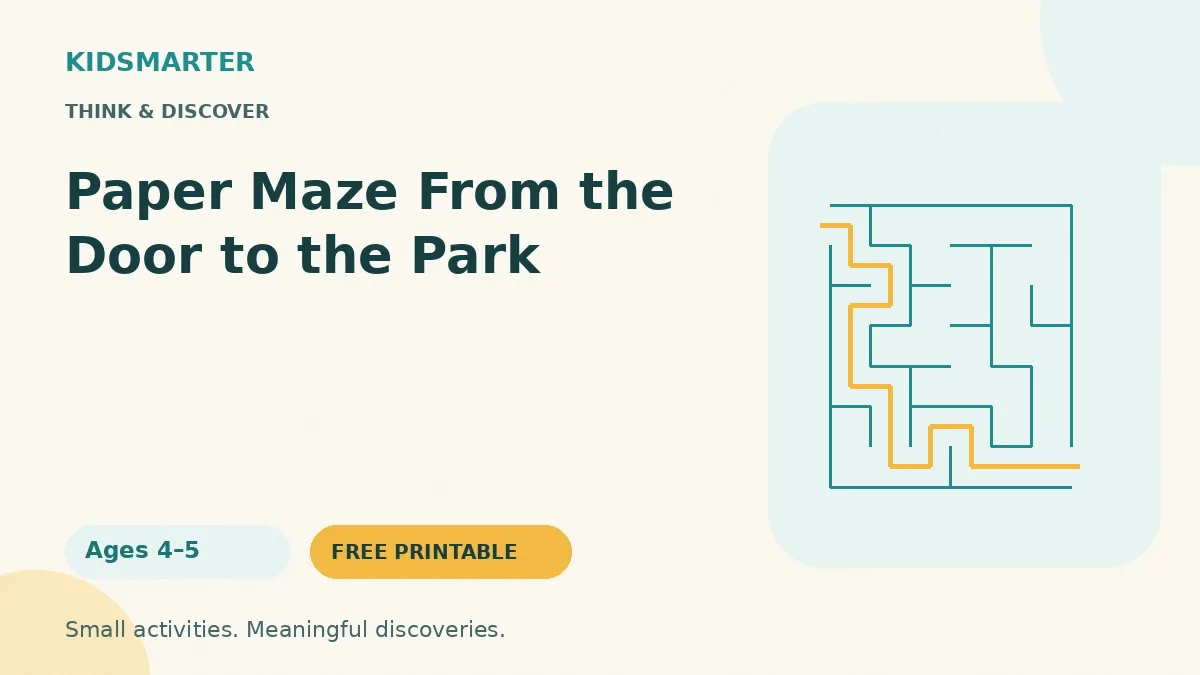
A route from a door to a park gives this paper maze a little story. Use a fingertip to follow its open corridors, try a branch, and backtrack when a wall closes it. The revised printable marks the entrance at the upper left and the exit on the lower right side. A crayon is optional; planning the turns and controlling a drawn line are different jobs.
Materials You’ll Need
- The revised two-page maze, or plain paper for a simpler route
- A fingertip for tracing
- Optional whole crayon; an adult manages marker and caps
Use page 1 for play and keep page 2’s adult solution aside. The entrance is a gap in the LEFT wall near the top; PARK is beyond the RIGHT-wall opening near the bottom, not across the bottom wall. The original maze walls are preserved. If drawing a simpler route, test that its start and finish really join through open space before offering it.
Step-by-Step How to Play
-
Point to the starting door and the park at the end. Trace the outer boundary together and explain, "The spaces are paths. The dark lines are walls, so we go around them." Let the child place a fingertip inside the starting corridor. Demonstrate a tiny legal move and one move that would cross a wall, then return to the start without turning it into a quiz.
-
Invite the child to look at the next stretch: “Which way might lead toward the park?” Point to an open corridor, then follow it with a fingertip. Hold the sheet steady at an unused edge. The adult can demonstrate if tracing is uncomfortable; a small toy or counter is not necessary.
-
At the first junction, pause and compare the options. Ask, "Can your eyes see where this branch stops?" If the child chooses a dead end, follow it until the wall makes the result visible. Say, "This path closes here. We can return to the place where we chose." Backtracking is part of the game, not evidence that the child should have known the answer.
-
Once a route has been explored, offer a crayon to record it. A child who dislikes mistakes can use a second copy or continue with a finger. Ask them to stop at junctions and look ahead before drawing. If the line accidentally touches a wall, distinguish pencil control from planning: "You knew the turn; your crayon slipped. Let's keep following the space."
-
Celebrate reaching the park with a short retelling: "We went up, tried a closed path, came back, and turned right." Let your child guide you through the route using words or pointing. Then invite them to draw one simple wall on a fresh page and make a route around it. Keep the successful maze for replay; familiarity can make planning easier and more enjoyable next time.
Why This Activity Helps
A maze brings together a visible route and a rule: move through open spaces without crossing the walls. At a junction you can compare choices; at a dead end you can return to the previous choice. A drawn line adds a separate hand-control job. Ask about a turn the child can show instead of treating the finished page as a score.
Easy Ways to Adapt by Age
Make It Easier: On a fresh sheet an adult can draw one broad turning route with no branches. Trace that together before trying the full maze. If viewing a smaller part of the printed maze helps, use an adult-held blank sheet on the table and reveal the next stretch, without covering anyone’s face.
Add a Challenge: Ask an older preschooler to describe two upcoming turns before moving. Let them design a maze for you, then test it together to make sure an uninterrupted route exists. Discuss whether a dead end looks different when approached from the other direction. Avoid adding a timer; explaining a route gives more useful practice than simply drawing faster.
Free Printable Included
Print this activity-specific pack on Letter paper. An adult prepares any cut pieces; use the activity directions above.
Parent Tip & Safety Note
An adult handles markers, caps, and any optional cutting; this version needs no loose toy, counter, or cut pieces. Keep the page on a stable surface. If the paper or crayon would be mouthed, an adult holds the page and points through the route. Stop, simplify the route, or return another day rather than requiring completion.