Two Plates, Fair Shares
Quick Activity Snapshot
- Age Range
- Ages 3–4
- Prep Time
- 3 minutes
- Skills Practiced
- Equal shares and small-number counting
- Materials
- Two plates and six large identical counters
Age ranges are suggestions, not developmental milestones or standards. Choose the setup for this child, and stop whenever needed.
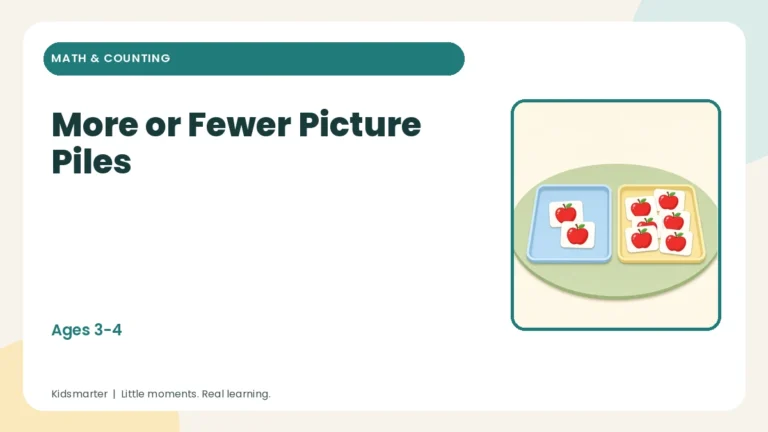
A small pile can become a sharing job: each plate should end up with the same number. This is everyday language about equal amounts, not a formal division lesson. Start with objects that are not food, and keep the total even so a fair share is easy to see.
Materials You’ll Need
- Two similar plates, bowls, or sheets of paper, placed side by side
- Six large identical counters that cannot fit entirely into a child’s mouth, such as big connecting blocks or large plastic lids already checked for size
Nonfood counters are the main version of this game. Choose pieces large enough that they cannot be swallowed, and use the same object six times so the only difference is quantity. If you later offer a snack version, use a food the child already eats, serve it at the table, and never use high-risk choking foods as counters. The child does not have to eat for the math talk to be complete.
Step-by-Step How to Play
-
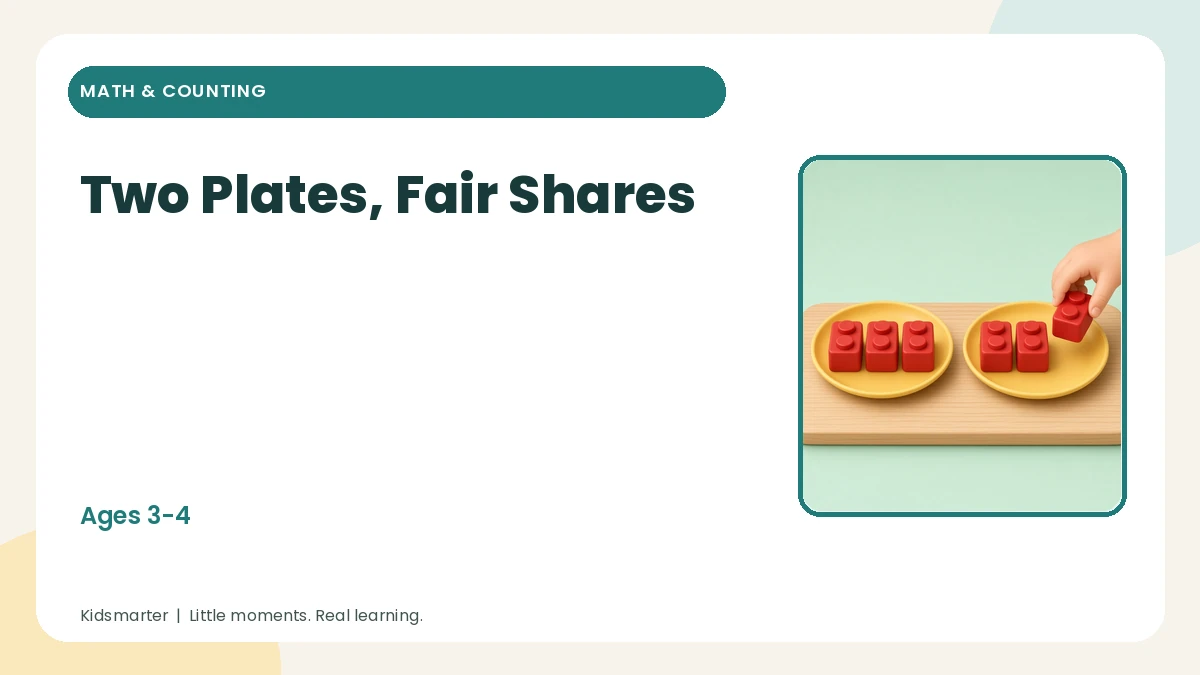
Set two plates side by side and place six large counters in one shared pile. Say, “We will give each plate the same number.” You do not need to name the total yet. If your child wants to start immediately, let them begin placing pieces.
-
Invite your child to give one counter to the first plate and one to the second, then repeat until the pile is gone. You may take turns. If they place two on one plate in a row, wait and notice together rather than grabbing the pieces back.
-
When the pile is empty, point and count the counters on each plate out loud: “One, two, three. This plate has three. One, two, three. This plate has three. They have the same number. That is a fair share.” Let your child listen or count with you. They do not have to produce the word equal.
-
If the plates do not match, treat that as useful information. Say, “This plate has more. We can move one so they have the same number.” Make the change together. A mismatch is not a failing; it is a chance to adjust.
-
Play again with four or eight counters if your child still wants a turn. Keep the starting total even in this basic version. When they are finished, put the counters away together. There is no score and no required number of rounds.
Small Details That Make This Activity Work
Sit close enough that counters stay on the table and do not travel to a younger sibling’s mouth. Use a slow, even rhythm when handing out pieces: one for you, one for me. If your child wants to keep all the counters on one plate, you can play “all on one plate, then share them out” as a second step, or stop. Avoid turning the language into a quiz (“How many is that?”) until they have had time to look. If you try a snack version, finish any counting before eating begins, then let the child eat without questions; do not ask them to speak with food in their mouth, and do not withhold food because a share was uneven.
Why This Activity Helps
Sharing a visible pile is one everyday way to talk about quantity and about two groups having the same number. NAEYC’s family math-talk guidance includes adult language such as “Now I have the same as you,” and it encourages discussion rather than a rapid quiz. This two-plate routine itself has not been evaluated as a mathematics curriculum or an intervention. Completing a fair share is not evidence of school readiness, and children may understand “the same” in the moment without being able to explain it in words.
Easy Ways to Adapt by Age
Make It Simpler
Start with four counters and two plates, and do the handing out together, one piece at a time. You can also draw four large circles on one intact sheet, two in each half, and simply point: “Two here, and two here. The same number.” No loose pieces are needed in the drawn version.
Ready for a Challenge
After a fair share of six, add one extra counter and ask what could happen. Some children will say one plate has more; some will want to find a third plate; some will leave a leftover in the middle. Describe what they decide without requiring a formal “remainder.” You may also hide one plate briefly and ask how many the covered plate should have if the shares were fair, then uncover and check.
Parent Tip & Safety Note
Use large nonfood counters as the default, and supervise the whole time so pieces are not mouthed, thrown, or left where a baby can reach them. If you offer food, have the child sit at the table, and do not let them walk, run, or play with food in their mouth. The American Academy of Pediatrics advises keeping common choking foods from young children and modifying or avoiding items such as whole grapes, nuts, popcorn, raw carrot sticks, raw fruit chunks, marshmallows, and chunks of cheese or meat. Do not use those foods as counters. The child chooses whether and how much to eat; this game is not a reason to introduce a new food or to insist on a bite.
Explore more activities in this category or free printable games.
For everyday language about quantity and “the same,” see NAEYC’s Math Talk With Infants and Toddlers and Support Math Readiness Through Math Talk. Those pages offer family conversation examples; they do not test this two-plate game. For choking hazards if you use a snack version, see HealthyChildren.org’s Choking Prevention for Babies & Children. That guidance is about safer eating, not about teaching math.