Mailbox Notes for a Stuffed Friend
Quick Activity Snapshot
- Age Range
- Ages 3–4
- Prep Time
- 5 minutes
- Skills Practiced
- Dictated writing and purposeful print
- Materials
- Paper or the printable note page, a crayon, a cardboard box mailbox, and a stuffed toy
Age ranges are suggestions, not developmental milestones or standards. Choose the setup for this child, and stop whenever needed.
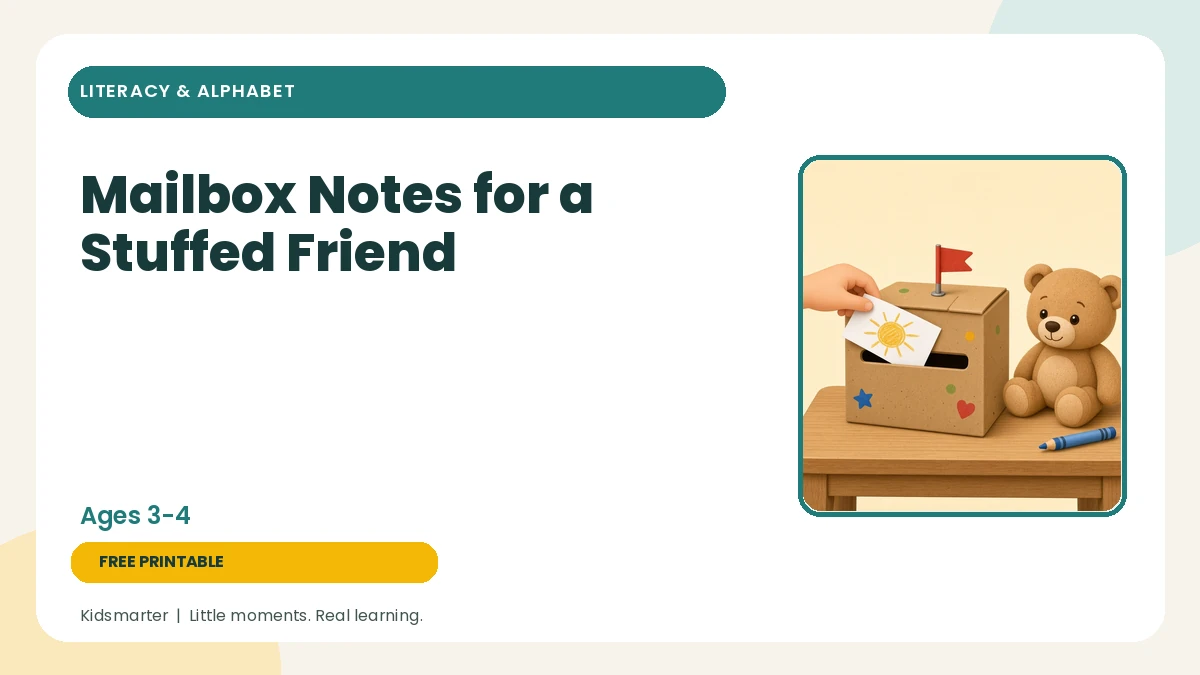
A short note can give writing a real job. Your child draws a picture, you write down a few of their words, and the paper travels through a homemade mailbox to a stuffed friend. The marks do not need to look like adult letters. One short message is enough.
Materials You’ll Need
- The printable note page, or a blank sheet of paper
- A thick crayon or washable marker
- A clean cardboard box with a wide slot cut by an adult, used as a mailbox
- One familiar stuffed toy, too large to fit in a child’s mouth
An adult prepares the mailbox in advance. Cut a wide, smooth slot that the folded page can enter easily, and trim or tape any sharp edges before the child joins you. You may write the word Mailbox on the box yourself. The child does not need scissors, a knife, or a box cutter. If a box is not available, a large paper bag with a wide opening can stand in, as long as it is not placed over anyone’s head.
Step-by-Step How to Play
-
Set the mailbox and the stuffed friend where both of you can see them. Show the paper and say, “We can send a note to your friend.” Let your child choose the toy. There is no required greeting or correct message.
-
Invite your child to draw a picture for the stuffed friend in the large box on the page. Scribbles, color patches, and a single mark all count. Stay nearby, but do not take over the drawing or require a recognizable picture.
-
Ask what they would like the note to say. Write their exact words slowly and clearly on the lines, saying the words as you write so they can watch speech become print. Keep the message short. If they only point or shrug, offer one sentence they can accept or change: “Should I write, I made this for you?” Do not invent a longer message they did not agree to.
-
If your child wants to add their own marks, a scribble signature, or a letter they already know, make space for that. Do not correct scribbling into “proper” letters or ask them to copy your handwriting. If they prefer to “write” the whole note themselves as scribbles, honor that, and you may add the dictated words on the back so the message can be reread later.
-
Let your child fold the note loosely and push it through the mailbox slot, then help deliver it to the stuffed friend. Read the words back to the toy and to your child. They may want to “be” the friend and listen. One delivery is a complete game. You can write another note another day if they ask.
Small Details That Make This Activity Work
The useful part of this game is the job the paper does, not a handwriting lesson. Write only a few words so the child can watch the whole sentence appear. If they say “I don’t know,” offer two short choices rather than repeating the question. A child who is not interested in mailing can still draw and hear their caption read aloud, then stop. In a familiar home language, write the dictated words in the language the child used. The mailbox is a prop, not a test of posting skill; you may hold the box steady while they feed the paper in.
Why This Activity Helps
Seeing a trusted adult write down spoken words can make a basic idea more visible: print is meaningful and can carry a message to someone else. NAEYC describes this as part of conceptual knowledge in emergent writing, and notes that children can dictate words for an adult to record, including notes. Reading Rockets likewise describes dictation as a way to model how spoken language becomes written language, then reread the short sentence together. This homemade mailbox routine itself has not been evaluated as a writing program or a reading intervention. Finishing a note is not evidence of writing readiness, and scribbling is a valid way for a young child to join in.
Easy Ways to Adapt by Age
Make It Simpler
Skip the dictated sentence. Let your child draw and “mail” the picture, then you may add a two-word caption they approve, such as For Bear. A child with fewer spoken words can point to the toy and the paper; you name the action and deliver the drawing together.
Ready for a Challenge
Invite an older preschooler to add the first letter of their name, or to tell a two-sentence message while watching you write both sentences. Some children like to “read” the note back to the toy by pointing under the words as you say them. Keep the pointing friendly; it is practice with print, not a test of word reading.
Download Free Printable PDF
This original US Letter note page is free to download. Print at actual size and use the whole page; no cutting or hole punching is required. The child draws in the large picture box; an adult writes the dictated words on the lines. No email signup is required.
Parent Tip & Safety Note
An adult, not the child, cuts any mailbox slot and checks that edges are smooth. Keep knives, box cutters, and scissors used for setup out of reach when the game begins. Use a stuffed toy too large to fit in a child’s mouth, and do not add buttons, beads, or other small decorations that could loosen. Cap markers when they are not in use, and do not let younger siblings mouth small torn bits of paper. Never place a box, bag, or lid over a child’s head. Stop if your child is finished, frustrated, or more interested in playing with the toy than mailing the note.
Explore more activities in this category or free printable games.
For guidance on dictation and early mark-making, see Reading Rockets’ Supporting Very Young Writers and NAEYC’s Promoting Preschoolers’ Emergent Writing. Those sources describe helpful adult support and the idea that print can carry meaning; they do not evaluate this mailbox game, and they do not promise later reading or writing achievement.