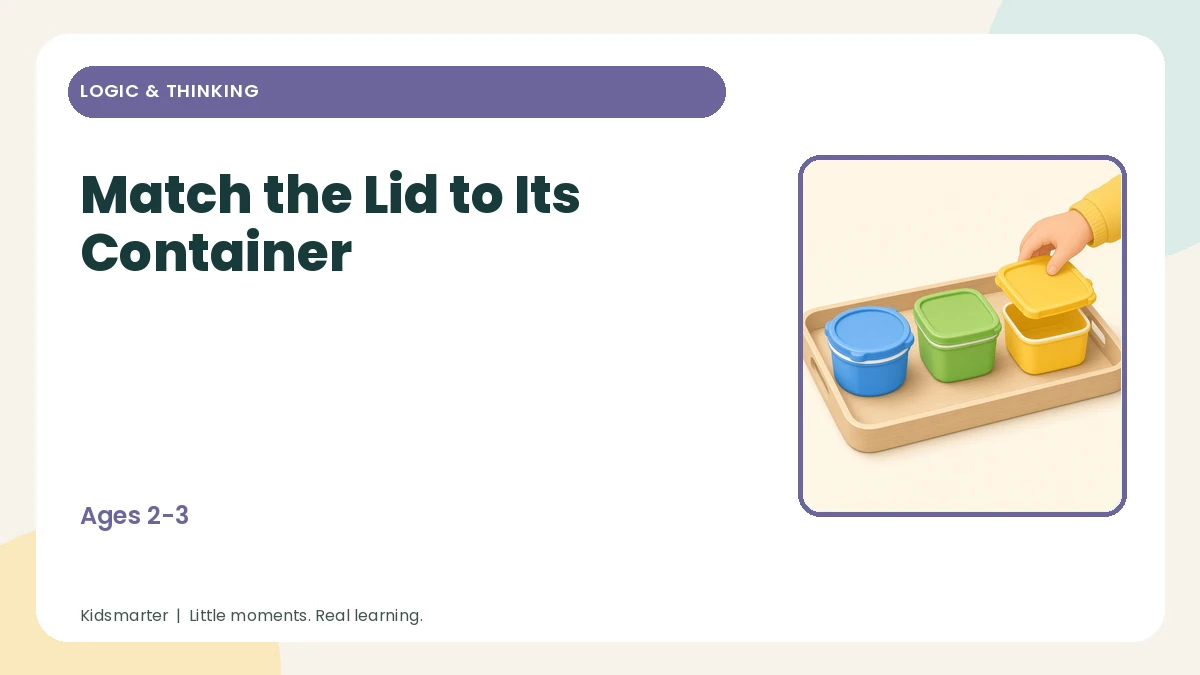
Match the Lid to Its Container
Quick Activity Snapshot
- Age Range
- Ages 2–3
- Prep Time
- 5 minutes
- Skills Practiced
- Matching and everyday classifying
- Materials
- Three clean, empty containers and their own lids
Age ranges are suggestions, not developmental milestones or standards. Choose the setup for this child, and stop whenever needed.
A lid that clicks onto its own tub gives matching a clear result: it fits, or it does not. This is different from lining lids up by size or hiding pictures under them. You will use the real partners that already live in your kitchen, chosen and cleaned by an adult.
Materials You’ll Need
- Three clean, empty, room-temperature containers that look clearly different from one another, such as a round tub, a square tub, and a small box with its own lid
- The matching lid for each container
- A towel or tray to keep the work in one place
An adult chooses the set before the child sits down. Use only lightweight, unbreakable containers with no sharp rims, no rust, no leftover heat from a dishwasher, and no traces of cleaning chemicals. Skip glass, ceramic, metal cans, heavy cookware, and any lid small enough to fit entirely in a child’s mouth. Three clearly different shapes are easier than three similar clear tubs.
Step-by-Step How to Play
-
Set the three containers on a tray with their lids in a mixed pile nearby. You may show one example: “This round lid belongs with this round tub.” Then invite your child to try.
-
Let your child pick up a lid and try it on a container. If it settles into place, name what happened: “It fits. That lid belongs with this one.” Give them time to open and close the same pair if that is the interesting part.
-
If a lid does not fit, stay matter-of-fact. Say, “That one is for a different container. Let’s try another.” Avoid the word wrong. You may hold a container steady, but do not rush to complete the set for them unless they ask.
-
When each lid has found its partner, pause and look at the three closed containers together. Mix the lids again if your child wants another round, or stop after one successful set. There is no timer and no required number of matches.
-
If they still want to play, you may put a familiar toy that is too large to swallow into one tub, close it, and say, “Which container is the home for Bear?” The child can use the lids as clues or simply open the tubs. Keep this optional and brief.
Small Details That Make This Activity Work
The satisfying moment is the fit, so choose lids that truly seat on their own containers and do not almost fit two items. If two lids are confusingly similar, put one pair away. A toddler may enjoy opening and closing a single favorite tub more than finishing the set; that is still useful practice. Wipe dry any container that is slippery. This activity is not a size line-up (you are not ordering lids from biggest to smallest) and not a memory game (nothing is hidden under a lid as a picture to recall).
Why This Activity Helps
Trying a lid on a container is a simple classifying job: this partner belongs with that one, and a nearby lid does not. NAEYC notes that everyday sorting and classifying—such as separating items into groups—are basic math ideas families already use, and that spatial and matching language can be part of ordinary talk. This kitchen matching routine has not been studied as a logic program. Completing the three pairs is not a test of reasoning, and a child who prefers to open one tub again and again is still exploring how objects go together.
Easy Ways to Adapt by Age
Make It Simpler
Start with two very different pairs, such as a large round tub and a small square box. Hand your child one lid at a time. You may rest the correct container slightly closer if they look stuck, then let them make the fit.
Ready for a Challenge
Add a fourth pair, or include two similar round tubs and talk about the small difference that makes one lid fit. You can also turn all three closed containers around and ask your child to point to the one they think a particular lid will open, then try it and check. Keep the tone curious, not like a quiz with a score.
Parent Tip & Safety Note
Stay with your child the entire time. Do not use glass, sharp rims, hot or just-washed heated containers, or lids small enough to be choking hazards. Never let a child put a lid, tub, bag, or box over their own face or head, or over another person’s. Do not store this game in plastic bags. Wash and fully dry the containers before play, and keep cleaning products closed and out of reach. If a lid is too tight for small hands, loosen it; a frustrated tug should not send a container flying.
Explore more activities in this category or free printable games.
For everyday classifying and spatial language, see NAEYC’s Math Talk With Infants and Toddlers. That page offers family examples of sorting, classifying, and talking about how objects relate; it does not evaluate this lid-matching game and does not treat a completed set as a developmental milestone. For small-object choking risks, see HealthyChildren.org’s Choking Prevention for Babies & Children.