What Comes Next in the Pattern?
Quick Activity Snapshot
- Age Range
- Ages 3–4
- Prep Time
- 5 minutes
- Skills Practiced
- Pattern prediction
- Materials
- The whole pattern page and plain paper, A whole crayon, adult-managed if needed, Optional six intact age-appropriate blocks in each of two kinds
Age ranges are suggestions, not developmental milestones or standards. Choose the setup for this child, and stop whenever needed.
A block pattern is a little rule you can touch. When red, blue, red, blue appears on the table, the useful question is not just what comes next but what keeps repeating. Start with two strongly contrasting blocks and let your child explain through building.
Materials You’ll Need
- The whole pattern page and plain paper
- A whole crayon, adult-managed if needed
- Optional six intact age-appropriate blocks in each of two kinds
The four rows use these repeating units: circle–square; triangle–triangle–circle; circle–square–triangle; star–circle. Say which unit you are using before asking for the missing shape. You may build a row BESIDE the sheet with suitable blocks, not on its 60-point boxes. Two block kinds cover the first two structures; for the three-shape row, point or draw instead of pretending two kinds are three.
Step-by-Step How to Play
-
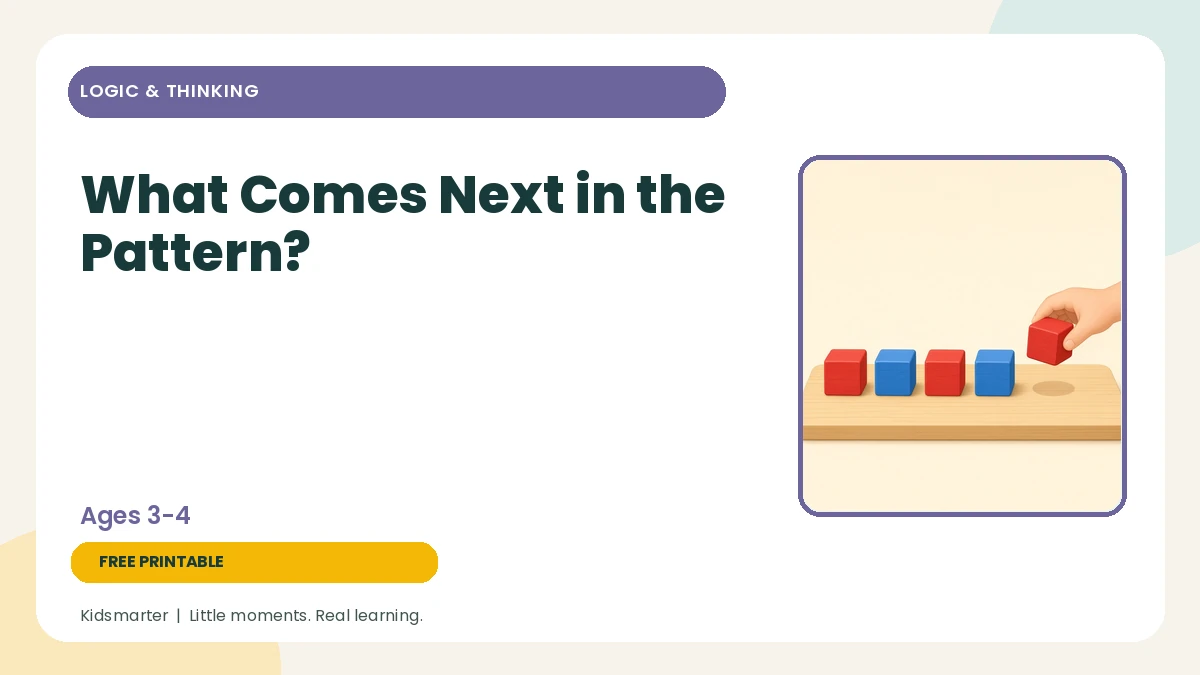
With suitable blocks, place red, blue, red, blue and read the row. Without blocks, an adult can draw circle, square, circle, square on plain paper. Leave a clear next space and name the repeating pair. Use a rhythm if enjoyable, without requiring the child to say every word.
-
Offer one block of each kind, or point to the circle and square as the two paper choices. Ask which continues the stated repeat. Try the choice, then read the whole row together; pointing is enough if drawing is difficult.
-
Point under the first two blocks or marks and say, “This pair repeats.” Compare it with the next pair. With loose blocks you may separate pairs slightly; with a drawing, an adult can draw a broad bracket underneath each pair. This is not simply choosing the opposite of the last color for every kind of pattern.
-
Choose one printed row and say its repeat. On the first row, point to circle–square, then circle; square completes another pair. A child can point to the earlier matching square rather than draw it. The other final answers under the stated units are circle, triangle, and circle. Build beside the page or let an adult draw the answer if a shape is difficult to form.
-
Let your child invent a repeating row for you. Ask them to show its smallest repeating part. If the arrangement is random, describe it as a design and offer to help make a repeating version separately.
Small Details That Make This Activity Work
AB, AAB, and ABC are adult shorthand, not names your child must learn. Show the complete unit and build two copies together before extending it. For an AAB row, choosing the opposite of the last color does not work every time: read the whole group again. A different proposed next shape needs a different stated rule; discuss that rule rather than calling every unfamiliar design wrong.
Why This Activity Helps
Finding a repeating unit supports prediction based on structure. Copying, extending, and identifying the unit are related but distinct tasks. Keeping the same rule while changing the materials helps reveal whether a child is noticing the relationship rather than memorizing colors.
Easy Ways to Adapt by Age
Make It Simpler
Copy a two-block pair underneath a model before extending a longer row. Use only four blocks and leave the repeating pair visible beside the work area.
Ready for a Challenge
Try red, red, blue repeated, then translate that pattern into clap, clap, tap. Compare why the repeated unit now contains three positions rather than two.
Parent Tip & Safety Note
Use only intact materials suitable for this child, checking for loose or broken parts. Skip loose blocks whenever mouthing is a concern; an adult can hold the whole page while the child points to the shape that would continue the stated unit. No beads, food counters, loose crayon caps, or cut strips are needed.
Explore more activities in this category or free printable games.