Soft or Hard?
Quick Activity Snapshot
- Age Range
- Ages 2–3
- Prep Time
- 3 minutes
- Skills Practiced
- Sorting familiar things by how they feel
- Materials
- A few soft things, a few hard things, and two clear places to put them
Age ranges are suggestions, not developmental milestones or standards. Choose the setup for this child, and stop whenever needed.
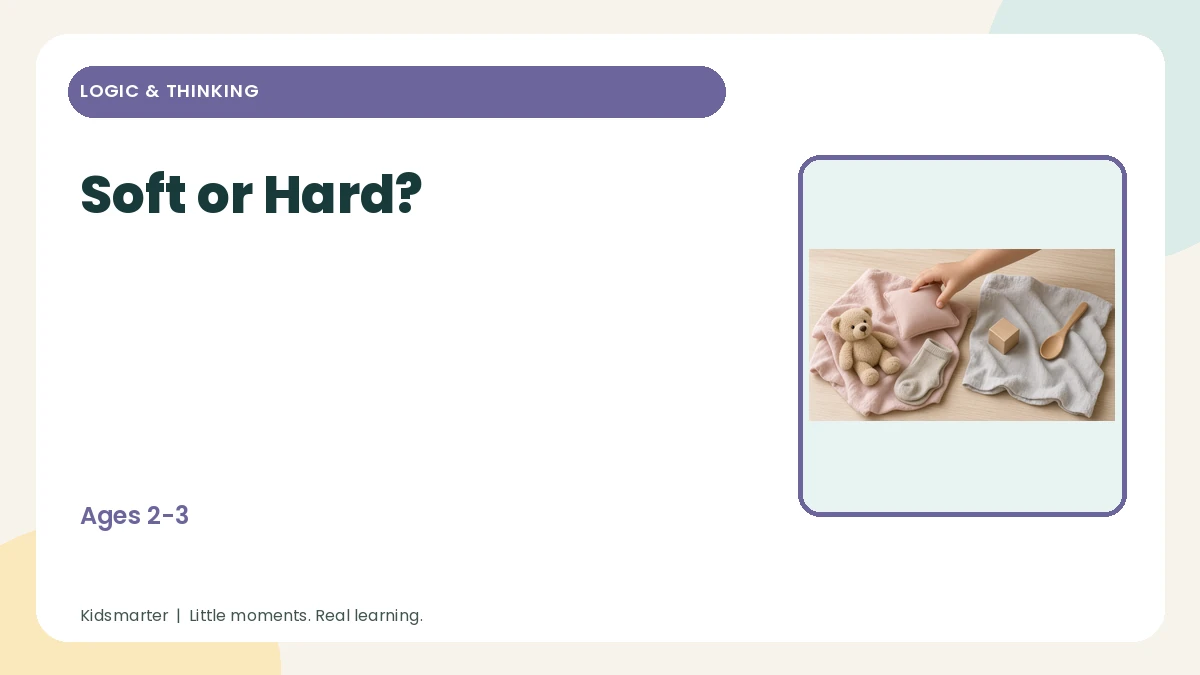
Some familiar things feel soft, and some feel hard: a stuffed bear and a sock are soft; a wooden block and a spoon are hard. This game gives that feeling a simple sorting job. It is not a guessing bag, not a color sort, and not a game about which room an object belongs in.
Materials You’ll Need
- Two clear places on a table, such as two cloths, two trays, or just a left side and a right side
- Two or three clearly soft objects, such as a stuffed toy, a soft sock, or a small cushion
- Two or three clearly hard objects, such as a wooden block, a wooden spoon, or an unbreakable cup
Choose objects that are too large to fit in a child’s mouth. Skip glass, sharp tools, and toys with loose buttons or eyes that could come off. You do not need a bag to hide the objects; the job is to feel them in the open and sort them.
Step-by-Step How to Play
-
Set out the two places and name them: “This side is for soft things. This side is for hard things.” Place one clear example in each place, such as a stuffed toy on the soft side and a block on the hard side.
-
Hold out one more object and invite your child to feel it. Say, “Does this feel soft or hard?” Invite them to place it. A touch, a word, or a placement all count.
-
If they place it in the other group, name what they chose and try again, or model once: “The spoon feels hard.” There is no score.
-
Sort the remaining objects if your child still wants a turn, then stop. Two or three placements can be a complete game. When you are finished, put the objects away together.
Small Details That Make This Activity Work
Start with objects that feel clearly different, not with things that are only a little soft or a little hard. Let your child feel each object before they place it. If they want to hug the stuffed toy instead of sorting, you can name that it feels soft and stop, or try one more object later. This is not Mystery Bag, not Laundry Sock Color Sort, not Kitchen or Bedroom, and not What Does Not Belong on the Tray: the rule is how the object feels in the hand.
Why This Activity Helps
Putting things into groups is one everyday way to notice how objects are alike and different. NAEYC’s family math-talk guidance includes sorting and classifying, and it gives a daily-life example of separating clothes by color. This game uses a different grouping rule—whether something feels soft or hard—and it has not been evaluated as a thinking or school-readiness program. Finishing a few placements is not a developmental test, and children may enjoy feeling the objects without explaining the rule.
Easy Ways to Adapt by Age
Make It Simpler
Use only four objects, and keep one example already sitting in each place. You can sort together, and simply say soft or hard as you set each thing down.
Ready for a Challenge
Add one more object that is a little less obvious, such as a hardcover book or a folded washcloth, and talk about what you feel. Stop if the extra object turns the game into a debate, and never add small, sharp, or breakable items to make it harder.
Parent Tip & Safety Note
Stay at the table. Use objects that are too large to swallow, and skip glass, sharp tools, and plastic bags. If a stuffed toy has loose eyes, buttons, or ribbons, choose a different soft object. When you are finished, put everything away so small items are not left on the floor. Stop if your child is finished or wants to play with the objects in another way.
Explore more activities in this category or free printable games.
For everyday language about sorting and classifying, see NAEYC’s Math Talk With Infants and Toddlers. That page offers family conversation examples, such as separating clothes by color; it does not test this soft-or-hard game, and it does not treat sorting by feel as a developmental screening.