Is It Taller Than This Block?
Quick Activity Snapshot
- Age Range
- Ages 3–4
- Prep Time
- 2 minutes
- Skills Practiced
- Comparing how tall two standing objects are
- Materials
- A standing block and a few other large, unbreakable objects
Age ranges are suggestions, not developmental milestones or standards. Choose the setup for this child, and stop whenever needed.
A standing block can be a height to compare. You set one block upright, stand another object beside it, and talk about which one is taller. This is not measuring length with a string, not counting footsteps, and not pouring to see which cup holds more.
Materials You’ll Need
- One sturdy wooden block that can stand on its own
- Two or three other large, unbreakable objects that can stand, such as a sturdy plastic cup or another block, each too big to swallow
Use unbreakable objects only, never glass. You do not need a ruler or a tape measure. Keep everything on a table, and stay close so nothing is knocked off.
Step-by-Step How to Play
-
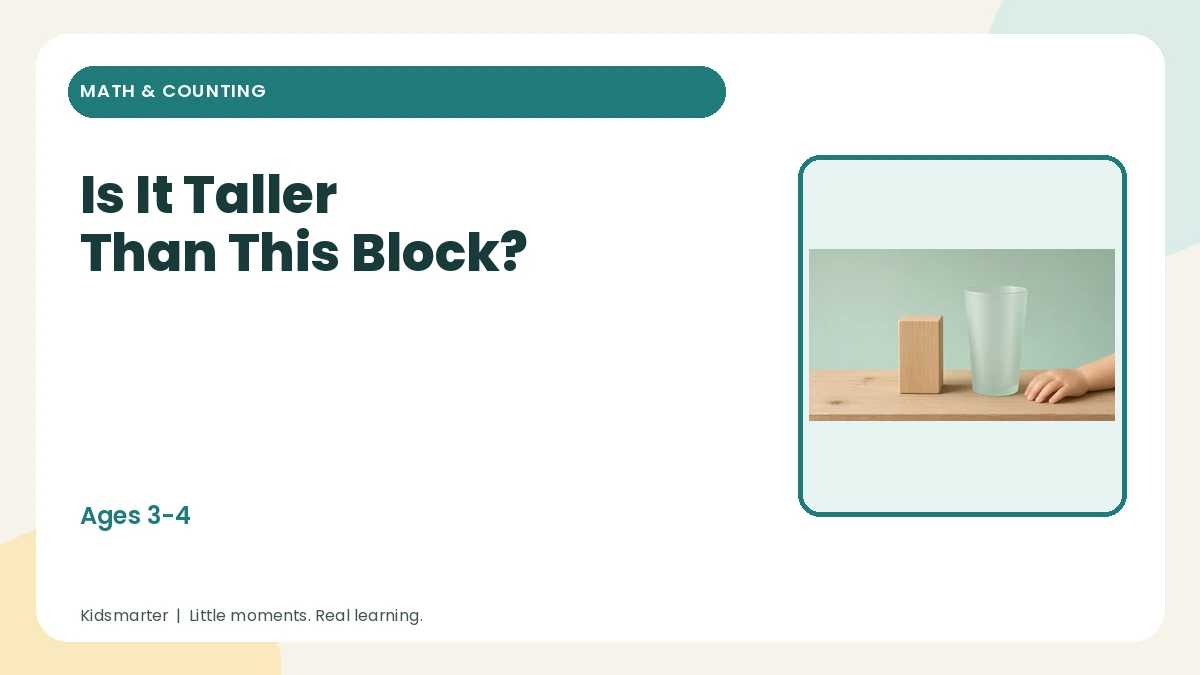
Stand the block upright on the table and say, “This block is our height. Let’s see if something else is taller than this block.”
-
Stand a second object beside it, such as a plastic cup, so both bases are on the table. Look across the tops together.
-
Say what you notice: “The cup is taller than the block,” or “The block is taller.” Invite your child to choose the next standing object and compare again.
-
Try one or two more objects if they still want a turn. Then put everything away. One clear comparison can be a complete game. There is no required number of objects.
Small Details That Make This Activity Work
Keep both objects standing, and start with a pair whose heights are clearly different so the idea of taller is easy to see. Compare the tops while the bases stay on the table; do not hold one object in the air. If they want to stack the objects, you can count the stack and stop, or you can return to one-to-one standing comparisons. This is not a string-length game, not footstep measuring, not a capacity pour, not a group-of-three count, and not a packing-the-box game: the job is to compare how tall two standing objects are.
Why This Activity Helps
Comparing two standing objects is one everyday way to talk about height. NAEYC’s family page Preschoolers Are Natural Mathematicians includes measuring at home and asking questions such as how tall a dog is. That page offers family examples of talking about height and measuring; it does not evaluate this block-and-cup comparison, and deciding which object is taller is not evidence of later math achievement. Children may enjoy standing the objects without using the word taller.
Easy Ways to Adapt by Age
Make It Simpler
Compare only two objects whose heights are very different, such as a short block and a clearly taller cup. You may do the standing, and you can say “taller” while they look.
Ready for a Challenge
After one easy pair, invite your child to find one more standing object and predict first: “Do you think this one will be taller than the block?” Then stand it beside the block and look. Stop if the extra predictions start to feel like a quiz.
Parent Tip & Safety Note
Stay at the table. Use only large, unbreakable objects; a plastic cup is fine, but never glass. Do not let objects stand near the edge of the table, and do not use anything heavy enough to hurt if it falls. Put extra objects out of reach so the set stays small. Stop when your child is finished or wants to play with the objects in another way.
Explore more activities in this category or free printable games.
For family talk about measuring and asking how tall something is, see NAEYC’s Preschoolers Are Natural Mathematicians. That page offers everyday examples, such as asking how tall a dog is; it does not test this standing-block comparison, and it does not treat deciding which object is taller as a developmental screening.