Lid Memory Match
Quick Activity Snapshot
- Age Range
- Ages 3–4
- Prep Time
- 8 minutes
- Skills Practiced
- Visual memory
- Materials
- Four matching broad opaque food-container lids or intact paper cups, Two matching pairs from the printable, prepared by an adult, A clear flat tabletop
Age ranges are suggestions, not developmental milestones or standards. Choose the setup for this child, and stop whenever needed.
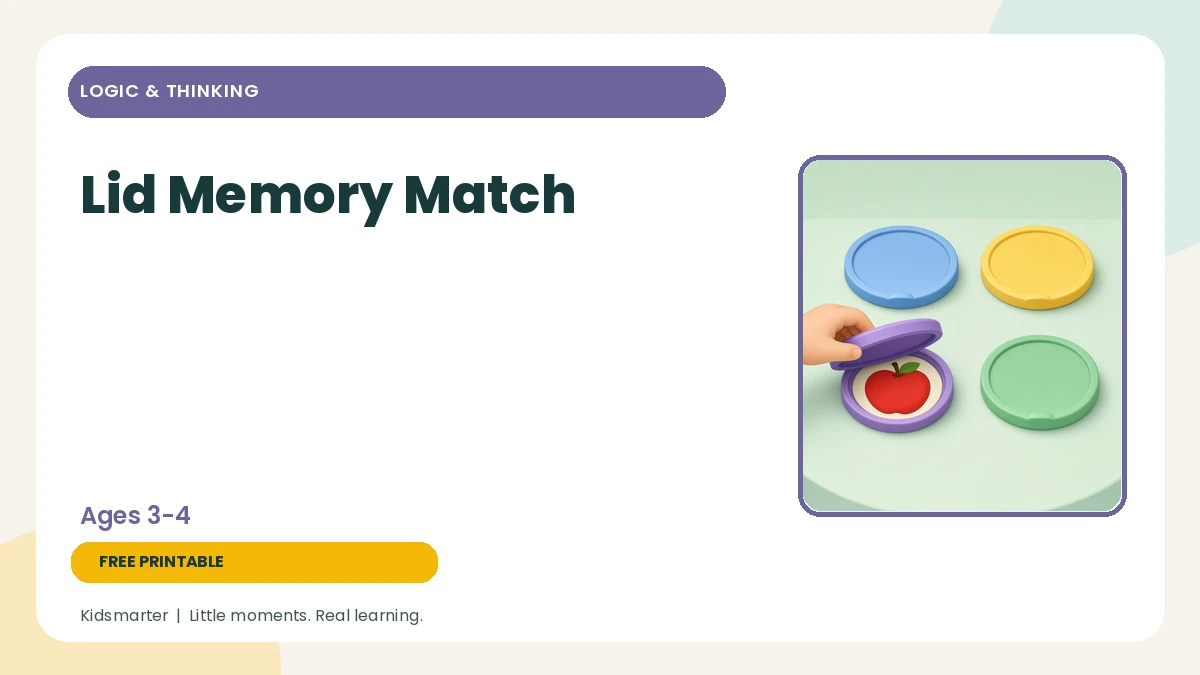
A few familiar lids can hide a small matching mystery. This version starts with only two pairs, giving preschoolers a manageable reason to remember where a picture appeared. The aim is to compare and revisit, not to beat an adult with a better memory.
Materials You’ll Need
- Four matching broad opaque food-container lids or intact paper cups
- Two matching pairs from the printable, prepared by an adult
- A clear flat tabletop
The PDF has four pairs: star, circle, square, and triangle. An adult prepares both stars and both circles, then puts unused cards and scraps away. Arrange the four face-up cards in a two-by-two square and show the two pairs. Cover each picture and its word label without shifting it. Use four matching broad opaque covers with no seals, valves, sharp rims, or damage; test that each hides the whole image and label. Never use bottle caps. If mouthing makes pieces unsuitable, skip covers and cut cards: use the whole page face up for pointing to pairs.
Step-by-Step How to Play
-
Lift one cover and leave that picture visible. Say, “A star is near this corner.” Let your child choose a second cover before hiding either picture. The pictures stay in their original positions; moving the covers is not a chance to shuffle the hidden cards.
-
Lift the second cover and compare the two visible pictures. If they match, leave both uncovered. If they differ, name each and replace both covers in the same places. Do not slide a nonmatching card into a new position while covering it.
-
Offer your child the next turn, with permission to peek at a remembered location. Ask, “Where did we see another star?” Wait before pointing; a short pause makes room for their strategy.
-
If the same unsuccessful pair is chosen repeatedly, keep one picture uncovered while searching for its partner. This reduces the memory load without changing the purpose of finding identical pictures.
-
Finish when both pairs are visible. Invite your child to hide them for your turn, checking that each picture still has a partner. Add one extra pair only on a later comfortable round.
Small Details That Make This Activity Work
Check that no logo, scratch, transparent patch, or visible word gives away a picture. Keep the cards stationary. Matched pairs can remain uncovered, which is simplest; if you move them to a finished row, leave their old spaces empty rather than closing the gaps. On a face-up round, call it matching, since no hidden location needs remembering.
Why This Activity Helps
This game combines visual matching with remembering a location across a brief delay. Limiting the array helps isolate that task from managing many choices. Talking about positions can support a search strategy, but forgetting a location is an ordinary part of play.
Easy Ways to Adapt by Age
Make It Simpler
Use the whole page face up and point to two matching pictures. If prepared cards are appropriate, they can instead be placed together. On a later covered-card round, leave one picture of each pair visible as a reminder of the target.
Ready for a Challenge
Use three or four pairs and let your child describe a memory cue before uncovering. Keep the covers stationary; secretly moving them would turn remembered information into unreliable evidence.
Parent Tip & Safety Note
Use only the checked intact broad covers, not small bottle caps or loose stickers. An adult prepares card pieces and counts the covers back into storage. Switch to whole-page face-up pointing whenever children mouth objects or younger siblings join. End if the covers become a throwing or biting game rather than insisting on another memory turn.
Explore more activities in this category or free printable games.