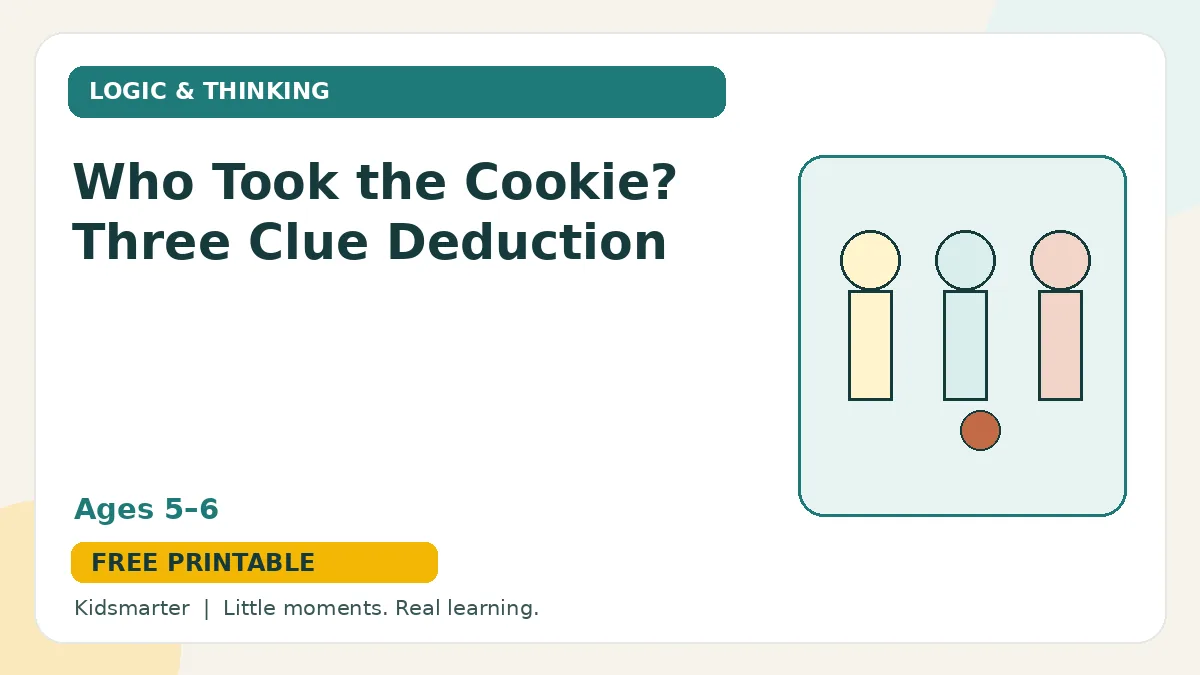
Who Took the Cookie? Three Clue Deduction
Quick Activity Snapshot
- Age Range
- Ages 5–6
- Prep Time
- 10 minutes
- Skills Practiced
- Using clues to rule out options
- Materials
- The printed character and clue sheet; a pencil is optional
The cookie mystery is a paper thinking game. The sheet shows three named characters you can point to: Pip the cat has a hat, Bo the dog has spots and no hat, and Kit the bear has a bow and no hat. Read each clue, set aside anyone it cannot be, and check the remaining options. The cookie on the page is a picture, not food.
Materials You’ll Need
- The printed character and clue sheet
- A pencil, optional, for marking ruled-out names
Print the sheet at actual size and keep it whole. You do not need loose toys, a real cookie, or cups for hiding. If you later add intact figures you already consider suitable, they are optional and should stay on the table.
Step-by-Step How to Play
-
Look at the three characters and name what you can see: Pip has a hat, Bo has spots and no hat, and Kit has a bow and no hat. Say, ‘We will use clues to find who took the cookie on the page.’
-
Start with Mystery A and read the clues in order. Clue 1 is ‘The one who took it is not Bo the dog.’ Set Bo aside. Clue 2 is ‘The one who took it is wearing a hat.’ Only Pip has a hat, so Pip remains. Clue 3, ‘The one who took it is Pip or Kit,’ agrees with that result. Point to the paper cookie beside Pip.
-
If a clue is forgotten, reread it rather than adding a new hint. Every printed clue can be checked against the pictures.
-
Play Mystery B the same way. Clue 1 rules out anyone with a hat (Pip). Clue 2 rules out Bo. That leaves Kit, and Clue 3, ‘The one who took it has a bow,’ confirms Kit.
-
If interest remains, swap roles: your child reads a clue and you point to who is still possible. Then put the sheet away. Do not hide food or small objects under cups to ‘reveal’ the answer.
Small Details That Make This Activity Work
Keeping all three characters in view makes each elimination visible. A clue that repeats what you already know, such as Mystery A’s third clue, is still useful as a check. One mystery at a time is enough.
Why This Activity Helps
Each clue gives a reason to keep or set aside a character, and the pictures let you check that reason. The activity is a playful paper mystery, not a test of formal logic or a promise that practice will build reasoning skill in general.
Easy Ways to Adapt by Age
Make It Simpler
Play only Mystery A, and cover the characters you have already ruled out with a scrap of paper you keep under adult control. Read each clue twice before moving on.
Ready for a Challenge
After Mystery B, ask which clue first made the answer certain, and which clue only confirmed it. You can also make a new three-clue mystery on another day, writing the answer on a separate adult slip.
Parent Tip & Safety Note
This is a paper game. Do not use real cookies, candy, or other food, and do not hide small objects under cups. Keep the sheet whole. The age range above is a suggested starting point for this setup, not a developmental milestone or a standard your child must meet.
Find another small invitation to play in Logic & Problem Solving, or explore our free printable games. Choose one that fits your child’s interests, available materials, and energy today.