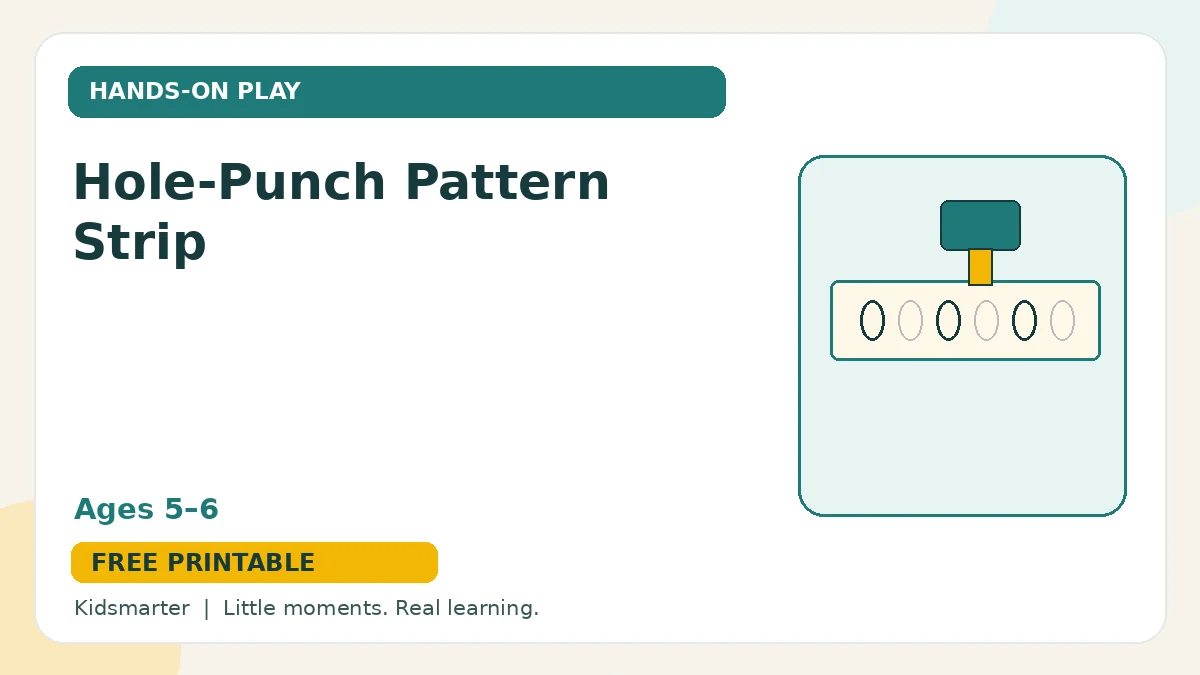
Hole-Punch Pattern Strip
Quick Activity Snapshot
- Age Range
- Ages 5–6
- Prep Time
- 8 minutes
- Skills Practiced
- Lining up a punch and following a short pattern
- Materials
- A hole punch, a strip of cardstock, and a simple dotted pattern to copy
Age ranges are suggestions, not developmental milestones or standards. Choose the setup for this child, and stop whenever needed.
A hole punch is a satisfying tool, and a dotted strip gives that punch a pattern to follow. Your child punches only the marks in the sequence and leaves the other spaces alone, which combines a firm squeeze with careful looking. The strip is short on purpose: a few accurate punches are more useful than a long rushed row. Show how the punch works, line it up over a dot, and then let your child try the motion.
Materials You’ll Need
- A hole punch
- A strip of cardstock
- A simple dotted pattern to copy
Provide a hole punch your child can squeeze with two hands if needed, a strip of cardstock, and the printed dotted patterns. An adult may cut one strip at a time from the page. Sit at a table with the scrap side of the punch over a tray to catch the dots. The printed circles are lining-up marks, not the finished hole size. Test that the punch cuts cleanly before you begin.
Step-by-Step How to Play
-
Show the punch away from the pattern first. Squeeze it on a scrap so your child can see a hole appear and feel the pressure needed. Say, ‘We line up the punch with a dot, squeeze, and then move to the next mark in the pattern.’
-
Place the pattern strip so the first dot sits in the punch. Help with lining up if needed, then let your child squeeze. Look together at the hole and the remaining dots. If the punch misses, adjust the strip and try the next mark rather than punching over and over in the same spot.
-
Continue along the sequence, skipping any unmarked spaces. Ask, ‘Is this a punch spot or a space we leave?’ A short pause before each squeeze is part of the work. If the pattern is a simple repeat, say it aloud: ‘Punch, punch, space,’ and then check the strip.
-
When the strip is finished, hold it up to the light or lay it on paper and compare it with an unpunched copy of the pattern. Talk about one hole that landed well and one that drifted, without treating a slightly off hole as a failure.
-
Offer a second strip only if hands are not tired. Collect the punched dots in a cup if your child wants them, and store the punch closed. A single careful strip is a complete activity.
Small Details That Make This Activity Work
If holes drift to one side, try rotating the strip or holding the punch more steadily on the table. Save one finished strip as a model. On another day, repeat the same pattern before introducing a new one, so the punching motion can settle.
Why This Activity Helps
Hole punching asks for a steady squeeze and a careful line-up over each mark, while a pattern adds a decision before each punch. Checking the finished strip against the dotted model shows which holes follow the sequence. Because the strip is short, children can finish a whole sequence and then review it. This describes the work in this setup, not a promise of stronger hands or a general fine-motor gain. Tired hands are a reason to stop, not a reason to push for one more page.
Easy Ways to Adapt by Age
Make It Simpler
Use a punch with an easy squeeze and a strip with only three or four large dots in a straight line. You can line up each dot while your child squeezes. A child can also punch freely on scrap card first and try the pattern later.
Ready for a Challenge
Try a two-row pattern, or a strip that uses two hole sizes if you have a second punch. Your child can design a pattern for you to copy on another strip, then compare the two sequences.
Parent Tip & Safety Note
Keep fingers away from the punch opening, and supervise every squeeze. Cardstock works better than very thin paper, which tears and jams. Collect small punched dots so they are not mouthed or scattered. Stop at the first sign of hand fatigue or frustration with a stiff punch.
The age range above is a suggested starting point for this setup, not a developmental milestone or a standard your child must meet. Line up the punch before each squeeze, keep fingers away from the opening, and collect every punched dot so none are mouthed or scattered.
Find another small invitation to play in Hands-On & Fine Motor, or explore our free printable games. Choose one that fits your child’s interests, available materials, and energy today.