O’Clock Daily Routine Clocks
Quick Activity Snapshot
- Age Range
- Ages 5–6
- Prep Time
- 8 minutes
- Skills Built
- Telling time to the hour
- Materials
- The whole printed clock-and-routine page, Plain paper and a whole crayon for drawing another clock, An adult to read routine labels aloud
A clock picture can start a conversation about an hour and a familiar event. Look at a printed o’clock face, name the time, and choose a routine label or tell your own example. These are pictures to discuss, not a timetable to obey. You can point, draw, and talk without changing a real clock or building moving hands.
Materials You’ll Need
- The whole printed clock-and-routine page
- Plain paper and a whole crayon for drawing another clock
- An adult to read routine labels aloud
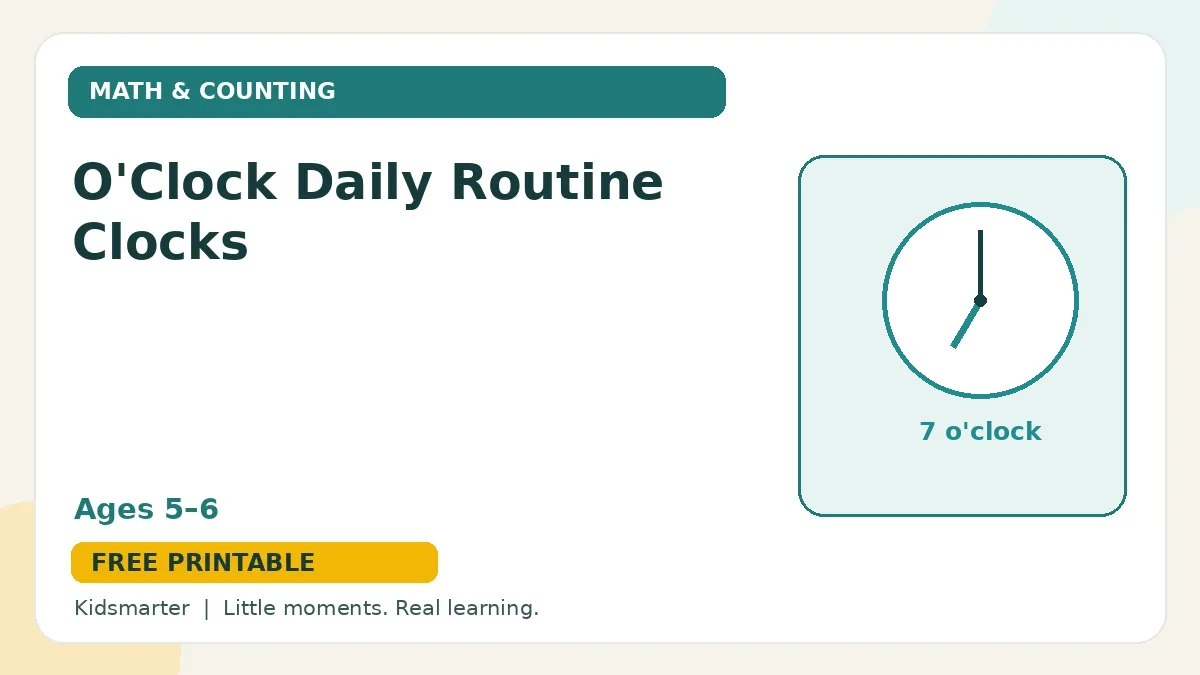
The printable shows four fixed clocks: seven, twelve, three, and eight o’clock, plus five routine labels and a blank label. They are pictures to compare, not movable clock hands. Keep the page whole and point between a clock and a label. For another hour, an adult can draw a fresh clock on paper using the printed number order. No fastener, detachable hands, or real clock is needed.
Step-by-Step How to Play
-
Point to the seven-o’clock picture. Say, “The long minute hand points to twelve, and the short hour hand points to seven.” At an exact hour the short hand points at the hour, not somewhere between numbers. On the twelve-o’clock picture the two hands lie on top of one another; an adult can draw a thick short hand and a thin long hand on paper to show both.
-
Read the routine labels aloud and ask, “Could one fit an example from our day?” Seven in the morning might go with breakfast in one family and another event elsewhere. Use a printed face that is useful, or draw another exact hour. If an event happens between hours, describe it as around that time rather than claiming the picture shows its precise time.
-
Choose a different printed clock, or draw a new one with the long hand up at twelve and the short hand on the chosen hour. Name it, then choose a routine label. These are separate drawings of different times, not instructions to push the hands of a real clock independently of its mechanism.
-
Let your child choose a routine label first, with the adult reading its words. Pick a printed hour that is roughly relevant, or draw another hour. If breakfast is at seven thirty, say, “That is not an o’clock time; seven is only an earlier example,” rather than relabelling seven thirty as seven o’clock. Nobody has to change a family routine to match the worksheet.
-
Choose a few examples and tell them in daily order, supplying morning, afternoon, or evening. For an imaginary day you might use seven in the morning, three in the afternoon, and eight in the evening; say these are examples. Point between the clock pictures and labels rather than trying to move printed hands. Your family’s actual routine can be different.
Small Details That Make This Activity Work
A clock face alone cannot tell morning from evening. Seven in the morning and seven in the evening look the same; add a spoken morning/evening label or a drawn sun or moon. Twelve may mean noon or midnight, so supply that context too. Routine matches are family examples, not an answer key about when every child should eat or sleep.
Why This Activity Helps
The long hand on twelve marks an exact hour; the short hand identifies which hour. Keeping those two jobs visible gives you a clear way to name each printed time. Routine labels provide something familiar to discuss, but matching a label does not change what the hands show. Read the words aloud so learning to read a routine card is not a hidden extra task.
Easy Ways to Adapt by Age
Make It Simpler
Discuss just one or two clock pictures. Read their exact hours aloud, then choose a routine example if one is useful. An adult may draw a sun or moon beside a picture to specify morning or evening; no moving clock hands or cut labels are needed.
Ready for a Challenge
Use the same seven-o’clock picture twice: once for a morning example and once for an evening example. Ask what context tells you which is meant. Or draw a new exact-hour clock and compare it with a printed face. Keep half-hours for another activity rather than changing the rule in the middle of this one.
Parent Tip & Safety Note
Use printed or drawn clocks instead of loose clock hands, paper fasteners, or a real clock’s battery compartment. Leave wall clocks in place; nobody climbs to reach one or opens a clock for this game. Adults manage crayons if mouthing is likely. Stop whenever the conversation has run its course; the worksheet is not a family schedule to enforce.
The age range is a suggested invitation, not a developmental deadline. Naming one pictured hour together is enough for a short conversation.
Find another small invitation to play in Math & Counting, or explore our free printable games. Choose one that fits your child’s interests, available materials, and energy today.