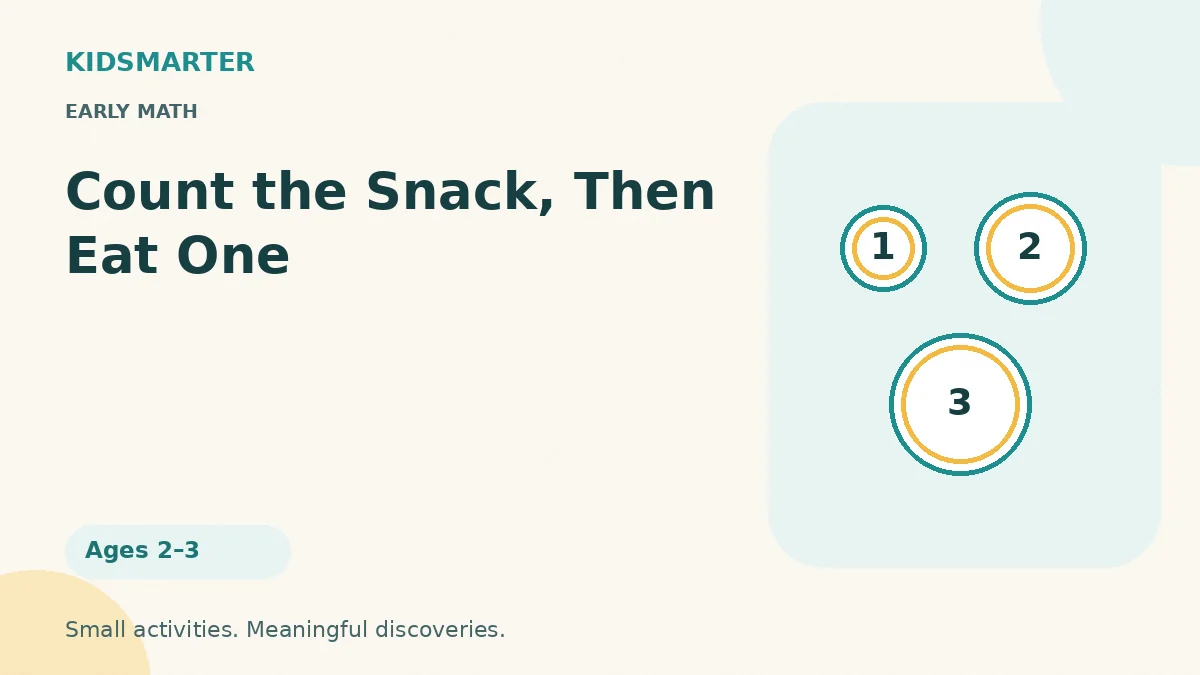
Count the Snack, Then Eat One
Quick Activity Snapshot
- Age Range: Ages 2–3
- Prep Time: 3 minutes
- Skills: Counting small sets
- Materials: A small plate, Up to five adult-prepared soft snack portions suited to the child; or drawn paper circles for a nonfood game
Age ranges are suggestions, not developmental milestones or standards. Choose the setup for this child, and stop whenever needed.
A few visible pieces can give you a way to describe a small quantity, but a toddler’s snack does not need to become a lesson. Count briefly before eating starts, then let the child eat without questions or a demand to take a bite. If your child is hungry, excited, or needs all their attention for eating, serve the snack normally and do the number play later with three circles drawn on one intact sheet. No loose paper “snacks” are needed.
Materials You’ll Need
- A small plate
- Up to five adult-prepared soft snack portions suited to the child; or drawn paper circles for a nonfood game
Prepare a small plate with no more than five soft portions of a food the child already eats comfortably, such as ripe banana flattened and cut to an appropriate size and texture for that child. Do not offer whole berries, grapes, raisins, nuts, hard raw apple, popcorn, or round hard foods as counters. Wash hands, sit together, and use drawn circles instead if food preparation or eating makes the game unsuitable.
Step-by-Step How to Play
-
Before the child starts eating, show three adult-prepared soft portions on their plate. Point near one portion at a time and say, “One, two, three. Three pieces.” Let the child listen or point without requiring an answer. Use only a food already appropriate for this child’s usual eating; this is not a reason to introduce a new texture or make portions larger. Skip the demonstration and serve the snack if the child wants to eat now.
-
Stop the counting while the child is eating. They choose whether and how much to eat; do not request a bite to make the numbers work. If one piece happens to be eaten and the child has finished chewing and swallowing, you may briefly notice what remains. If the child declines food or eats more than one, accept that and leave the planned “one less” example for the drawn-circle version.
-
Only when the mouth is empty and your child is comfortable, describe the actual plate: “There were three; now there are two.” Use that sentence only if exactly one of the three pieces was eaten or removed. If two went, there is one left. Do not interrupt another mouthful for a response, keep a question running while the child eats, or ask the child to speak with food in their mouth. The snack can continue in silence.
-
Save any longer experiment for a separate nonfood moment. Draw three big circles on an intact sheet and cover one with your palm: “Three were showing; now two are showing.” Remove your hand to reveal all three again. There is no cutting, loose counter, or food to put in a mouth. This repeats the visible quantity change without asking a two-year-old to explain why a spread-out row still has the same number.
-
Let the child finish the snack at their own pace, without needing to answer a final question. Keep extra food available as appropriate for the usual snack rather than rationing it to fit a counting example. At another time, count two shoes together or return to the drawn circles. Counting language can accompany a routine; the routine does not have to wait for a correct count.
Why This Activity Helps
Matching one spoken number to one touched item supports one-to-one correspondence. Naming the final total introduces the idea that the last number tells how many objects are in the set. Removing one creates an early experience of quantity changing, well before formal subtraction is needed. Small visible sets allow children to check their thinking by looking and touching instead of relying on a memorized counting chant.
Easy Ways to Adapt by Age
Make It Easier: Use two circles drawn on one intact sheet and do the counting yourself while the child points. Keep paper play separate from eating. If using an actual snack, a brief adult description before the first bite is enough; hunger is a reason to serve food, not to require another turn.
Add a Challenge: At a separate nonfood time, draw five circles on one sheet. Before covering one with your palm, ask whether more or fewer will be visible. Count the four still showing if the child wants to check. Leave formal subtraction notation out unless it is already familiar; the point is describing what changed, not reaching a target age level.
Parent Tip & Safety Note
Keep eating seated upright, calm, and continuously attended by an adult. Prepare the shape, size, and texture for the individual child; this activity does not make any food safe. Do not use whole grapes or berries, unprepared raisins, nuts, popcorn, hard raw fruit, or hard round foods as counters. Ask no questions while the child is chewing, do not hurry bites, and never make food a reward for counting. Check the family’s usual allergy precautions. If playful handling distracts from eating, use only the separate intact-paper version.
Safety reference: CDC choking-hazard guidance.