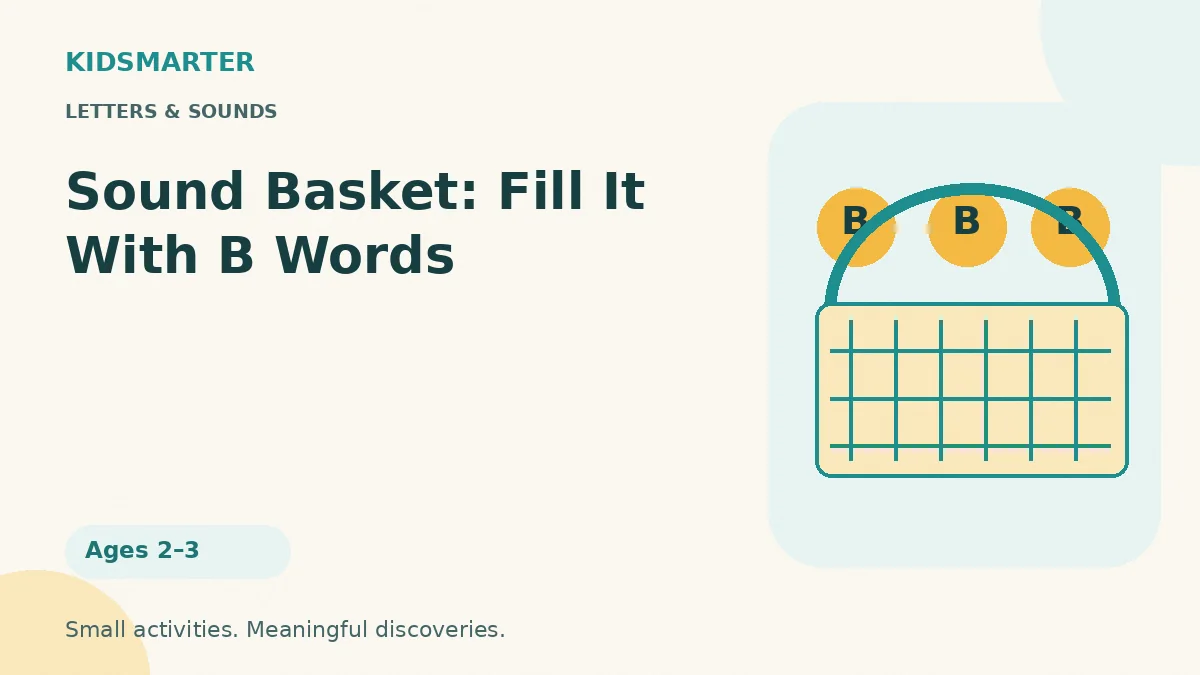
Sound Basket: Fill It With B Words
Quick Activity Snapshot
- Age Range: Ages 2–3
- Prep Time: 5 minutes
- Skills: Beginning sounds
- Materials: A small basket, Everyday objects (ball, book, bottle, banana), A large paper letter B (not a loose sticky note)
Age ranges are suggestions, not developmental milestones or standards. Choose the setup for this child, and stop whenever needed.
A basket of familiar things makes a friendlier first sound game than a row of flashcards. Your child can feel a ball, turn a book, and hear how both words begin. This version focuses on the sound /b/, not on memorizing a letter name or collecting a huge pile. Play on the floor with just a few objects. A toddler who happily puts everything in the basket is still joining a conversation about words and objects.
Materials You’ll Need
- A small basket
- Everyday objects (ball, book, bottle, banana)
- A large paper letter B (not a loose sticky note)
Gather a small basket, a large ball, a sturdy board book, a banana, and an empty plastic bottle with its cap removed and stored away. Add one clearly different object, such as a sock. Write B on a large piece of paper rather than using a loose sticky note with a child who mouths paper. Check that every item is clean and safe to handle.
Step-by-Step How to Play
-
Place only the ball and book beside the basket. Hold up the ball and name it naturally, then repeat its beginning sound briefly: "Ball. /b/, ball." Keep /b/ short instead of adding a long "buh," which can obscure the sound. Invite your child to touch or roll the ball. They do not need to repeat the sound to take part.
-
Pick up the book and use the same pattern: "Book. /b/, book. Ball and book start with the same little sound." Put both items into the basket with an exaggerated, gentle plop. If your child says a different name, acknowledge it first. "Yes, that's your bedtime story book. We can call it a book for our sound game."
-
Set out a banana and the sock. Name both before asking anything: "Banana. Sock." Ask, "Which one starts like ball: banana or sock?" Allow your child to choose, point, or pass an object. If the sock goes in, do not dump it out dramatically. Repeat the two words, place them side by side, and model putting the banana in while keeping the invitation playful.
-
Add the bottle and revisit the collected objects one at a time. Say, "We found ball, book, banana, bottle. Listen to that beginning." Let your child remove and return each item. The shared rhythm can hold attention better than repeated questions. Avoid insisting that the toddler distinguish an unfamiliar word; first sounds are easier to notice when the object's name is already well known.
-
Offer a tiny search in the same room: "Could our big blue blanket join us? Blanket begins like ball." Bring a large item near the basket rather than forcing it inside. End with a favorite book or a pretend picnic using the banana. Take a quick note of the words you used so another adult can repeat the same simple game later.
Why This Activity Helps
Hearing a common beginning sound is an early form of phonological awareness: noticing parts of spoken language. Handling concrete objects helps connect that listening task with meaningful vocabulary. Letter recognition is a separate skill, so the B label is an optional bridge rather than the main test. Many two-year-olds are still learning object names and will need repeated adult demonstrations before sound sorting becomes meaningful.
Easy Ways to Adapt by Age
Make It Easier: Use only two B objects and skip the nonmatching sock. Say each word while your child puts it in the basket, then enjoy taking everything out. For children learning more than one language, choose the language for this round and name the items in it; the same object may begin with a different sound in another language.
Add a Challenge: For an interested older preschooler, add a bowl and a boot, then invite them to explain why a cup stays outside. Compare /b/ with a clearly different sound such as /s/ before attempting close sounds. Let the child invent a silly basket sentence: "A bear brings a banana." Accept playful ideas without requiring written words.
Parent Tip & Safety Note
Inspect the basket for broken wicker and remove bottle caps, toy parts, and other choking hazards. Children under three need close supervision with all small items, and a real banana should be eaten only while seated with appropriate preparation. Do not roam the kitchen collecting detergents or breakable containers. Keep the game conversational; silence, gestures, and giggles count as participation.