Toy Story Problems on the Rug
Quick Activity Snapshot
- Age Range
- Ages 5–6
- Prep Time
- 5 minutes
- Skills Built
- Early addition and subtraction
- Materials
- Five intact age-appropriate toy vehicles or blocks, if suitable, An arrival space and a separate departure space, Plain paper and a whole crayon for a no-loose-pieces story
A word problem becomes clearer when toys can act it out on the rug. Instead of asking your child to imagine three buses and then two more, place the buses where both of you can see them, move the newcomers in, and look at the whole group. The story supplies a reason to add or take away, but the toys carry the meaning. Keep the numbers small, and tell stories that sound like ordinary play.
Materials You’ll Need
- Five intact age-appropriate toy vehicles or blocks, if suitable
- An arrival space and a separate departure space
- Plain paper and a whole crayon for a no-loose-pieces story
Prepare five intact toy vehicles or blocks suitable for the child, checking for detachable wheels or other loose parts. Keep an unused arrival space and a separate parking place for departures. If mouthing makes toys unsuitable, put them away: an adult can draw the story on one whole sheet, adding two vehicles to three, or cross out two of five while clearly counting only those still at the station. This is separate from food and eating.
Step-by-Step How to Play
-
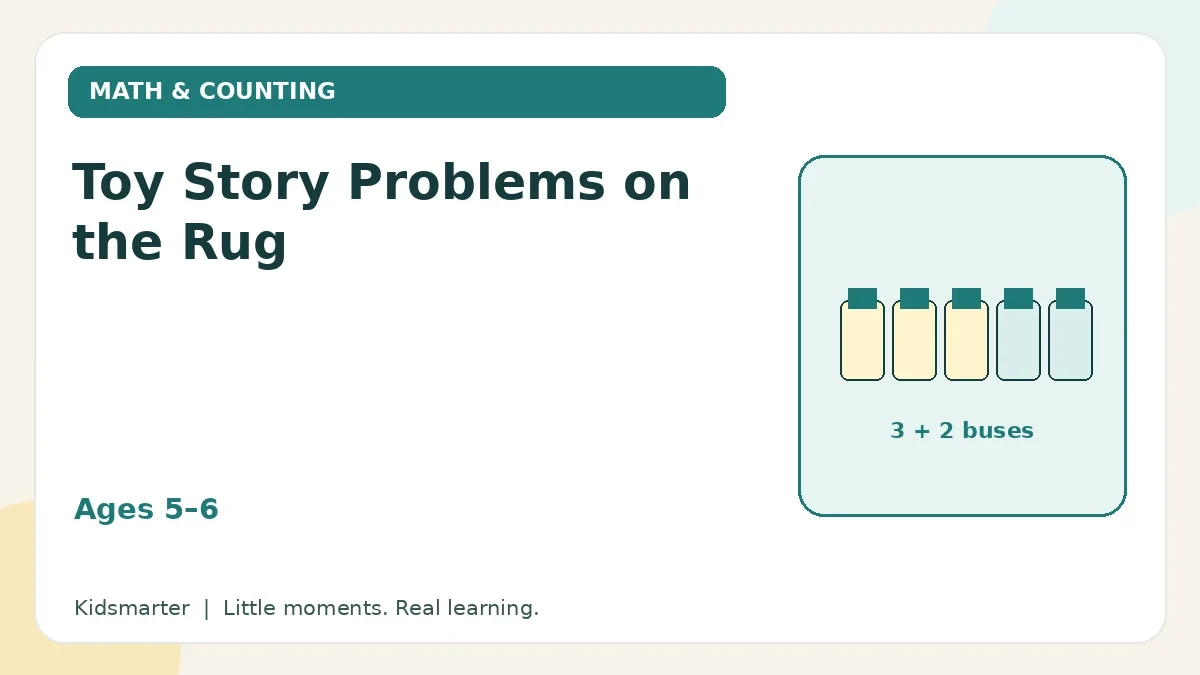
Set out three toys in a little row. Say, ‘Three buses are in the station.’ Touch each one as you count, then sweep your hand around the group: ‘Three.’ Invite your child to count with you if they wish, and wait until the starting amount is agreed.
-
Bring two more toys from behind your back. Say, ‘Two more buses arrive.’ Place them at the end of the row, not mixed in at random. Ask, ‘How many buses are here now?’ Give thinking time. If your child says a number, suggest checking by touching each toy once.
-
Tell a taking-away story with the same toys: ‘Five buses are here. Two drive away to the park.’ Let your child move the two leaving toys onto a nearby book or cushion. Look at the group that remains and count it together. Keep the departed toys visible so the whole story can be retold.
-
Invite your child to invent the next story using the same toys. They might add one or send three away. Repeat their idea in a complete sentence, then act it out exactly as told. If the action and the spoken numbers disagree, follow the toys and adjust the words together.
-
Finish by retelling one favorite story from the beginning, moving the toys again. You can sketch a quick picture of the start and the end if your child wants a keepsake, but do not turn the drawing into required number writing. Put the toys away while the play still feels like a short scene.
Small Details That Make This Activity Work
Listen for whether your child talks about the arriving group, the remaining group, or only the last number they heard. That tells you what to emphasize tomorrow. Reuse the same buses or animals for a few days so the story language stays attached to familiar objects.
Why This Activity Helps
Acting out a story connects the words all, more, and away with visible quantities. Children can check an idea by moving objects rather than holding every word in mind. Starting with a clear first amount, changing only one part of the story, and recounting at the end keep the acted-out amounts honest. The activity is not a race toward formal addition sentences; those can wait until the toy stories already make sense.
Easy Ways to Adapt by Age
Make It Simpler
Use two or three toys only, and let your child move them while you tell the story. Ask them to point to the arriving group and the whole group, even if they are not ready to name the new total. A child can participate fully by moving the toys.
Ready for a Challenge
For a two-step story, begin with two buses, let three arrive, then send one away. Check two plus three makes five, and five minus one leaves four. In a drawing, mark the departed bus clearly and point only to the four still at the station. A number sentence can be an optional caption, not another required task.
Parent Tip & Safety Note
Inspect the toys and put any small or detachable pieces away before play. Use the adult-drawn version if mouthing is likely. Keep both parking spaces in easy reach, and invite the child to move toys rather than taking them out of their hands. Use no real snack or tiny pretend-food pieces in these stories.
The age range above is a suggested starting point for this setup, not a developmental milestone or a standard your child must meet. Keep the first stories within a total you can check by touching each toy once, and follow the toys if the spoken numbers and the scene disagree.
Find another small invitation to play in Math & Counting, or explore our free printable games. Choose one that fits your child’s interests, available materials, and energy today.