Addition-to-5 Dice Mat
Quick Activity Snapshot
- Age Range
- Ages 5–6
- Prep Time
- 2 minutes to print
- Skills Practiced
- Addition within 5
- Materials
- Printed mat, One or two dice (or a 1–3 cube), Counters
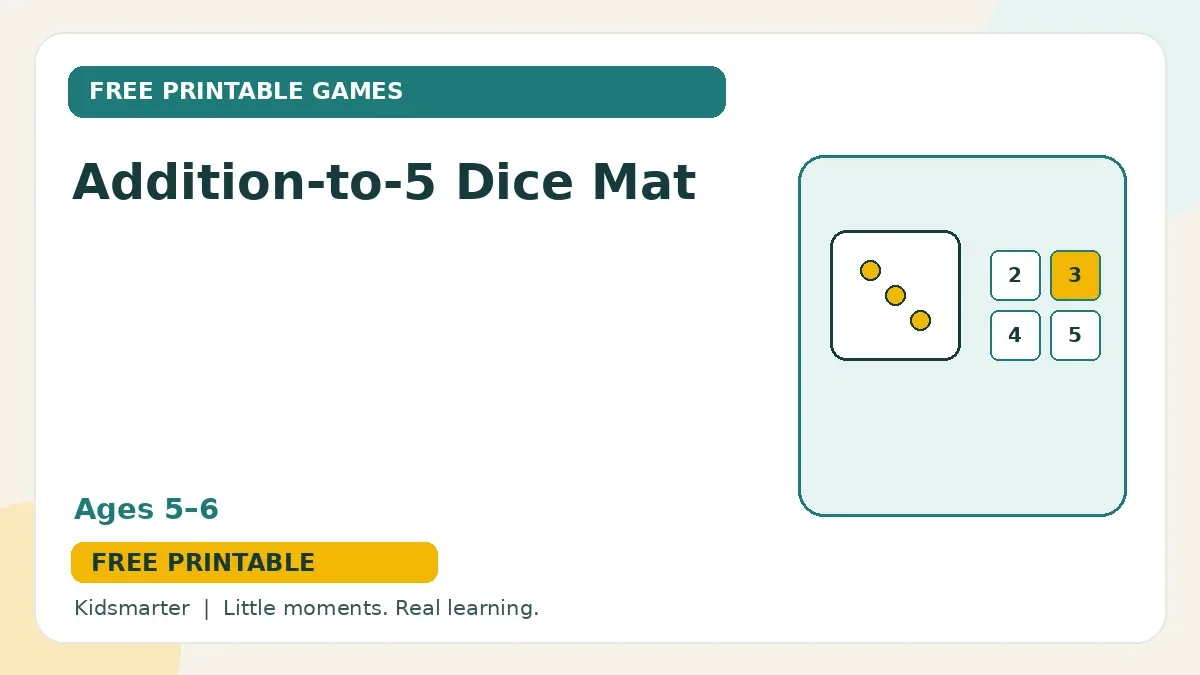
A dice mat can keep early addition inside a friendly range and give it a reason to be repeated. Your child rolls, adds the amounts, and covers the sum on the mat, aiming to fill the spaces or to cover a chosen path. Totals stay within five, so the counting can stay careful. You will print the mat, provide one or two simple dice or a 1–3 cube, and demonstrate a single turn before the game begins in earnest.
Materials You’ll Need
- Printed mat
- One or two dice (or a 1–3 cube)
- Counters
Print the addition-to-5 mat and provide counters plus one die, two dice, or a homemade 1–3 cube. Sit opposite your child so both of you can see the mat. Agree on a simple goal, such as covering four spaces, before the first roll.
Step-by-Step How to Play
-
Show a practice roll. If you are using one die, roll it and add one more with a counter, or use two dice with small numbers. Count the dots, then find that sum on the mat and cover it. Say the addition in ordinary words: ‘Two and one more is three.’
-
Invite your child to take a turn the same way. If the sum is already covered, they may roll again or cover a matching unmarked space if your rules allow it. Keep the rule consistent, and recount the dice whenever the total is uncertain.
-
Continue taking turns, or play cooperatively to fill the mat together. Notice which sums appear often. If a roll would make a number larger than five, use the 1–3 cube or ignore a die and talk about staying inside the mat’s range.
-
When a few spaces are covered, ask your child to predict a roll that could cover an empty number, then try it. A missed prediction is simply a chance to cover a different sum. Avoid turning the prediction into a test.
-
End when the agreed spaces are filled, or after a set number of turns, even if empty spaces remain. Gather the counters and dice, and leave the mat ready for a second, shorter game another day.
Small Details That Make This Activity Work
If adding is slow, leave the die in view and count the dots every time rather than rushing toward remembered facts. Store the mat with the same die so the next game can start with a familiar tool and the same small range.
Why This Activity Helps
A game structure gives early addition a clear purpose: find the sum and mark it. Keeping totals within five lets children count all, or count on from one number, without losing track of a large set. Repeating turns shows that the same sum can appear more than once, which makes the addition feel familiar. Rules should stay simple enough that the thinking stays on the amounts, not on a complicated scoring system.
Easy Ways to Adapt by Age
Make It Simpler
Use a 1–3 cube and a mat that only shows 2, 3, and 4 at first. You can count the dots and place the counter while your child finds the number. A child may also add two groups of counters without a die.
Ready for a Challenge
Use two dice with a ‘roll again if the total is more than five’ rule, or try to cover every number on the mat. You can record one turn as a short number sentence after the counters are placed. Keep any competition gentle and optional.
Parent Tip & Safety Note
Supervise dice, which are choking hazards for children under three and for anyone who mouths objects. Keep play at the table. If two children play, agree that the mat is a shared puzzle rather than a chance to grab counters. Stop while the game still feels friendly.
The age range above is a suggested starting point for this setup, not a developmental milestone or a standard your child must meet. Keep totals within five, and use the 1–3 cube or a single die when you want the 1 space or a smaller addend.
Find another small invitation to play in Free Printable Games, or explore our free printable games. Choose one that fits your child’s interests, available materials, and energy today.