Kitchen or Bedroom?
Quick Activity Snapshot
- Age Range
- Ages 2–3
- Prep Time
- 3 minutes
- Skills Practiced
- Sorting familiar things by the room they belong in
- Materials
- A few kitchen things, a few bedroom things, and two clear places to put them
Age ranges are suggestions, not developmental milestones or standards. Choose the setup for this child, and stop whenever needed.
Some familiar things have a home in the house: a cup and a spoon belong in the kitchen, a pillow and a stuffed toy belong in the bedroom. This game gives that idea a simple sorting job. It is not a color sort, not an animals-or-vehicles sort, and not a game about two things we use together.
Materials You’ll Need
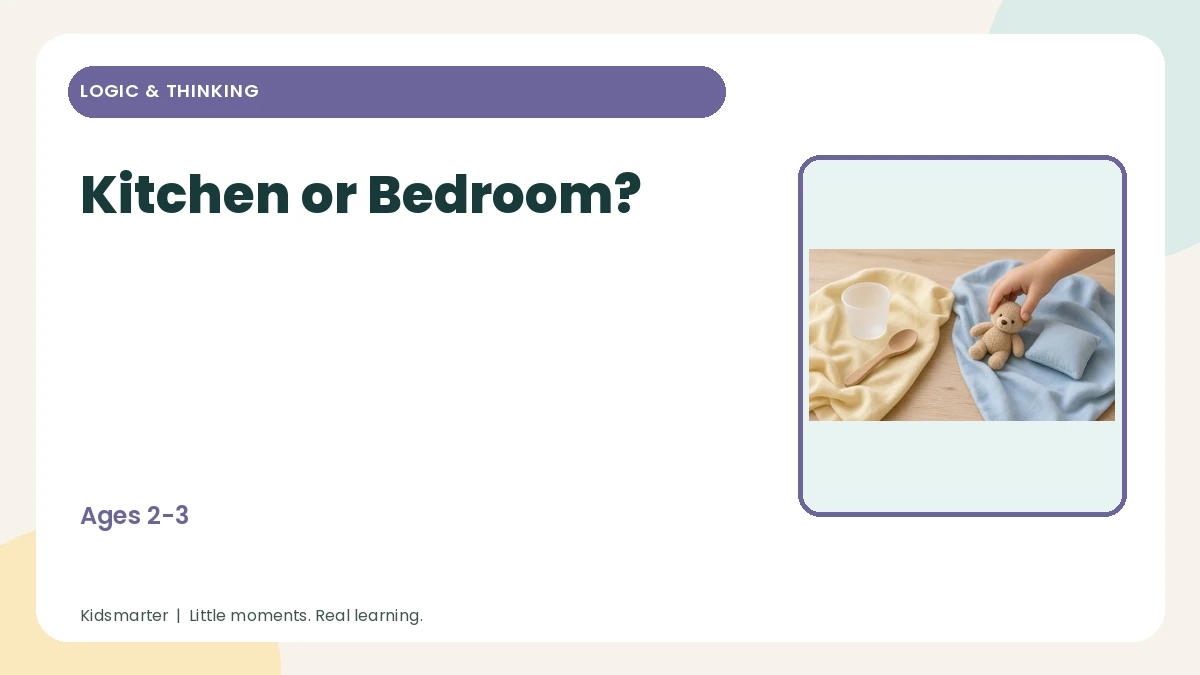
- Two clear places on a table, such as two cloths, two trays, or just a left side and a right side
- Two or three familiar kitchen objects, such as an unbreakable cup, a wooden spoon, or a plastic bowl
- Two or three familiar bedroom objects, such as a small pillow, a stuffed toy, a soft sock, or a folded pajama top
Choose objects that are too large to fit in a child’s mouth. Use unbreakable dishes, not glass. Skip medicines, cleaners, sharp tools, plastic bags, and anything with small parts that could come off. You do not need printed room labels, though you may say the words kitchen and bedroom as you point.
Step-by-Step How to Play
-
Set out the two places and name them: “This side is the kitchen. This side is the bedroom.” Place one clear example in each place, such as a cup in the kitchen and a pillow in the bedroom.
-
Hold up one more object and say, “This is a spoon. Does it belong in the kitchen or the bedroom?” Invite your child to place it. A point, a carry, or a word all count.
-
If they place it in the other group, name what they chose and try again, or model once: “We use a spoon in the kitchen.” There is no score.
-
Sort the remaining objects if your child still wants a turn, then stop. Two or three placements can be a complete game. When you are finished, put the objects away together, or carry them back to the real rooms if that is easy and safe to do.
Small Details That Make This Activity Work
Start with objects that have a clear home in your house, not with things that live in several rooms. Keep the groups to two rooms at first. If your child wants to play with the stuffed toy instead of sorting, you can name where it belongs and stop, or try one more object later. This is not laundry color sort, not animals or vehicles, not “what does not belong on the tray,” and not go-together pairs: the rule is the room where the thing usually lives.
Why This Activity Helps
Putting things into groups is one everyday way to notice how objects are related. NAEYC’s family math-talk guidance includes sorting and classifying, and it gives a daily-life example of separating clothes by color. This game uses a different grouping rule—the room a familiar object belongs in—and it has not been evaluated as a thinking or school-readiness program. Finishing a few placements is not a developmental test, and children may enjoy carrying familiar objects without explaining the rule.
Easy Ways to Adapt by Age
Make It Simpler
Use only four objects, and keep one example already sitting in each place. You can sort together, hand over hand, and simply say kitchen or bedroom as you set each thing down.
Ready for a Challenge
Add one more room, such as the bathroom, with a clearly safe object like a dry washcloth, or walk to the real kitchen to put the cup away after you sort. Stop if the extra room or the walking turns the game into a hunt you cannot stay with, and never bring cleaners, medicines, or sharp tools into the game.
Parent Tip & Safety Note
Stay at the table. Use unbreakable cups and bowls, and keep objects too large to swallow. Do not use glass, cleaners, medicines, plastic bags, or small loose parts. If a stuffed toy has loose eyes or buttons, choose a different object. When you are finished, put everything back where it belongs so the game does not leave small items on the floor. Stop if your child is finished or wants to play with the objects in another way.
Explore more activities in this category or free printable games.
For everyday language about sorting and classifying, see NAEYC’s Math Talk With Infants and Toddlers. That page offers family conversation examples, such as separating clothes by color; it does not test this kitchen-or-bedroom game, and it does not treat sorting by room as a developmental screening.