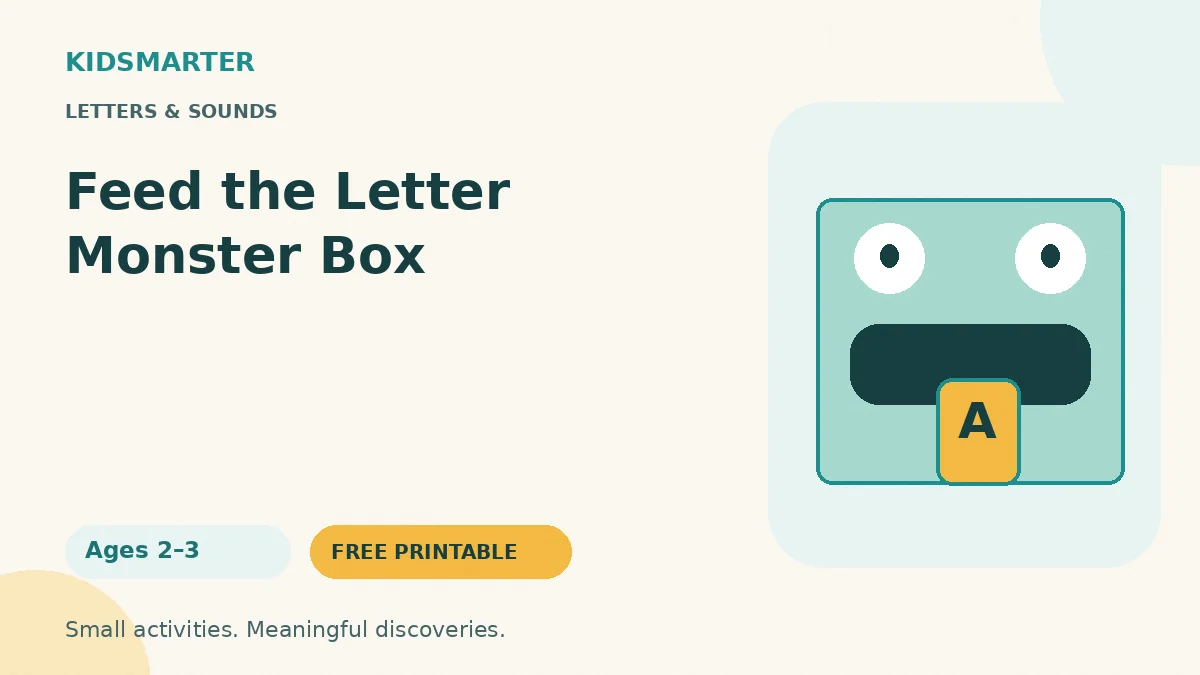
Feed the Letter Monster Box
Quick Activity Snapshot
- Age Range: Ages 2–3
- Prep Time: 10 minutes
- Skills: Letter recognition and posting cards
- Materials: An adult-prepared tissue box without plastic film, A thick marker, adult-managed, Large printed paper letter cards
Age ranges are suggestions, not developmental milestones or standards. Choose the setup for this child, and stop whenever needed.
A cardboard monster can make letter practice feel like feeding a funny pet. The secret is to give it a very small menu: one target letter and a few clear choices, not the whole alphabet. Your child selects a card, names it with your help, and posts it through the mouth. Once the box is built, a round takes only a few minutes and can end with the monster politely burping its cards back out.
Materials You’ll Need
- An adult-prepared tissue box without plastic film
- A thick marker, adult-managed
- Large printed paper letter cards
Use an empty tissue box, a thick marker, and large paper letter cards. The included printable has 12 uppercase cards: three A, four B, three C, and two D. An adult cuts the cards and prepares the mouth. Start with A and B only, using one card as the menu. Draw eyes straight onto the box instead of gluing on small craft eyes. Keep the design sturdy enough to survive enthusiastic feeding.
Step-by-Step How to Play
-
Remove any plastic film from a tissue opening and check the inside for rough edges. If using a cereal box, an adult cuts a wide mouth before the child joins. Fold sharp cardboard edges inward and cover them with tape. Draw a friendly face, then announce, "Our monster is hungry for A today." Place one large A card above the mouth as its menu.
-
Lay out two A cards and one B card, face up and well separated. Show an A beside the menu: "These match. They both have two sloping lines and a line across." Feed that card slowly. Leave enough card above the mouth for your child to see what happens, then let it drop. There is no need to rehearse every letter name first.
-
Invite your child to choose the next snack: "Can you find another card like the menu?" If they choose B, let the monster say, "That is B. I'm looking for A this time." Compare the shapes without making a loud rejection sound. Return both choices to the table. A toddler can feed any card after you name it if matching feels too demanding.
-
Open the back or bottom of the box and let the cards tumble onto a tray. Count the A cards together only if counting adds enjoyment. Change roles so your child holds the menu and you deliberately offer the wrong letter once. Ask, "Does this belong on today's menu?" Give them time to point, laugh, or show you the matching card.
-
Repeat with a new menu on another day rather than switching every thirty seconds. Keep each round to three or four successful feeds. Store the dry cards flat in a large envelope away from younger siblings. A brief ending ritual, such as the monster saying "Thank you for my A snacks," helps the child know the game is finished without demanding one more correct response.
Why This Activity Helps
Matching a printed target with another example encourages attention to letter features. Sliding a large card through a slot adds a manageable hand-and-eye coordination task and a clear physical result. Neither activity requires early reading. When you name the letter during shared play, the child hears a label attached to the shape. Accuracy can fluctuate with fatigue, so this game is practice and conversation rather than an assessment.
Easy Ways to Adapt by Age
Make It Easier: Offer only two identical A cards and let the child feed both. Enlarge the mouth and use firmer cardstock so a floppy card does not become the main obstacle. A child who cannot yet compare letters can enjoy posting plain cards while you say one letter name naturally. Keep hands free instead of guiding their wrist into position.
Add a Challenge: Offer three known letters, or introduce the lowercase partner of a familiar uppercase target. Explain the new rule explicitly: "Big A and little a can both go in." Avoid mixing case until the original matching game feels easy. An older child might draw tomorrow's menu and tell a sibling which cards the monster wants to eat.
Free Printable Included
Print this activity-specific pack on Letter paper at actual size. An adult cuts the 12 large cards; start with only A and B.
Parent Tip & Safety Note
Adults handle blades, scissors, tape dispensers, and any box repairs. Supervise children under three closely around cards, scraps, and detached decorations; replace wet or chewed paper immediately. Use large paper cards rather than small magnetic letters. Never let a child put their head into the box, and keep the opening wide enough that fingers slide freely without catching.