Salt-Free Tray Letter Paths
Quick Activity Snapshot
- Age Range
- Ages 3–4
- Prep Time
- 5 minutes
- Skills Practiced
- Finger-tracing letter paths
- Materials
- An empty shallow tray or plain paper, Large printed letter cards, A thick washable crayon (optional)
Age ranges are suggestions, not developmental milestones or standards. Choose the setup for this child, and stop whenever needed.
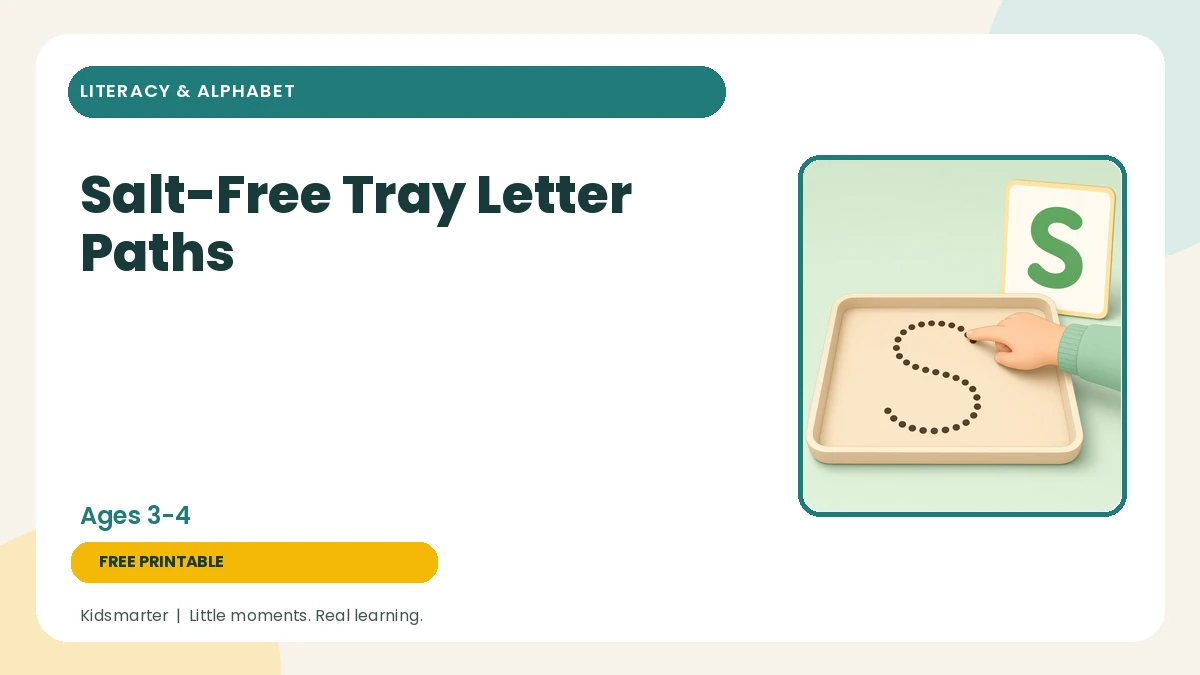
A finger can explore a letter path without a tray of loose grains. In this salt-free version, use the empty tray for large movements and the printed card as a visible model. Add a crayon on plain paper if your child wants a lasting mark. A gentle reset is still possible simply by beginning another finger journey.
Materials You’ll Need
- An empty shallow tray or plain paper
- Large printed letter cards
- A thick washable crayon (optional)
Use an empty tray on a nonslip towel, with the letter model beside it. Do not add salt, raw flour, cornmeal, sand, or other loose fillers. Print the letter cards and choose L or T first. The activity works without a visible mark in the tray; paper and crayon are an optional second surface.
Step-by-Step How to Play
-
Explore straight paths first. Draw a road down the tray, then another across it. Say, “My finger starts here and travels down.” Let your child sweep a flat hand across the empty tray.
-
Stand a single letter card above the tray. Trace its model once while describing direction. For L, say, “Start at the top, go down, then across.” Avoid asking for a whole alphabet at once.
-
Invite one finger to make the path across the empty tray. Watch the movement rather than the final appearance. If the child starts elsewhere, demonstrate again alongside their mark without physically steering their hand.
-
Begin again at the model without shaking the tray. Take turns choosing a card, keeping L available for repeated attempts. Offer T, I, or O only if another letter is wanted, and say the chosen letter name during your demonstration.
-
End with a choice: follow the model again, invent a free road, or stop. Put any crayon marks on separate paper rather than on the tray. Store the cards flat and wipe the empty tray before it returns to ordinary household use.
Small Details That Make This Activity Work
Keep the letter model in the same orientation as the tray so your child is not also solving a rotation problem. A small drawn starting dot can show where your finger began, but it should remain a cue rather than a rule enforced after every attempt. Watch whether the difficulty is remembering the shape or following the movement. You can solve the first by keeping the card closer, and the second by using a wider empty tray. After a few attempts, invite a freely invented road; the difference between copying a model and making a design is worth naming clearly.
Why This Activity Helps
A visible model and a large finger movement let the child compare the letter shape with an action without also managing a pencil. The tray itself need not retain a mark. This is playful exploration, not a requirement to form accurate letters at three.
Easy Ways to Adapt by Age
Make It Simpler
Point along the letter on the card together. Skip the tray if transferring from picture to movement is confusing. No sensory filler or sealed plastic bag is needed, and watching a demonstration is a valid way to join.
Ready for a Challenge
Compare L and T, which both include a straight vertical line. Ask which also has a line across the top and which has one at the bottom. Do not imply their entire stroke sequence must be identical.
Parent Tip & Safety Note
Keep all grains and raw ingredients out of this version, especially for a child who mouths materials. Adults manage marker caps and torn paper pieces. The card and empty tray provide the same copying invitation without edible-looking filler, dust, or a bag that could open.
Explore more activities in this category or free printable games.