Story Retell With Three Picture Cards
Quick Activity Snapshot
- Age Range
- Ages 4–5
- Prep Time
- 5 minutes
- Skills Built
- Story sequence and oral language
- Materials
- A familiar picture book or the sample seed story, Three blank or printed scene cards, A crayon
If your child closes a book and says, ‘Again!’, you already have the perfect starting point for retelling. Instead of asking for a detailed report, give the story three little picture stops. A beginning, a problem or important event, and an ending are enough. This is conversation beside a familiar book, not a memory test. Your child can point, act, draw, or use a home language while you help connect the events with a few useful words.
Materials You’ll Need
- A familiar picture book (optional when using the sample seed story)
- Three index cards or printed scene cards
- A crayon
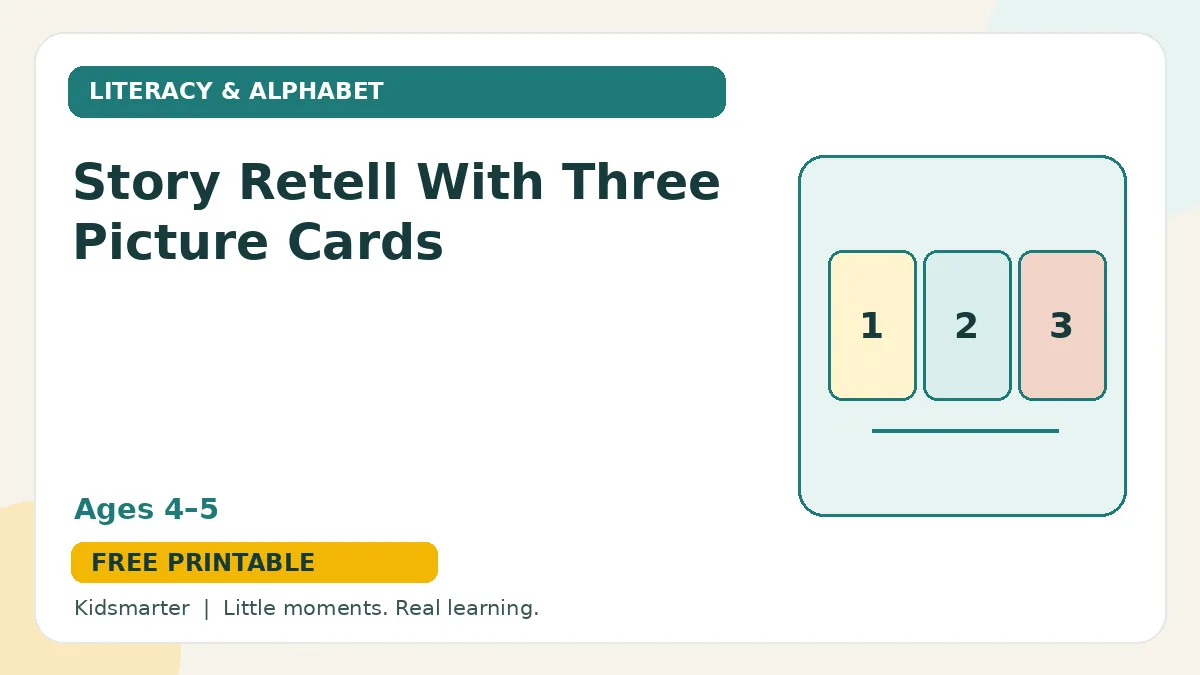
Choose one route. For a familiar book, use the printable’s three blank cards and draw events from that book. The printed seed, sprout, and flower cards are a separate sample mini-story, not pictures from whichever book you happen to choose. For that route, an adult reads the sample captions first; the simple drawings do not show every action. The three scenes stand for different times, not a flower appearing after one quick watering.
Step-by-Step How to Play
-
For the book route, read the chosen story without stopping at every page for questions. Ask which part your child wants to tell you about. For the seed route, skip the unrelated book and tell the three-caption mini-story once: a child plants a seed, waters the sprout later, and eventually sees a flower. Say which route you are playing before you put out the cards.
-
For the book route, choose three events and draw them in the blank boxes, with you drawing while the child dictates if needed. For the sample route, use only the three illustrated seed cards. Ask, “What could we add to show watering?” if the middle drawing alone does not communicate its caption. Do not require copying the printed sentences or reading the labels before retelling.
-
Put the three selected cards in a left-to-right row. Ask which event starts this particular story. For a book, return to the relevant pages to check; for the seed mini-story, refer back to the captions you read together. If your child invents a different sequence, distinguish “our new story” from “the story we just read” rather than treating invention as a memory error.
-
Touch each card as your child tells its part. Offer ‘First…’, ‘Then…’, and ‘At the end…’ only when helpful. Expand a short response naturally: if they say ‘Water,’ answer, ‘Yes, then she watered the little sprout.’ Leave space for them to add or change your words.
-
Invite a toy or another family member to be the audience. Your child can hold up each card as they speak or ask you to tell it together. Finish by returning one card to the matching book page. This shows that the quick retelling stands for a much richer story.
Small Details That Make This Activity Work
Keep the cards inside the book for a second visit later in the week. Listen for a new connection, a character’s feeling, or a more precise word rather than counting how many details were remembered. A fresh detail often matters more than repeating your exact version.
Why This Activity Helps
Retelling involves choosing events and putting them in an order a listener can follow. With the cards visible, you can point back to an event instead of repeatedly asking the child to remember your words. Sequence labels such as first and then name the order you are discussing. They are not a template every plot must fit: a circular story or several parallel adventures may be better enjoyed through conversation than forced into three boxes.
Easy Ways to Adapt by Age
Make It Simpler
Use two cards labeled first and last, or leave the book open while you retell together. Accept gestures and single words. Retell a familiar real event, such as making toast, if an invented story feels harder to remember.
Ready for a Challenge
Ask, ‘Why did that happen?’ at one turning point, or add a fourth card for a missing event. Let your child invent an alternative ending, clearly separating the book’s ending from their own new version so both can be enjoyed.
Parent Tip & Safety Note
Adults handle scissors and collect scraps before play. If a child mouths paper or a younger sibling joins, use the intact page with an adult pointing to the three boxes; no loose cards are necessary. A child may tell only one part, point, or use a home language. Another reading is never a reward that depends on completing a retelling.
The age range above is a suggested starting point for this setup, not a developmental milestone or a standard your child must meet. Save the three cards with the book so you can retell the same story another day, and let pointing or a home language stand in for a full spoken summary.
Find another small invitation to play in Literacy & Alphabet, or explore our free printable games. Choose one that fits your child’s interests, available materials, and energy today.
Reading Rockets describes beginning–middle–end story maps. Its broader teaching guidance does not test these three original seed pictures or set a requirement for four-year-olds.