House Shape Hunt
Quick Activity Snapshot
- Age Range: Ages 2–3
- Prep Time: 3 minutes
- Skills: Shape recognition
- Materials: Your home, A paper with a circle, square, and triangle drawn on it
Age ranges are suggestions, not developmental milestones or standards. Choose the setup for this child, and stop whenever needed.
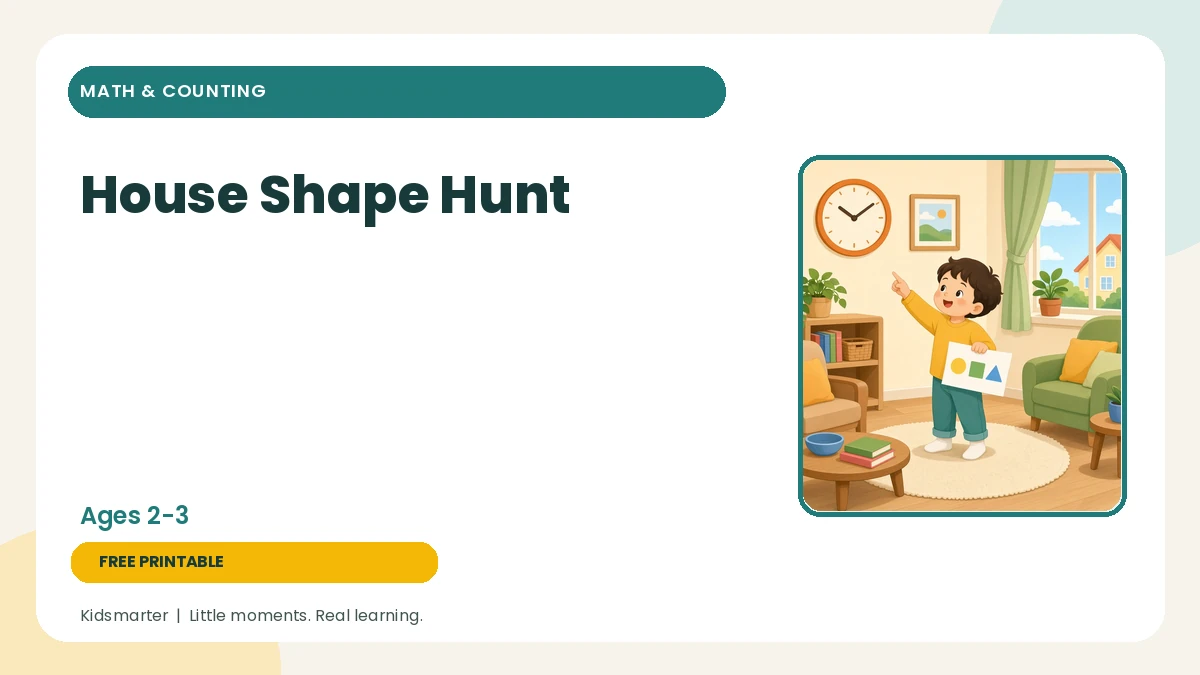
A clock face, a tile, and the end of a toy block can turn a familiar room into a shape museum. The aim is to notice flat outlines on real objects, not to label every three-dimensional object as a two-dimensional shape. Your toddler can point, touch safe surfaces, and make a mark on a simple hunt sheet. One room and three discoveries are plenty for a first outing, especially if your child wants to talk about what each object does.
Materials You’ll Need
- Your home
- A paper with a circle, square, and triangle drawn on it
Draw a large circle, square, and triangle, or use the whole checklist. The sheet has one checkbox and a drawing line for each shape; nothing needs cutting. Scout one reachable area while your child waits. Choose intact, unbreakable surfaces to look at, not small objects to collect. Leave loose caps, little blocks, glass, outlets, hot surfaces, and anything reached by climbing out of the hunt. An adult can hold a whole crayon for recording if your child puts drawing materials in their mouth.
Step-by-Step How to Play
-
Sit together and trace each example with a finger. Say, “A circle curves all the way around. A triangle has three straight sides that meet.” For the square, add, “Four equal sides and four corners like this book’s corners.” Point to the corners rather than expecting your toddler to repeat a definition. Choose one target and fold the other rows underneath if needed.
-
Walk to a safe round object you noticed earlier. Point to its flat face: "The front of this clock looks like our circle." Trace an imaginary outline in the air without lifting a heavy object. Invite your child to compare it with the picture. Ask, "Does it go round, or does it have corners?" Accept a gesture as an answer.
-
Make a mark beside the circle on the checklist. Your toddler can scribble, draw a line, or ask you to write "clock." The mark simply records a discovery. Look for a second circle only if they are eager, and point out that the round lid and clock face can share an outline despite different sizes. Avoid requiring the objects to match the printed circle exactly.
-
Switch to square or triangle within the same small area. If your child finds an oblong rectangle, say, “This rectangle has two longer sides. Our square has four equal sides.” Compare the corner shapes too. A square is a special rectangle, so avoid teaching that the names are opposites. Rotate the printed triangle and notice that three meeting sides remain three, even when the point faces sideways.
-
Return to the sheet and look at your marks. Ask, “Which shape did we notice?” If you found no triangle, leave its box blank and trace the printed triangle together. There is no need to produce a small triangular block or search a harder-to-reach place to finish. Let your child show one discovery to a family member if they want to.
Why This Activity Helps
Comparing the printed example with a real surface gives words such as side, corner, and round something visible to refer to. The same outline can appear on objects of different sizes and uses. Your toddler may begin with “round like a wheel”; you can echo that observation and supply a shape name without turning the walk into a naming quiz.
Easy Ways to Adapt by Age
Make It Easier: Offer only circle hunts and place two safe round objects where the child can reach them. Hold the paper beside the object for a direct comparison. Instead of carrying a crayon, take a mental note together and make marks afterward. A seated tabletop hunt works well when walking and managing a sheet at once is too complicated.
Add a Challenge: Invite an older preschooler to find the same shape in two orientations or to explain why a door is not a square. Trace a flat object on scrap paper and compare the outline with the hunt card. Separate "solid object" from "flat face" by exploring which face of a box resembles a square or rectangle.
Free Printable Included
Print this activity-specific pack on Letter paper. An adult prepares any cut pieces; use the activity directions above.
Parent Tip & Safety Note
An adult chooses what can be touched and keeps the search on a clear, level route. Leave the sheet whole and keep loose caps and broken crayon pieces put away. Look or point instead of handling anything unsuitable. Print size does not affect the shape answers: this is an outline hunt, not a ruler or a requirement to fill all three boxes.