Stick-and-Play Shape Builders
Quick Activity Snapshot
- Age Range
- Ages 3–4
- Prep Time
- 8 minutes
- Skills Practiced
- Building shapes
- Materials
- Broad paper strips prepared by an adult, or intact blunt sticks for building beside the cards, The whole printed shape-card page, A flat work surface
Age ranges are suggestions, not developmental milestones or standards. Choose the setup for this child, and stop whenever needed.
Three straight sides can close a triangle; four equal sides with square corners make a square. Turn that square and it stays a square. Push its corners out of shape and you have changed the shape, not merely turned it. Broad paper strips let children try both actions on a flat surface without pointed tools or tiny connectors.
Materials You’ll Need
- Broad paper strips prepared by an adult, or intact blunt sticks for building beside the cards
- The whole printed shape-card page
- A flat work surface
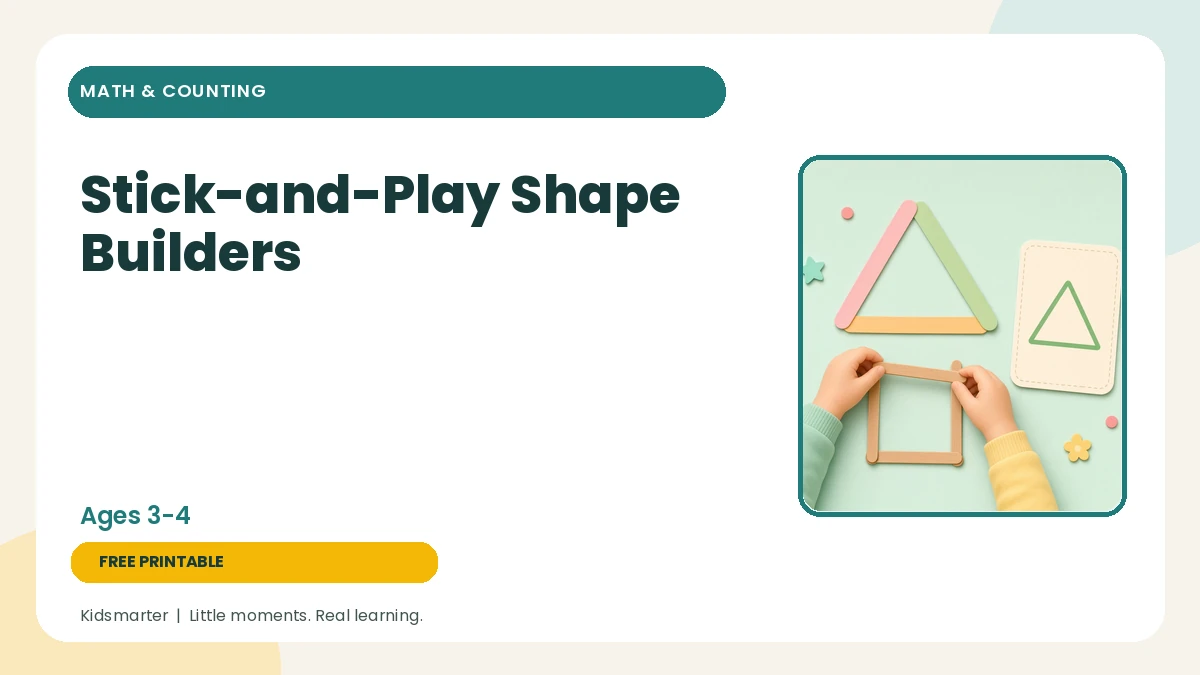
The PDF has four panels: two triangles, one square, and one oblong rectangle. Use it whole as a reference. The printed triangle and square do not have equal side lengths to each other. Either build beside the page with your own equal-length strips, or let an adult prepare separate sets that fit each outline. Keep the broad strips flat; no joins or glue are needed. If loose paper would be mouthed, leave the strips put away and trace the complete printed outlines together.
Step-by-Step How to Play
-
Lay out three equal-length strips beside either triangle panel. Point along one printed side and place a strip in the same direction on the table. Say, “Our sides need to meet so the path closes.” If using the printout as a tracing guide, use the separate strips the adult matched to that outline.
-
Invite your child to position the other two sides with the ends meeting. They may overlap a little at the corners; follow the middle of each broad strip to see the intended outline. Count three sides, touching each once, then point to the three meeting places. Leave the model flat instead of trying to lift or fasten it.
-
Build a square with four equal strips and corners like the corner of the printed page. Turn the whole arrangement carefully, keeping its corners unchanged. Then push one corner sideways so the corners are no longer square. Say, “Now these corners changed.” Four equal sides alone do not make every arrangement a square.
-
Rotate the triangle card and the finished model together. Ask whether it is still a triangle when the point faces sideways. Show that turning a shape does not change its number of straight sides.
-
Photograph or draw the favorite construction before dismantling it. Invite one free invention with leftover sticks, describing open paths honestly rather than calling every arrangement a closed shape.
Small Details That Make This Activity Work
Compare a closed triangle with three sticks that almost meet. Ask what would happen if a tiny pretend animal followed the edge: could it travel all the way around without crossing a gap? This gives closed a concrete meaning without requiring a formal definition. Sticks can represent sides but cannot make a true curved circle, so name an attempted many-sided ring honestly. You can admire the construction while explaining that its edges are still straight. After the game, leave a drawing of one construction beside the dismantled pieces if your child wants to rebuild it; a visible model offers a fresh spatial challenge.
Why This Activity Helps
Constructing and rotating shapes supports attention to defining features rather than a single familiar appearance. Counting sides and corners introduces precise mathematical language. A bendy model also offers an honest reason to discuss which features stay constant and which change.
Easy Ways to Adapt by Age
Make It Simpler
Offer a partly built triangle with one side left to place. If positioning strips is frustrating, the adult can draw two sides and invite your child to point where the last line should go. An adult completes the line; there are no adhesive blobs or cut pieces to handle.
Ready for a Challenge
Build a rectangle with two long and two short strips. Compare it with the square without saying a square is not a rectangle; both have four right-angle corners.
Parent Tip & Safety Note
Use no toothpicks, pretzels, marshmallows, cut straws, or tiny edible-looking connectors. Broad paper strips on a flat mat are the default. Adults prepare strips, inspect any sticks for splinters, and omit playdough if mouthing or ingredient sensitivities make it unsuitable.
Explore more activities in this category or free printable games.