Count the Doors We Pass
Quick Activity Snapshot
- Age Range
- Ages 3–4
- Prep Time
- 2 minutes
- Skills Practiced
- Counting the doors you pass as you walk slowly together
- Materials
- A familiar indoor hallway or rooms with a few doors, and an adult walking with the child
Age ranges are suggestions, not developmental milestones or standards. Choose the setup for this child, and stop whenever needed.
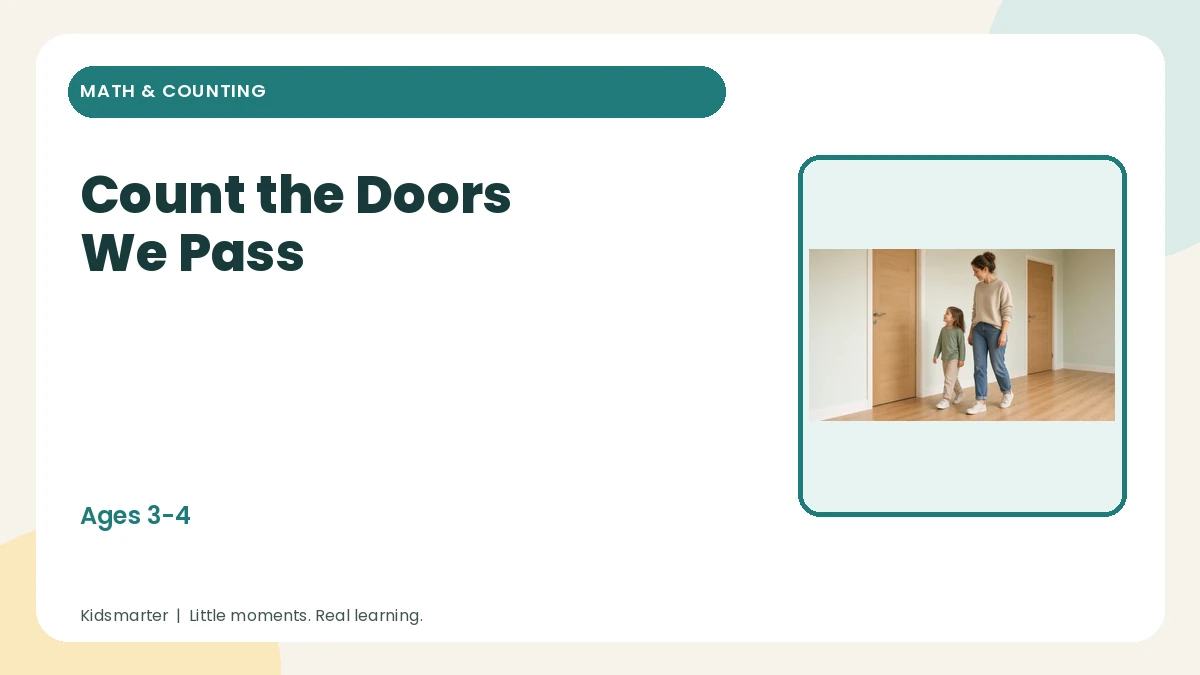
A slow walk through familiar rooms can become a short counting job. You walk together, and you count each door you pass. This is not lining blocks into a row of four, not measuring the room with footsteps, not making a group of three, and not packing objects into a box.
Materials You’ll Need
- A familiar indoor hallway or a few connected rooms in your home, with two or three doors you can pass safely
- An adult walking beside the child the entire time
Stay indoors for this game, and walk slowly. You do not need a worksheet or a number line. Do not turn the walk into a race, and do not send the child ahead alone.
Step-by-Step How to Play
-
Stand together at the start of a familiar hallway or room. Say, “We’ll walk slowly and count the doors we pass.”
-
Walk side by side. When you reach the first door, pause, point, and say, “One.” You may wait for your child to point or say the number with you.
-
Continue to the next door and count, “Two.” If there is a third door, count that one too. Then stop and say how many doors you passed, such as “We passed two doors.”
-
If they still want a turn, you may walk back and count the same doors once more. Two or three doors can be a complete walk. There is no required long route.
Small Details That Make This Activity Work
Count only the doors you actually pass, and keep the walk short so the count stays easy to hear. Pause at each door instead of counting while rushing. If they want only to open a familiar door, you can name it as one door and stop. This is not a line of four on a table, not first-second-third in a queue, not footstep measuring, not a hallway number-line hop, not a group of three, and not packing a box: the job is to count the doors you pass as you walk together.
Why This Activity Helps
Counting things you pass on a short walk is one everyday way to talk about “how many.” NAEYC’s family page Support Math Readiness Through Math Talk includes examples of counting things you notice while walking, such as light poles or cracks in a sidewalk. That page offers family examples of counting as you go; it does not evaluate this homemade door-counting walk, and counting the doors you pass is not evidence of later math achievement or of “math readiness.” Children may enjoy pointing to a door without saying the number.
Easy Ways to Adapt by Age
Make It Simpler
Count only one or two doors. You may say the number first, and invite your child to point to the door as you pass it.
Ready for a Challenge
After one short walk, you may walk back and ask, “How many doors did we pass this time?” Stop if the extra count starts to feel like a quiz. An optional second version, only with an adult holding the child’s hand, is to count two or three low indoor steps. Do not use a full staircase, and do not let the child climb alone.
Parent Tip & Safety Note
Stay beside your child the entire time. Walk slowly; do not run, and do not send the child ahead. Keep fingers clear of door gaps, and do not slam doors. Choose a route away from stairs if you can; if you must pass a stairway, an adult holds the child’s hand and you do not count the stairs as part of the main game unless you have chosen the optional low-step version, still with a hand held, and only a few low steps. Stay indoors, away from streets and driveways. Stop when your child is finished or wants to walk without counting.
Explore more activities in this category or free printable games.
For family examples of counting things you notice while walking, see NAEYC’s Support Math Readiness Through Math Talk. That page includes counting light poles or cracks in a sidewalk as you go; it does not test this homemade door-counting walk, and it does not treat counting the doors you pass as a developmental screening or as later math achievement.