A Question About This Picture
Quick Activity Snapshot
- Age Range
- Ages 3–4
- Prep Time
- 2 minutes
- Skills Practiced
- Asking a simple question about a picture and looking together for the answer
- Materials
- A familiar picture book or sturdy board book your family already shares
Age ranges are suggestions, not developmental milestones or standards. Choose the setup for this child, and stop whenever needed.
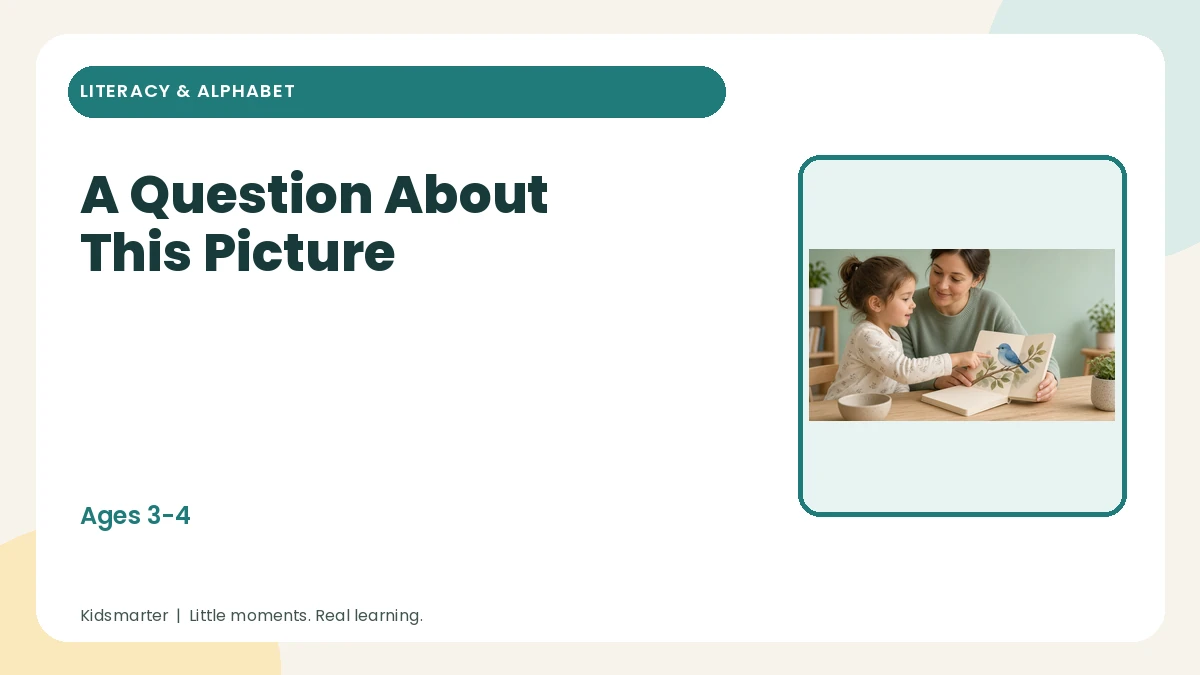
A familiar book can leave room for one simple question about a picture. You open a page you both can see, point to the illustration, and look together for the answer. This is not guessing what happens next, not lingering on a favorite picture, not a three-question cover walk, and not retelling the whole story with a set of cards.
Materials You’ll Need
- One familiar picture book or sturdy board book your family already shares, with no need to buy a new title
- A clear table, couch, or rug where you can sit together and both see the pages
Choose a book you already own. You do not need to copy any pages, and you do not need a printed worksheet. Stay with your child, and help turn the pages so they are not torn.
Step-by-Step How to Play
-
Sit so you can both see the book. Open it to a page with a clear picture and say, “Let’s look at this picture. I have one question.”
-
Point to the picture and ask one short question you can answer by looking, such as “Where is the bird?” or “What is the bird sitting on?”
-
Look at the picture together and find the answer. If your child points or names it, you can say what you both see. If they are quiet, you may point and say the answer yourself. This is not a quiz, and there is no score.
-
You may close the book, or turn to one more page if they still want a turn. One clear question can be a complete activity.
Small Details That Make This Activity Work
Keep the question something you can both see in the picture, not a guess about what will happen later. Use a book they already know, and stop after one or two questions so the time stays light. If they only want to turn pages, you can name one thing you see and stop. This is not a cover-clues book walk, not talking about a favorite picture, not pausing to guess what happens next, not finishing a familiar line, and not a three-card or four-card story retell: the job is to ask one simple question about a picture and find the answer together.
Why This Activity Helps
A short question about a picture is one everyday way to look closely at a book together. Reading Rockets’ page Use a PEER When You Read Aloud includes pointing to something in a picture and asking a simple question, such as “What is that?” That page describes a broader dialogic-reading reminder for parents; it does not evaluate this homemade one-question activity, and asking one question about a picture is not the full PEER method and is not evidence of later reading. Children may enjoy pointing to the picture without saying much.
Easy Ways to Adapt by Age
Make It Simpler
Ask a very clear pointing question, such as “Can you show me the bird?” and look together. You may do the pointing first, then invite your child to try.
Ready for a Challenge
After one easy question, you may ask one more about a smaller detail in the same picture. Stop if the extra question starts to feel like a quiz, or if they would rather just look.
Parent Tip & Safety Note
Stay together. Use a book you already own, and do not copy pages from a copyrighted book to make a new packet. Help turn the pages so they are not torn, and keep small or loose pieces of a damaged book out of mouths. Sit in a stable place, and do not balance the book where it could fall and hit anyone. Stop when your child is finished or wants to hear the story without questions.
Explore more activities in this category or free printable games.
For pointing to something in a picture and asking a simple question, see Reading Rockets’ Use a PEER When You Read Aloud. That page includes an example of pointing to a picture and asking “What is that?” as part of a broader dialogic-reading reminder; it does not evaluate this homemade one-question activity, and it does not treat asking one question about a picture as the full PEER method or as evidence of later reading.