Roll-and-Move Letter Path Game
Quick Activity Snapshot
- Age Range
- Ages 3–4
- Prep Time
- 3 minutes to print
- Skills Practiced
- Letter identification
- Materials
- Printed game board, a die, two tokens, and a crayon
Age ranges are suggestions, not developmental milestones or standards. Choose the setup for this child, and stop whenever needed.
A printable path gives toy travelers somewhere to go while letters appear along the way. The first version uses a die only to decide movement, not to turn every landing into a reading test. An adult may name the letter. Help with counting so the game stays playful and shared.
Materials You’ll Need
- Printed game board
- A die
- Two tokens
- A crayon
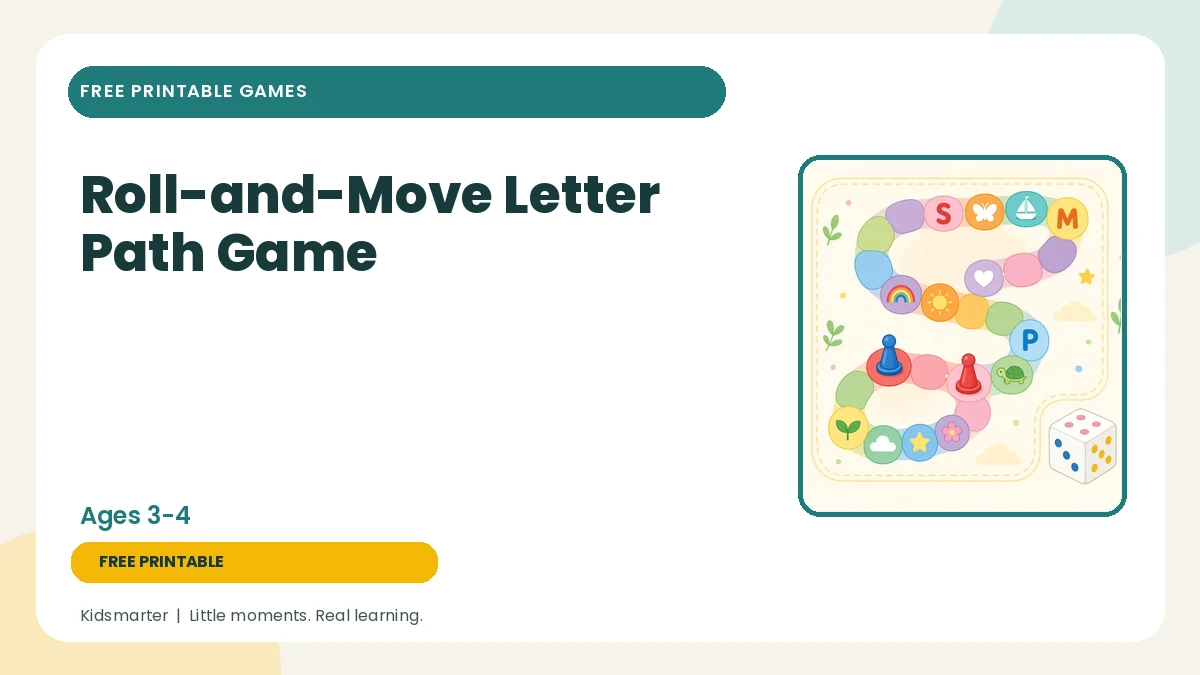
Print the board at actual size and place it flat. Use the whole page; no cutting is required. Choose two large tokens that cannot be swallowed, or a large block as the traveler. The path has a clear start, connected numbered spaces, and a finish; follow its arrows rather than jumping across neighboring rows.
Step-by-Step How to Play
-
Walk a finger along the full route with your child before playing. Name a few letters already familiar to them. Explain that tokens begin on START, before the first movement space.
-
Roll a die and move one space for each dot, touching each destination once. Count new spaces only, not the space the token already occupies. Model this slowly during your first turn.
-
Look at the letter on the landing space and say its name together. Your child may repeat it, trace it in the air, or simply hear you model. There is no lost turn for an unfamiliar letter.
-
Take turns rolling and moving. If a large roll makes counting hard, use only one, two, and three by agreeing to reroll higher numbers. Keep the same movement rule for both players.
-
Stop on FINISH even if the roll is larger than the remaining distance. Cheer both travelers home and ask which letter your child remembers seeing. Put the tokens away while the board can remain for another day.
Small Details That Make This Activity Work
Agree on the end rule before playing. Stopping at FINISH on an oversized final roll avoids a frustrating wait for an exact number. The path letters repeat deliberately, so encountering A again is another chance to notice the same form in a new location. A token on a space can cover its letter; move it slightly aside when discussing the landing. If moving along the serpentine route is difficult, trace its connecting arrows together before rolling again. You can also play cooperatively with one traveler, taking turns moving the same piece and reaching the finish together rather than racing.
Why This Activity Helps
The game combines counting one movement per dot with encounters with written letters and shared turn-taking. These tasks can compete for attention, so an adult may handle counting while the child notices letters. Landing on a symbol is an introduction, not evidence of reading ability.
Easy Ways to Adapt by Age
Make It Simpler
Skip the die and move exactly one space on each turn. Let an adult name the letter and use the same token together if two-player turn-taking is distracting.
Ready for a Challenge
Say a familiar sound for a landing letter or find an object beginning with it. Avoid insisting every letter has only one possible sound; use a simple example your child knows.
Parent Tip & Safety Note
Dice and small tokens are choking hazards. Use a large homemade paper die or an adult-operated die with large tokens, supervise directly, and keep pieces away from younger siblings. Do not laminate if it makes the board slippery.
Explore more activities in this category or free printable games.