Toy Shadow Match on the Wall
Quick Activity Snapshot
- Age Range
- Ages 3–4
- Prep Time
- 8 minutes
- Skills Practiced
- Visual matching and spatial reasoning
- Materials
- An adult-operated cool LED flashlight with a tool-secured battery compartment, Large sturdy toys with clear outlines, Printed matching sheet and a thick crayon
Age ranges are suggestions, not developmental milestones or standards. Choose the setup for this child, and stop whenever needed.
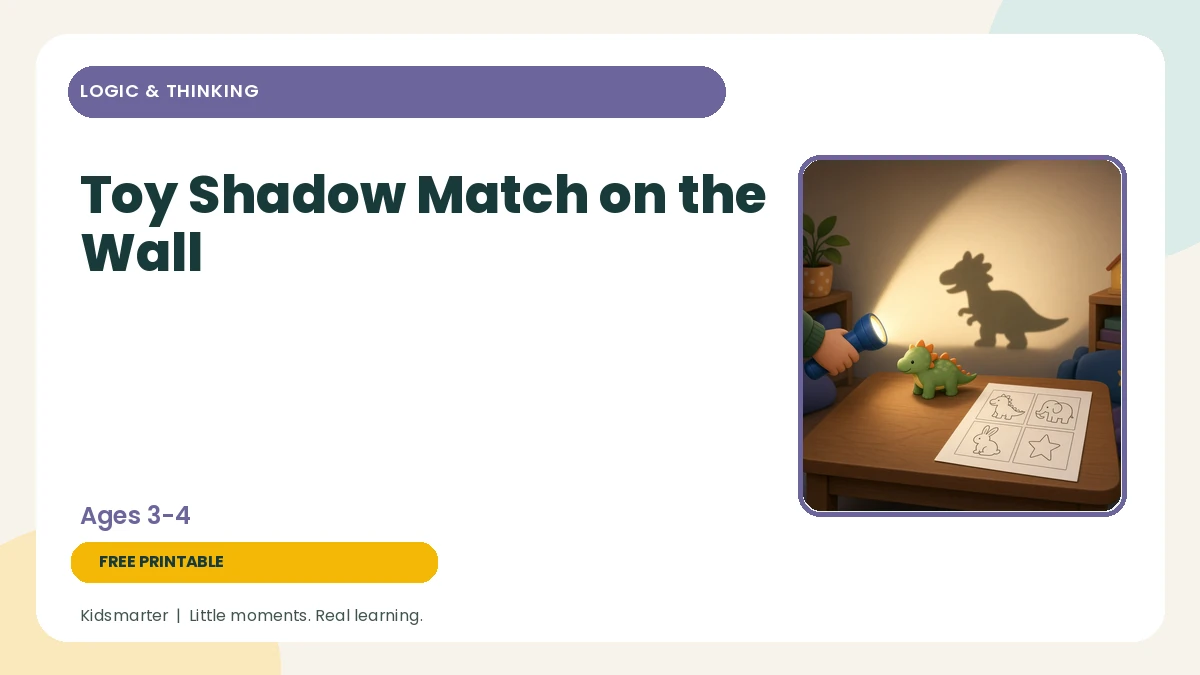
A dinosaur's shadow may be enormous while the toy itself fits in your hand. A wall and a flashlight let your child explore that surprise, then compare a few distinctive outlines. Start with familiar objects whose shapes differ clearly, not a difficult pile of similar animals.
Materials You’ll Need
- An adult-operated cool LED flashlight with a tool-secured battery compartment
- Large sturdy toys with clear outlines
- Printed matching sheet and a thick crayon
Choose two or three intact age-appropriate toys with distinct outlines, checking for loose wheels, decorations, or other detachable parts. An adult positions the cool LED light toward a blank wall while the child stays out of its beam. Keep enough room light to move safely. The separate two-page matching sheet shows a car, bear, block, and tree; no household toy has to match those drawings exactly. If powered equipment or toys are unsuitable, use the whole matching page only.
Step-by-Step How to Play
-
Hold one toy between the light and wall. Ask what your child notices before naming the shadow. Move the toy slightly while keeping the lamp still, showing that the dark outline follows it.
-
Invite your child to identify the toy from its outline. Reveal the actual object beside the shadow. Say, “The tail helped you decide,” connecting the guess to a visible feature rather than calling it clever.
-
With the wall and light fixed, move the same toy a little toward the light, then toward the wall. Compare the two shadows and describe what happened in this setup. Return to the starting position before changing the angle. Your fingers can make their own shadows, but keep them out of the beam when examining only the toy’s outline.
-
Rotate the toy slowly. Discuss how a side view may show a recognizable tail while a front view hides it. The same toy can produce quite different silhouettes, so an uncertain guess can be reasonable.
-
On page 1, point or draw lines between each object and its filled silhouette. The key on page 2 is car–C, bear–D, block–B, tree–A. These are shuffled drawings, not one matching pair in every horizontal row. Compare a distinctive edge rather than the row position. Finish with another paper match or one final adult-operated wall experiment.
Small Details That Make This Activity Work
The printed outline match uses simplified objects so every pair is deliberate and clear. A real toy may cast a different shape from the drawing, and that difference is an opportunity to explain viewpoint, not a flaw the child must ignore. Turn the live toy until a recognizable view appears, then compare its most distinctive feature with the printed silhouette. Avoid promising that a larger shadow always means an object is closer to the light without keeping the rest of the arrangement stable during your test. Change one distance at a time and describe only what your shared experiment actually shows.
Why This Activity Helps
Recognizing an object from an outline involves noticing shape while ignoring surface color and detail. Changing the light arrangement also creates an early cause-and-effect investigation. A shadow is a blocked-light region, not a separate object living on the wall.
Easy Ways to Adapt by Age
Make It Simpler
Use two strongly contrasting objects and keep their positions fixed. Let your child see both toy and shadow at once instead of requiring identification from memory.
Ready for a Challenge
Predict how a shadow will change before moving the toy, then check together. Trace two outlines on paper and compare what stayed similar across positions.
Parent Tip & Safety Note
Only the adult operates the cool LED light. Its battery compartment must be intact and secured with a tool; exclude button-cell novelty lights, loose batteries, lasers, candles, and hot bulbs. Keep cords out of reach and beams away from eyes. The child can use the paper matching sheet instead of any powered light.
Safety reference: CPSC battery safety.
Explore more activities in this category or free printable games.