Question-and-Clue Deduction Cards
Quick Activity Snapshot
- Age Range
- Ages 5–6
- Prep Time
- 5 minutes to print and cut
- Skills Practiced
- Asking questions and using clues
- Materials
- Printed clue cards and object cards, A small envelope
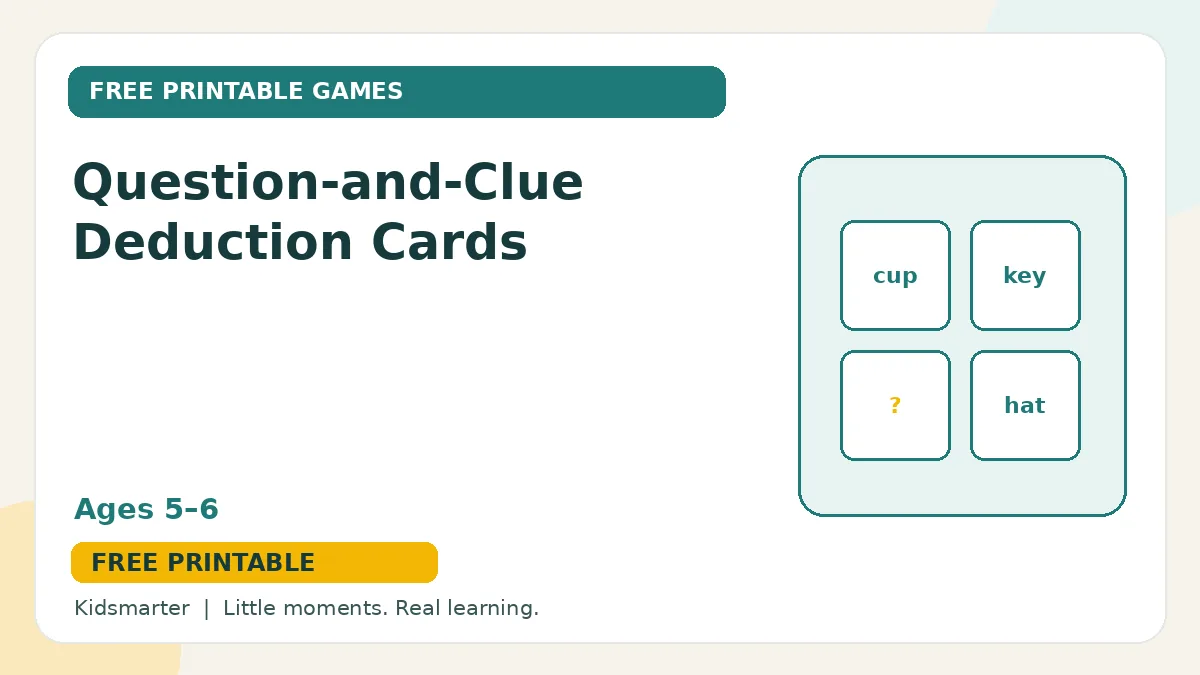
A pocket set of clue cards can turn waiting time into a short thinking game. One player draws a secret object card, then gives clues or answers questions until the other player can guess it. The useful work is choosing a helpful clue and listening for what it rules out. You will print and cut the cards, slip them into an envelope, and play one or two rounds that could later travel in a bag for a trip or an appointment.
Materials You’ll Need
- Printed clue cards and object cards
- A small envelope
Print the object cards and clue or question cards, cut them with adult help, and place them in a small envelope. Sit where you can hold a secret card without it being seen. Agree whether you will give clues, answer yes-or-no questions, or mix both in a simple way.
Step-by-Step How to Play
-
Show a sample object card, such as a cup, and give one model clue: ‘You use this at the table, and it can hold a drink.’ Let your child guess, then reveal the card so the connection between clue and object is clear.
-
Draw a new secret card and give two or three clues, starting with a broader one and then a narrower one. If your child guesses early, you may confirm or continue with one more clue. Keep the unused object cards face down so the set stays fair.
-
Switch to a question round if you like: your child asks yes-or-no questions, and you answer from the secret card. A prompt card can help, such as ‘Is it found in the kitchen?’ After several questions, invite a guess and then reveal.
-
Swap roles so your child holds the secret card and gives a clue. If a clue is very broad, you may ask for one more detail, but avoid taking over the turn. Celebrate a clear clue even when the first guess is not right.
-
Play one last quick card, then put the set back in its envelope. Talk about a clue that helped and a question that narrowed the choices. The envelope is the natural end of the game, and it is ready to come along another day.
Small Details That Make This Activity Work
If a clue is hard to use, model one clearer version rather than listing many rules. Leave the same small set in the envelope for a few days so your child can get better at both asking and describing, then rotate in one new object card.
Why This Activity Helps
Giving and using clues practices taking another person’s knowledge into account: what would help them narrow the options? Yes-or-no questions add a second way to gather information. A small, familiar set of object cards keeps the game fair and portable. The reveal should confirm the clues, not embarrass a wrong guess, and a mismatched clue is a reason to look at the card together and try a clearer sentence next time.
Easy Ways to Adapt by Age
Make It Simpler
Use only four very familiar object cards and have an adult give all the first clues. You can also place two objects on the table and hide a mark under the secret one, so each clue chooses between visible items. A child may guess after a single clue.
Ready for a Challenge
Add more object cards, or require two clues before any guess. Your child can write or dictate a new clue on a blank card for a household object. Keep the language concrete, and save tricky riddles for later.
Parent Tip & Safety Note
Adults should cut the cards and watch small pieces around children under three. Do not include pictures of medicines, sharp tools, or anything you would not want as a guessing object in a waiting room. Keep the envelope out of reach between games so cards are not scattered or mouthed.
The age range above is a suggested starting point for this setup, not a developmental milestone or a standard your child must meet. Give a fair clue or a yes-or-no answer, and reveal the secret card to check the information rather than to embarrass a guess.
Find another small invitation to play in Free Printable Games, or explore our free printable games. Choose one that fits your child’s interests, available materials, and energy today.