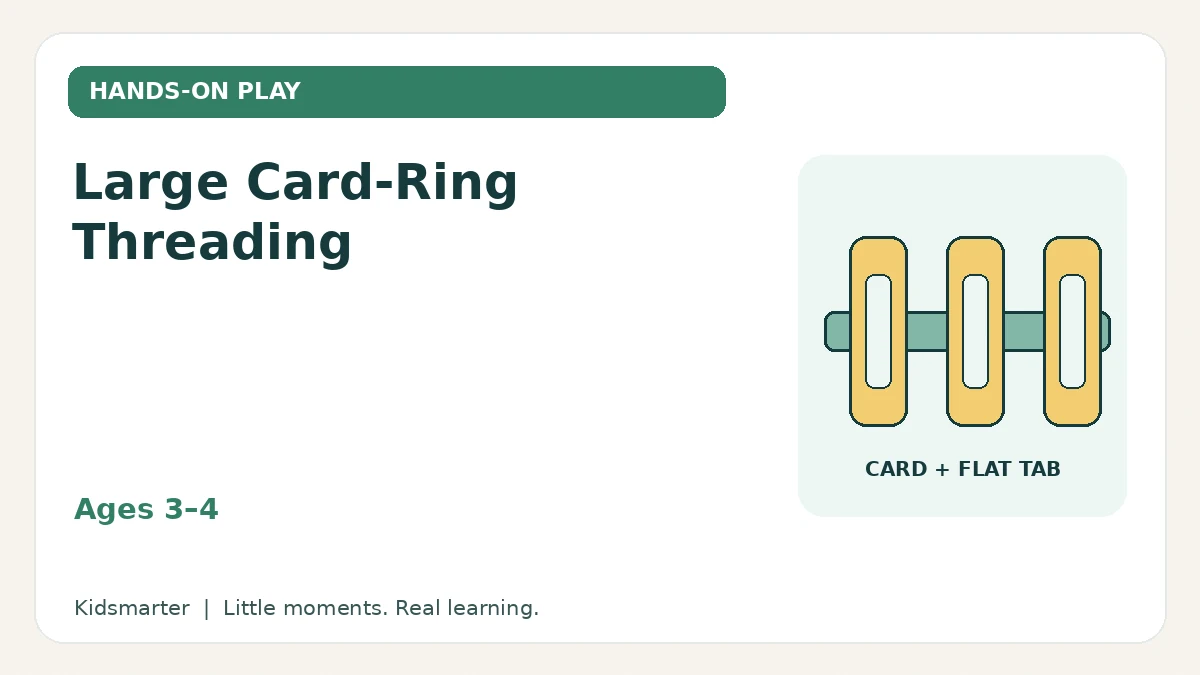
Large Card-Ring Threading
Quick Activity Snapshot
- Age Range
- Ages 3–4
- Prep Time
- 8 minutes
- Skills Practiced
- Steadying an opening and sliding a ring
- Materials
- Large adult-cut cardboard rings, a broad blunt cardboard tab or an age-appropriate stacking-ring toy, two shallow bowls
Age ranges are suggestions, not developmental milestones or standards. Choose the setup for this child, and stop whenever needed.
A large ring sliding onto a broad tab makes a visible success without a necklace, dry pasta, or a cord. This tabletop version keeps the useful two-hand action: one hand holds an opening steady while the other aims something through it. Offer only a few large rings and let the repeated push-and-slide movement carry the activity. There is no wearable product to finish.
Materials You’ll Need
- Large adult-cut cardboard rings
- A broad blunt cardboard tab, or an age-appropriate stacking-ring toy
- Two shallow bowls
An adult prepares broad card rings with smooth, generous openings and a short, wide tab with a rounded end. Use sturdy plain cardboard without staples or peeling layers. Test that every ring slides without catching. If the child mouths card or the homemade pieces cannot remain intact, use a commercially made age-appropriate stacking-ring toy instead. No lace, yarn, pasta, beads, or dowel is needed.
Step-by-Step How to Play
-
Put one large ring flat on the table and show its opening. Hold the broad tab close to that opening and say, “This end can travel through this space.” Let your child examine both pieces before anything is threaded. Name the opening rather than asking the child to aim quickly.
-
Push the rounded tab through your ring slowly until it emerges on the other side. Say, “In, through, and slide.” Keep the pieces close to the tabletop so a dropped ring does not require a search. Demonstrate only once before offering a turn; more explanation may hide the simple action.
-
Invite your child to hold a ring while you steady the tab. Switch roles if aiming the tab is more appealing than holding the opening. Let the child use both hands on one piece if needed. The task can be shared rather than requiring an independent, adult-looking grip.
-
Offer two more rings and leave the first visible as a model. The child can thread, slide, remove, and thread again. If a piece jams, separate it and inspect the fit together. Do not pull against the child’s hands or ask them to force a bent tab through a tight hole.
-
Place finished rings in a second bowl or slide them off one at a time. Ask whether the child wants another round before resetting. Check the table and floor for every piece, discard damaged cardboard, and store the tab and rings together away from younger siblings. Nothing is worn or looped around a toy or child.
Small Details That Make This Activity Work
Rest the ring on the table while aiming the tab. If it jams in every orientation, change the opening rather than asking for more force. A homemade fitting task should be solvable. If the tab buckles, reinforce or replace it before another turn.
Why This Activity Helps
The hands perform different but connected jobs: stabilizing an opening and directing an object through it. Looking at the emerging end provides feedback about alignment. This describes the movement practiced during play, not an evidence-based promise of stronger hands, better writing, or a general developmental gain.
Easy Ways to Adapt by Age
Make It Simpler
Use an age-appropriate stacking-ring toy with a broad stable base and large rings, following its instructions. An adult may start the ring while the child completes the slide. Work with only one ring if the bowl of choices distracts from finding the opening.
Ready for a Challenge
Compare two large rings with different hole widths and predict which will slide more easily over the same tab. Test the fit gently, then change the tab’s orientation. Keep all pieces broad and intact; making the rings smaller adds risk rather than a necessary learning challenge.
Parent Tip & Safety Note
Adults prepare and inspect all homemade cardboard. Do not use cords, necklace loops, brittle pasta, sharp dowels, or small rings in this setup. Stay beside the child, and stop using homemade card if it is mouthed, torn, damp, or shedding. Store every piece after play. Supervision does not make chewed scraps suitable; switch to a large stacking-ring toy if mouthing starts.
Explore more activities in this category or free printable games.