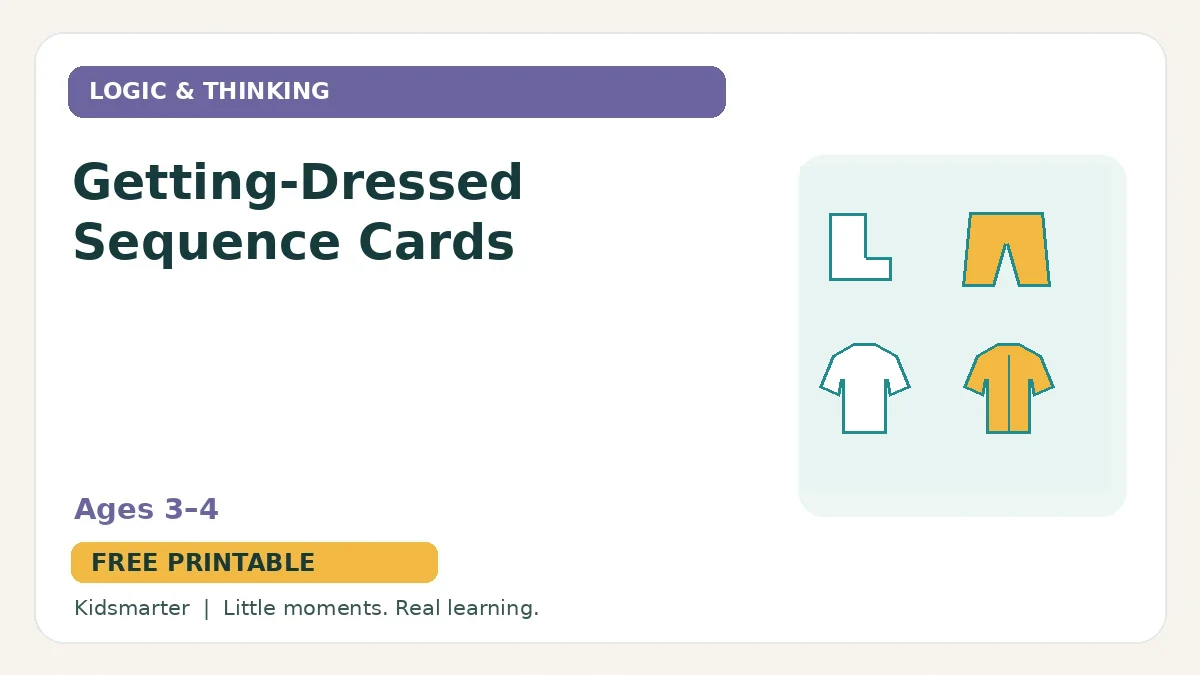
Getting-Dressed Sequence Cards
Quick Activity Snapshot
- Age Range
- Ages 3–4
- Prep Time
- 8 minutes
- Skills Practiced
- Sequencing everyday events
- Materials
- The four-picture clothing page: sock, pants, shirt, coat, Optional whole paper and a crayon for an adult-drawn plan
Age ranges are suggestions, not developmental milestones or standards. Choose the setup for this child, and stop whenever needed.
Getting dressed is a sequence, but not every clothing choice has one compulsory order. These picture cards help a preschooler plan a familiar routine and explain useful relationships, such as socks before shoes. Leave room for the way your household actually gets ready.
Materials You’ll Need
- The four-picture clothing page: sock, pants, shirt, coat
- Optional whole paper and a crayon for an adult-drawn plan
The page shows sock, pants, shirt, and coat, with no numbered “correct” order. Keep it whole and point to pictures as you discuss a plan. If loose cards are appropriate, an adult may prepare the four cards away from the child and collect scraps. No real clothes or doll accessories are required. A shoes drawing can be added later; shoes are not in this PDF.
Step-by-Step How to Play
-
Name each picture and ask which items fit your day. A coat need not join a hot-weather plan. Point to the fabric area on your already-worn clothes if an example helps; do not ask a child to undress to identify a picture.
-
Show one possible plan by pointing: pants, shirt, sock, coat. If using prepared cards, you can lay that order out. Say, “This is one way we could get ready.” A shirt and socks can often switch places, while a coat usually goes over a shirt.
-
Invite your child to choose an order. With loose cards, arrange them; with the whole page, point to first, next, and last while an adult sketches the chosen sequence on a fresh strip. Ask, “What would go over the shirt?” Test a relationship with gestures rather than treating every clothing choice as having one compulsory order.
-
Pretend to put on each item over the clothes already being worn. Point to its picture, then mime that step. Prepared cards can move to a finished row; on the whole page, an adult can name the completed steps instead. Stop if the child does not want to act; talking through the pictures is enough.
-
Choose a place to keep the cards for tomorrow. Revise the order when weather or plans change. The goal is a useful planning aid, not a fixed routine that becomes a source of conflict.
Small Details That Make This Activity Work
The card pictures are prompts, not a universal dressing prescription. A family may put on socks before pants, and a child using different clothing or adaptive equipment may have a more useful sequence entirely. Replace or redraw cards to match the actual routine. Introduce first, next, and last while pointing to the current plan, then move a card when the plan changes. If a coat goes on before a shirt during doll play, explore the physical consequence gently rather than telling the child the order is silly. Useful dependencies become clearer when children can test them without pressure or embarrassment.
Why This Activity Helps
Sequencing connects individual actions with a larger goal and highlights dependencies between steps. Explaining a choice practices causal language. Flexible parts of a routine are worth acknowledging so children do not confuse an adult preference with an unavoidable logical rule.
Easy Ways to Adapt by Age
Make It Simpler
Use two pictures, such as shirt then coat, and act them out immediately. Offer a choice of which card to place first instead of asking for the whole routine.
Ready for a Challenge
Draw a shoes card and decide where it belongs. Ask which actions could switch places and which would become awkward, checking suggestions with real clothing rather than requiring verbal reasoning alone.
Parent Tip & Safety Note
Respect privacy and offer help without rushing or shaming. Adults handle optional scissors and collect scraps. Keep real drawstrings, loose buttons, and doll accessories out of the activity. Do not photograph a child changing clothes for a demonstration; non-identifying pictures of the cards are enough.
Explore more activities in this category or free printable games.