Hallway Number Line Hop
Quick Activity Snapshot
- Age Range
- Ages 5–6
- Prep Time
- 10 minutes
- Skills Built
- Number line and counting on
- Materials
- The revised two-page number-line pack, A fingertip for pointing below the ticks, Optional adult-prepared number displays beside a clear walking route
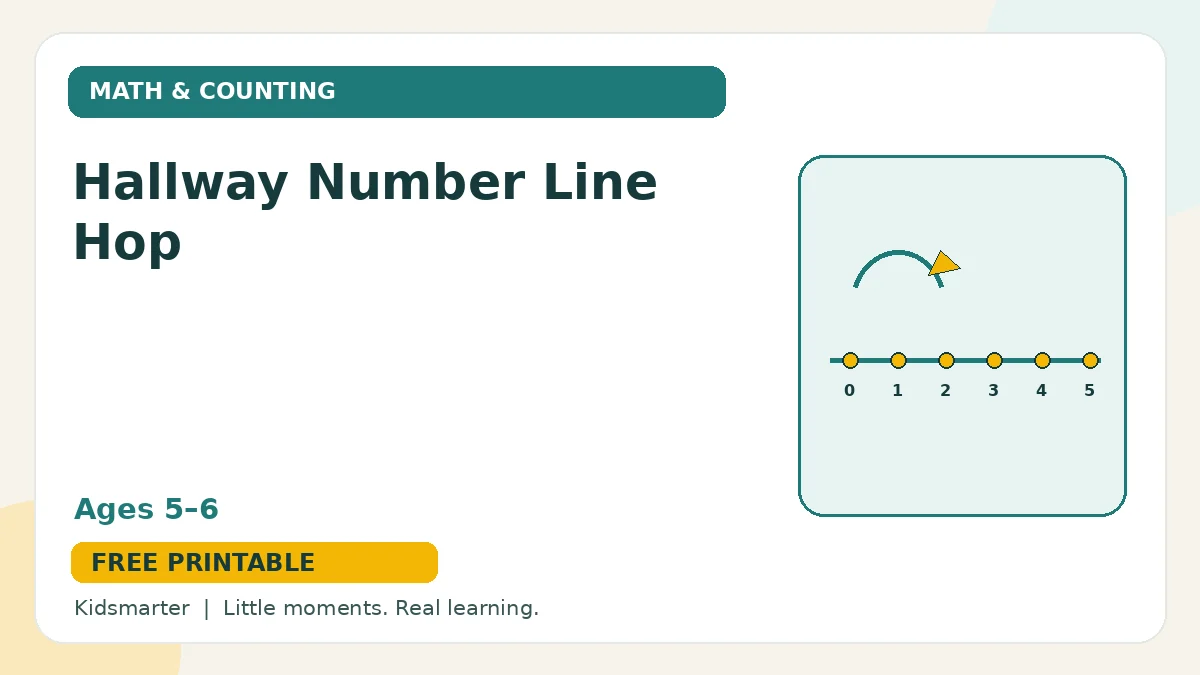
What happens when you start at four and move three places to the right? A number line lets you point to five, six, and seven in order. Begin on the tabletop strip, where you can see every move. A walking version is optional: displayed numbers stay beside the route, never underfoot, and there is no need to hop.
Materials You’ll Need
- The revised two-page number-line pack
- A fingertip for pointing below the ticks
- Optional adult-prepared number displays beside a clear walking route
Use page 1’s tabletop line from zero to twenty and begin with the zero-to-ten section. Point below a tick rather than placing a bulky token over several labels; tick spacing is 27 points at actual size. Page 2 provides starts zero to nine and moves one to six. An adult can select those on the intact page, so cutting is optional. For a walking version, display equally spaced numbers beside a clear, level route; put no paper on the footpath.
Step-by-Step How to Play
-
Trace the chosen section from zero upward with a fingertip below the ticks. Check the written order before starting. Ask, “Which comes after four?” and point to five. If using side displays for walking, keep their order and spacing clear, but count destinations rather than demanding a particular stride length.
-
Point below zero. Choose a move of two, then touch below one and two while saying “one move, two moves.” Zero is the starting position and is not counted as a move. Read the destination: two. No die is needed; an adult can call a move or choose one from page 2.
-
You can continue from the landing number, but choose only a move that fits the visible section. On zero to ten, nine plus two would need eleven: do not stop at ten and call it the answer. Choose a move of one instead, use a lower start, or switch to the full zero-to-twenty line. Stop and choose a new start when you reach the endpoint.
-
Point to four, then move three intervals: five, six, seven. Say, “Three moves from four land on seven.” The four you started on is not the first move. If you counted four, five, six, return to four and trace the three intervals slowly together.
-
Let your child choose a start and a move that fits. You can demonstrate a slow, accurate turn instead of deliberately making an error for them to catch. Finish by putting all displays away before the route returns to normal use.
Small Details That Make This Activity Work
The two-page pack offers different entry points. Use the long strip for tracking moves, the large numbered panels for naming and ordering, and the start/move page for choosing a new problem. Starts zero to nine plus moves one to six always fit on the full zero-to-twenty strip; a shorter strip needs the adult’s fit check first.
Why This Activity Helps
A number line displays numbers in order. Pointing from one tick to the next separates the starting position from each new move. Four followed by three new intervals ends at seven: this models adding three to four. Count and check the new intervals together rather than judging the result by how far a hand or body travelled.
Easy Ways to Adapt by Age
Make It Simpler
Use zero to five and moves of one or two, with an adult choosing combinations that fit. The child can point while the adult counts, or watch an adult trace each interval. If using a walking route, ordinary comfortable walking is enough; do not ask an unsteady child to balance heel to toe.
Ready for a Challenge
Extend the line to 20 once 0 to 10 is comfortable. Try hops of 4 or 5, or ask which landing is farther from 0: a start at 6 with two hops, or a start at 3 with three hops. Compare by looking at the cards, not by hurrying into written equations.
Parent Tip & Safety Note
Keep paper, loose tape, toys, and slippery rugs out of the walking surface. An adult prepares and removes any side displays. Use the seated tabletop version whenever space or balance is uncertain. Avoid stairs and climbing, and omit dice or loose markers when children who mouth objects are nearby.
The age range is a suggested invitation, not a developmental deadline. Keep the seated tabletop version whenever balance or space is uncertain.
Find another small invitation to play in Math & Counting, or explore our free printable games. Choose one that fits your child’s interests, available materials, and energy today.