Copy the Block Blueprint
Quick Activity Snapshot
- Age Range
- Ages 4–5
- Prep Time
- 8 minutes
- Skills Practiced
- Spatial reasoning and visual copying
- Materials
- Six equal square-faced large blocks or broad card squares, Printed top-down models with 3–6 visible squares
Age ranges are suggestions, not developmental milestones or standards. Choose the setup for this child, and stop whenever needed.
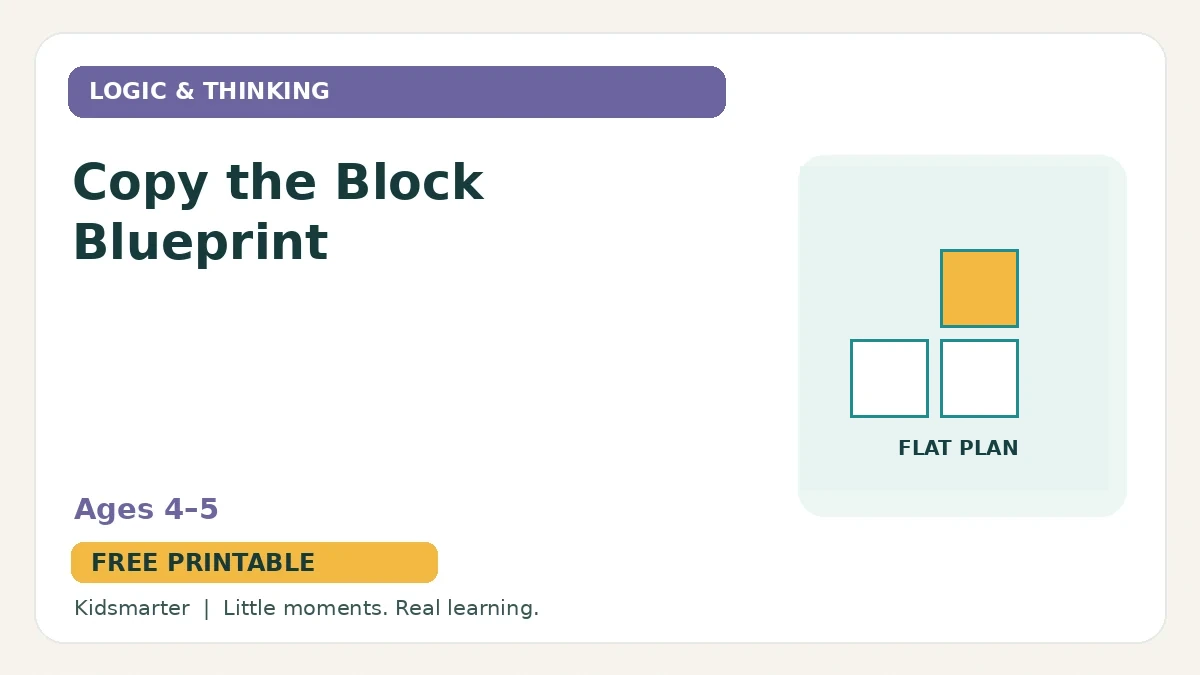
A block blueprint can be a flat picture to copy beside you. These four models show all their square units from above; a square higher on the page is not automatically a block stacked in the air. Begin with Model 1’s three squares, compare which edges are neighbors, and leave the picture available while you build.
Materials You’ll Need
- Six equal square-faced large blocks or broad card squares
- Printed top-down models with 3–6 visible squares
The models contain three, four, four, and six equal squares. Gather six intact square-faced blocks suitable for the child and build BESIDE the sheet: printed units are only 54 points across. Paper squares are optional only when appropriate. For a no-loose-pieces version, an adult draws a copy on whole paper while the child points out the next position. Keep every model visible; it is not a memory test.
Step-by-Step How to Play
-
Choose the three-block step model and count its squares together. Point to the bottom row, then the block above. Say, “These two are on the bottom. This one is above the block on the right.”
-
Find matching real blocks before building. Lay them flat on the table to copy the drawing from above; this avoids mixing a two-dimensional plan with a difficult three-dimensional perspective at the start.
-
Invite your child to place the bottom row, checking it directly against the model. Ask what touches the first block and what leaves a gap. Let the model, not your hands, guide corrections.
-
Add the square above the right-hand lower square, still flat on the table. Compare its neighbors with Model 1. Look from the same edge as the picture before deciding whether the copy matches. For a rotation experiment, use two whole-paper drawings that can turn without scattering pieces; turn both together, then compare what happens when only one turns.
-
Choose another card or let your child draw a blueprint for you. Use the same square units and keep hidden layers out of the first designs. Photograph a favorite copy before returning blocks to storage.
Small Details That Make This Activity Work
The four printed models are flat plans with every square visible. Model 4 has a gap beneath its top square, so it is not an upright tower instruction. Equal square faces let you compare the plan’s relationships; colors need not match. If available blocks have unequal faces, use an adult-drawn copy instead of forcing an impossible arrangement.
Why This Activity Helps
Copying asks you to compare positions with a visible model, choose a next square, and check whether the same edges are neighbors. A flat version keeps balance and hidden supports out of that task. Point to one relationship together, such as the square beside another, rather than judging how quickly the model was finished.
Easy Ways to Adapt by Age
Make It Simpler
An adult can draw a two-square model based on the actual blocks being used. Make an outline big enough for those blocks if direct placement is helpful; the printed 54-point models are not full-size templates for every toy. Or let the child point while the adult makes the whole-paper copy.
Ready for a Challenge
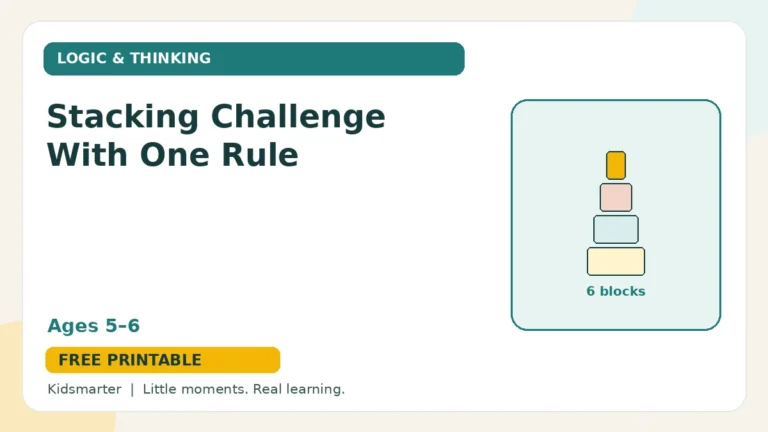
Copy the models flat first. For an optional upright version, try Model 1 only, where the upper block has a support directly beneath it. Model 4 is a flat arrangement with a gap beneath its top square; do not ask the child to balance that block in midair.
Parent Tip & Safety Note
Use only suitable intact blocks and a stable low surface. Skip loose pieces when mouthing is a concern and choose the adult-drawn version. Any optional upright Model 1 experiment stays low, with its upper block supported and away from faces; other printed models remain flat. Put pieces away before the floor returns to walking use.
Explore more activities in this category or free printable games.