Cardboard Lacing Card
Quick Activity Snapshot
- Age Range: Ages 4–5
- Prep Time: 10 minutes
- Skills: Aiming a short lace through a few holes
- Materials: Sturdy cardboard, a hole punch, a short shoelace with a firm tip, and the printed shape templates if wanted
Age ranges are suggestions, not developmental milestones or standards. Choose the setup for this child, and stop whenever needed.
A cereal box can become a reusable lacing card with a few holes around its edge. Your preschooler pushes a lace through one hole, finds the end on the other side, and pulls it through. The action is simple to describe but takes coordination, so begin with only a few holes and a short lace. A finished border is optional; practicing how to recover a hidden end is often the most interesting part of the activity.
Materials You’ll Need
- Clean cereal-box cardboard
- A hole punch, used only by an adult
- A short shoelace with a firm tip
- The printed shape templates, optional
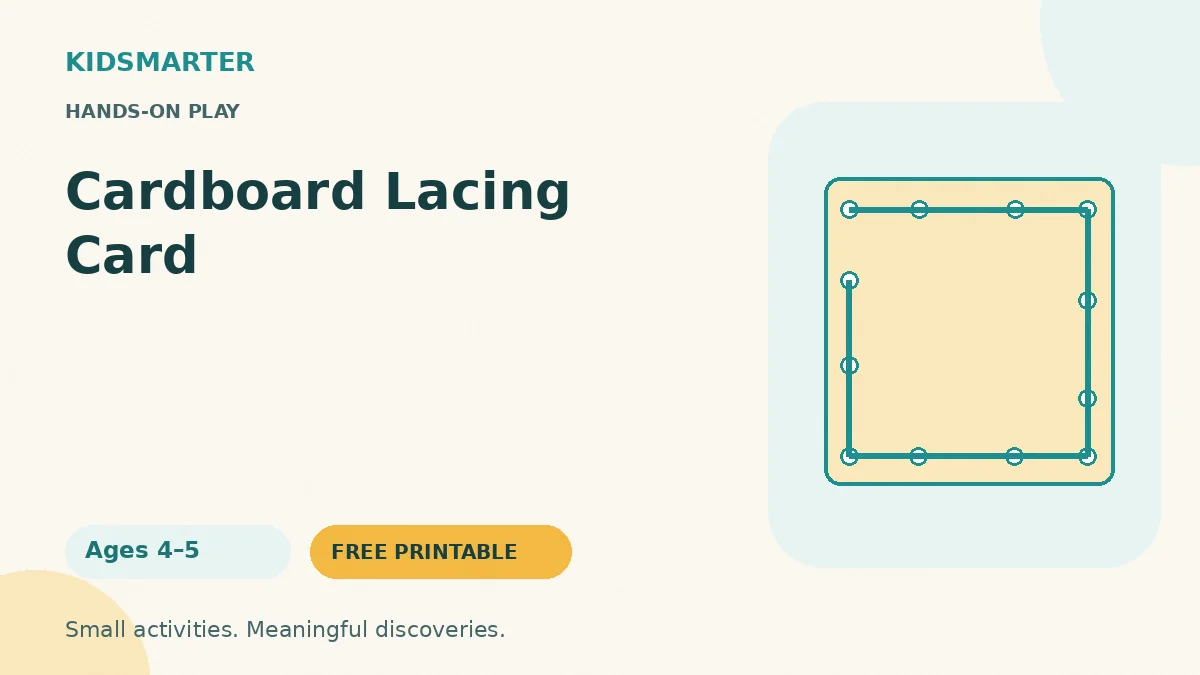
The printable shows a rounded rectangle and a broad triangle with suggested hole positions. Those printed circles are marks for an adult hole punch, not the finished hole size. Punch only four to six well-spaced marks at first, skipping any mark that sits close to an edge so a generous cardboard margin remains. A short shoelace with a firm tip is easier than fraying yarn; if you later use yarn, an adult can secure its end with tape and inspect it often. Avoid long cords and neck-sized loops.
Step-by-Step How to Play
-
Choose a simple broad outline and transfer it to cardboard, or cut the printed template and mount it onto the box panel. Round off sharp corners. Punch four to six holes around the edge, leaving a generous cardboard margin so they do not tear out easily. Show the empty card to your child and let them find each hole with a fingertip before introducing the lace.
-
Tie one end of the short lace to a starting hole yourself, keeping the knot secure and the loose length manageable. Demonstrate pushing the firm tip through the next hole from the front. Turn the card over, find the tip, and pull gently. Say, “One hand holds the card; the other hand sends the lace through.” Keep the card close to the table.
-
Invite the child to repeat the movement through a nearby hole. If the tip disappears, ask, “Could we look on the back?” Let them rotate the card rather than holding it rigidly in one orientation. Give the lace a little slack so it does not snag. Avoid pulling from your end while the child is still working.
-
Continue across several holes using any sensible route. An over-and-under border can come later; diagonal crossings are not mistakes in a first lacing exploration. If a hole tears, stop and repair or replace the card with the child watching. Explain, “The cardboard needs a stronger edge.” This keeps a material problem separate from the child’s coordination or patience.
-
Finish by tracing the lace’s route with a finger and noticing which holes remain empty. Ask whether the child wants to unlace it for another round or save it temporarily for display. An adult removes and stores the cord after the session, especially where younger children can reach it. Keep the cardboard flat and inspect its holes before the next use.
Why This Activity Helps
Lacing gives the hands different but connected roles: one stabilizes and turns the card while the other aims, pushes, and pulls the tip. Looking from front to back also requires keeping track of an object as its visible position changes. These are practical coordination experiences, not a promise of later sewing or writing proficiency. Hole size, lace stiffness, and cardboard strength can make the task much easier or harder.
Easy Ways to Adapt by Age
Make It Easier: Use a large rounded rectangle with just three broad holes and a stiff shoelace tip. Hold the card steady only if the child wants help, then gradually let them take over that role. Practice pushing through one hole and pulling back out before expecting a sequence. A purchased age-appropriate lacing toy may suit children who find thin cardboard frustrating.
Add a Challenge: Ask an older preschooler to follow a route from one hole to the next without skipping, or alternate front-to-back and back-to-front stitches. Let them design a new shape with adult help and predict where holes should go to avoid tearing. Compare a straight route with a zigzag route using the same short length of lace.
Free Printable Included
Print this US Letter template at actual size. An adult cuts and mounts a shape, then punches only four to six marked holes with a generous margin. The printed circles are position marks, not finished holes.
Parent Tip & Safety Note
Cords present an entanglement hazard; stay beside the child, keep the lace short, never loop it around a body, and store it immediately after play. Adults handle scissors and punches. Check for torn holes, sharp cardboard, loose lace tips, and knots that have worked free before each session. Keep scraps, tape ends, and extra cord out of reach of younger children.