Draw a Map of Our Living Room
Quick Activity Snapshot
- Age Range
- Ages 5–6
- Prep Time
- 15 minutes
- Skills Practiced
- Looking at a room and checking marks on a simple plan
- Materials
- Paper, pencil and crayons, the actual room to look at, and the printed example sheet if you want a model
A plan is a simple picture of a place as if seen from above, but you do not climb furniture to get that view. Sit in a familiar living room, look around, and choose marks for a few important things—the door, a window, the sofa. The drawing does not need to be neat or to scale. What matters is that a mark on paper can stand for a real place and can be checked by walking there.
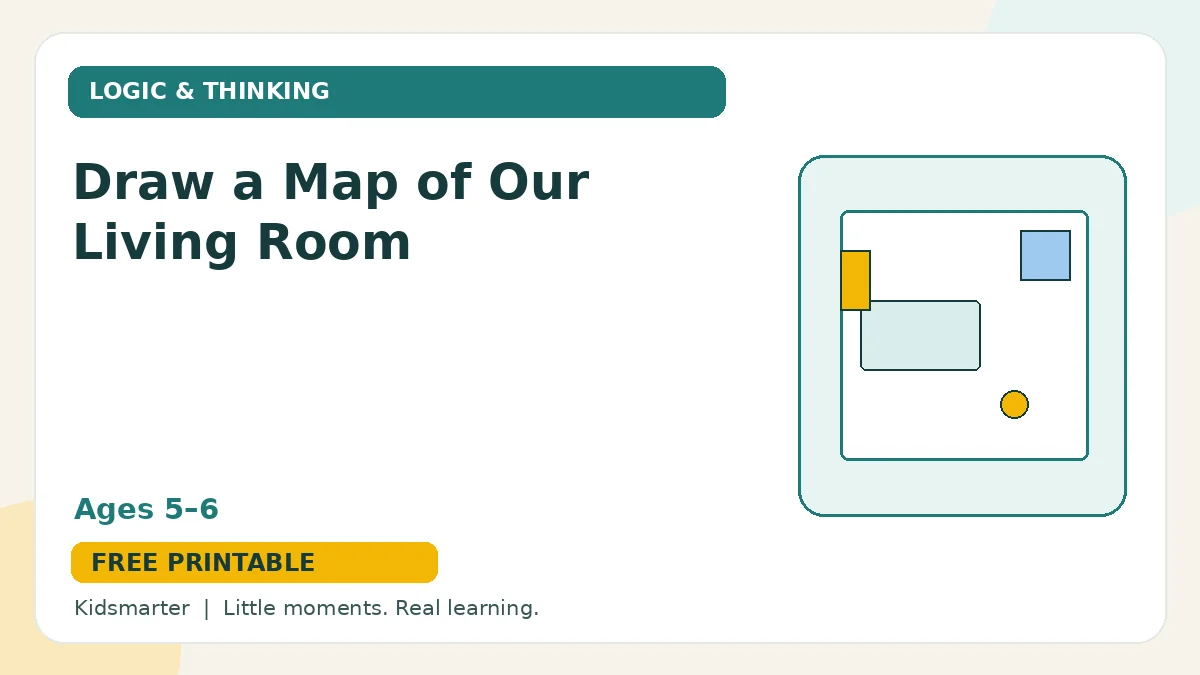
The printable shows one example layout plus a key. Those printed marks are not a map of your living room. Use the key as a model, then draw your own plan on a blank page.
Materials You’ll Need
- Paper, a pencil, and crayons
- The actual room to look at
- The printed example sheet, used as a model only
Bring paper, a pencil, and crayons into the room you will map. Sit where your child can see the door, a window, and at least one large piece of furniture. Keep the printed example nearby so you can copy its symbols, not its furniture placement.
Step-by-Step How to Play
-
Walk to the door together and then return to the blank page. Say, ‘The door is an important place on our map because it is how we enter.’ Draw a simple door mark along the side that matches the real room as your child sees it.
-
Look at the window and the sofa. Ask, ‘Is the sofa closer to the door or to the window?’ After looking, add both with very simple shapes. If the first marks feel wrong, start a second sketch rather than covering the page in erasing.
-
Add one personal detail, such as where a pet likes to sit or where a basket of toys lives. Your child can draw an X or a simple symbol. Say the location aloud: ‘The cushion is beside the sofa, near the window.’
-
Stand up and test the map. Choose one object in the room and ask, ‘Can we find it on our drawing?’ Then reverse the game: point to a mark on the paper and walk to that place. If the map and the room disagree, adjust one mark and try again.
-
Finish by adding a simple key, such as a square for a chair, only if your child is still interested. Write the room’s name at the top and display the map for a day.
Small Details That Make This Activity Work
If the first drawing puts the door on the wrong side, treat that as useful information and look at the room again together. Save the map and revisit it after you move a chair. Seeing one change appear on paper helps the drawing feel connected to real life.
Why This Activity Helps
Making a simple plan asks children to notice location and relative position, then check those ideas against the room. Words such as beside, near, and opposite become useful because you can walk over and test them. A key introduces the idea that a symbol can stand for an object. A first map is a thoughtful start, not a finished survey, and this game is not a lesson in formal map reading or a promise of academic gain.
Easy Ways to Adapt by Age
Make It Simpler
Draw the plan yourself while your child points to the real door and sofa. Use only two or three features, and accept stick shapes. Keep the work on one whole page rather than cutting out furniture pieces.
Ready for a Challenge
Try mapping a second familiar space, such as a bedroom, and compare the two plans. For a follow-the-map game, mark a large, intact object that is already in view—not a hidden small toy—and see whether a family member can walk to it from the drawing.
Parent Tip & Safety Note
Stay on the floor or at a table; do not climb furniture to get a bird’s-eye view. Keep walking paths clear while you look around. If you later map a kitchen, mark only what can be seen from a safe doorway and keep the paper away from heat and water. Do not hide small toys for this game.
The age range above is a suggested starting point for this setup, not a developmental milestone or a standard your child must meet. Check each mark by walking to the real place, and treat a first sketch as a useful plan rather than a finished survey.
Find another small invitation to play in Logic & Problem Solving, or explore our free printable games. Choose one that fits your child’s interests, available materials, and energy today.