Dice Race to Ten
Quick Activity Snapshot
- Age Range: Ages 4–5
- Prep Time: 5 minutes
- Skills: Counting on and numbers to 10
- Materials: The whole two-lane race sheet, A shared fingertip instead of a loose counter, An optional intact age-appropriate die; otherwise an adult calls moves of 1, 2, or 3
Age ranges are suggestions, not developmental milestones or standards. Choose the setup for this child, and stop whenever needed.
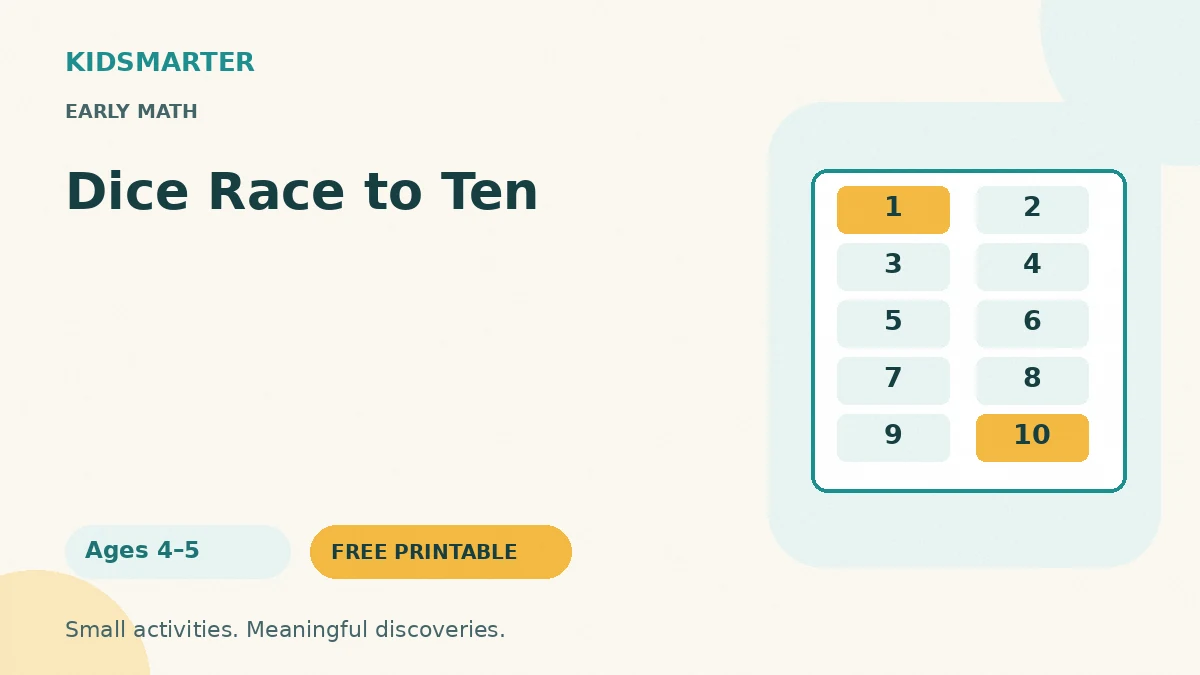
A tiny race path lets preschoolers practice counting for an appealing reason: they want to see where the next roll will take them. This cooperative-friendly version uses spaces one through ten, a starting area outside the path, and a clear finishing rule. You can race two counters or help one shared counter reach the picnic. What matters is matching each spoken count with one move, not beating another player or finishing the board as quickly as possible.
Materials You’ll Need
- The whole two-lane race sheet
- A shared fingertip instead of a loose counter
- An optional intact age-appropriate die; otherwise an adult calls moves of 1, 2, or 3
Keep the board whole on a table. Its lanes run upward from START to 10; each printed space is too shallow for many bulky block counters. Begin cooperatively with one shared fingertip marker and an adult calling moves of 1, 2, or 3. If a suitable die is used, choose an intact, age-appropriate one and play away from younger children who mouth objects. Otherwise omit it entirely. Agree that reaching or passing ten finishes; an exact roll is not required.
Step-by-Step How to Play
-
Place a fingertip at START below the first numbered space. For a move of two, touch 1 while saying “one move,” then touch 2 while saying “two moves.” START is not the first move. Return to START after the demonstration. For two-player play, each person can track a lane with a fingertip. Name the current position before changing fingers so no loose token is needed.
-
Call a move of 1, 2, or 3, or use the chosen die. With a die, count its dots or recognize a familiar dot pattern. To keep rolls within three, an adult can reroll four, five, or six; do not attach tiny replacement face labels. Without a die, ask your child to choose a move for you, then you choose one for them. The same spaces can be explored without a chance contest.
-
Invite the child to move a fingertip one space for each movement count. From 2 with a move of 3, touch 3, 4, and 5 while saying “one move, two moves, three moves.” Then read the destination: five. The three moves and the landing number five answer different questions. Model the turn again if a space was skipped.
-
Take your turn with the shared fingertip, or track a second lane with another finger. Say, “We are on four. Five, six: two moves.” This is counting on; the child may instead count the two movements from one. Name the current position before changing fingers, and pause there between turns so the place is not lost.
-
Near the finish, model the stopping rule. From 8 with a move of 3, touch 9 and 10, then stop: two spaces were enough. Eight plus three is eleven, but this game ends as soon as ten is reached; you do not need an 11th space off the page. Let both players finish, or celebrate the shared fingertip reaching home. End the round before leaving the table, and put any optional die or markers away.
Why This Activity Helps
A path game connects quantities on a die with repeated actions and ordered positions. Counting each space once provides practice in one-to-one correspondence, while noticing the landing numeral links the move with a written number. Counting on can emerge as children become comfortable with the path. The game also creates natural opportunities to wait, check a rule, and recover from an error without treating a mistake as losing.
Easy Ways to Adapt by Age
Make It Easier: Use the shared fingertip and adult-called moves of one or two. Finish at five for a shorter game, pointing to five together before starting; no loose cover card is needed. Keep the stopping rule unchanged throughout that round. Say each move while touching its destination, without requiring the child to call the final numeral independently.
Add a Challenge: Predict a landing number, then check on the board. For a separate exact-finish round, state the complete new rule first: if a roll would pass ten, stay where you are and wait for your next turn. From 8, a roll of 3 then means no move; a roll of 2 finishes. Do not introduce that rule halfway through a game using the easier reach-or-pass rule.
Free Printable Included
Print this activity-specific pack on Letter paper. An adult prepares any cut pieces; use the activity directions above.
Parent Tip & Safety Note
The fingertip-and-called-move version needs no die, tokens, or loose cut pieces. Use it whenever a child mouths objects or younger siblings are within reach. Do not offer damaged dice or foam that can be bitten into pieces. Keep any optional game parts stored between turns away from children who should not handle them, and stop the race if winning begins to overshadow a comfortable shared game.