CVC Word Build With Letter Cards
Quick Activity Snapshot
- Age Range
- Ages 5–6
- Prep Time
- 8 minutes
- Skills Built
- Blending short-vowel words
- Materials
- Large paper letter cards or printed tiles, A small tray, Simple picture prompts (cat, sun, map)
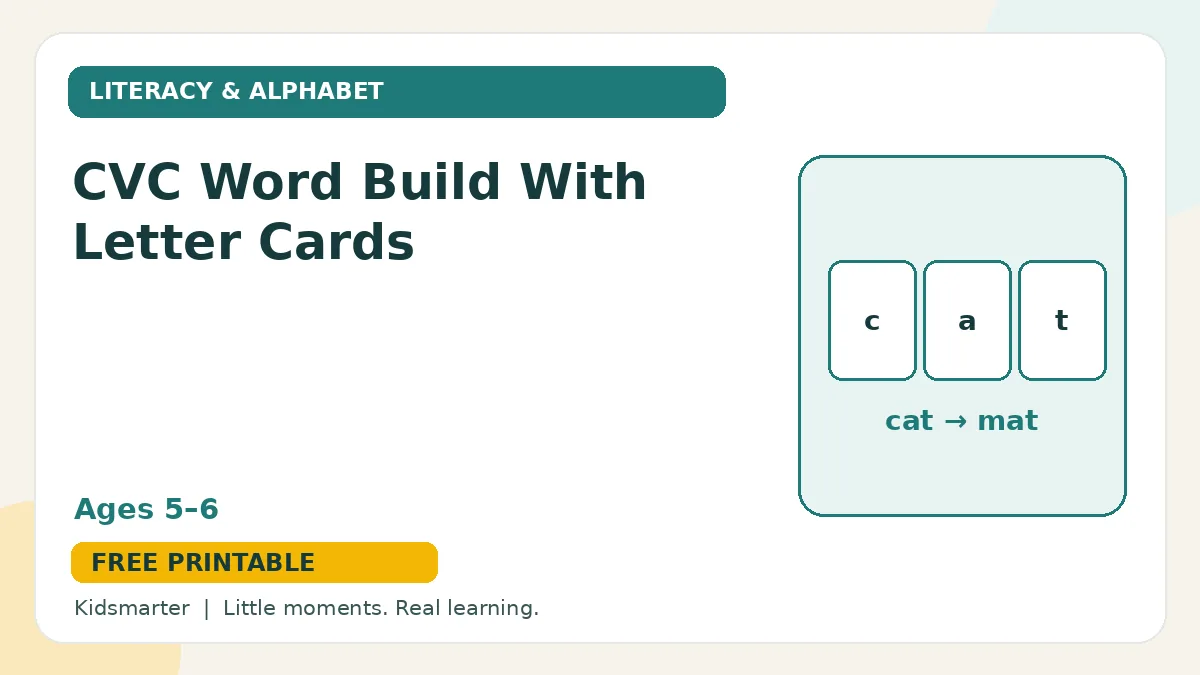
Moving one letter can turn cat into mat, giving you a small print change to talk about. This tray game is for a child who knows the selected sounds and is beginning to join them into words. Use only a few cards. If those correspondences are unfamiliar, let the adult demonstrate or use the oral version without print. A quick guess from a picture or the first letter is not the goal.
Materials You’ll Need
- Large paper letter cards or printed tiles
- A small tray
- A plain sheet to cover the picture row
- Simple picture prompts (cat, sun, map)
For the first chain, set aside m, a, t, c, and s from the printed tile row. Cover the picture row with a plain sheet before presenting the build mat. The PDF has cat, sun, and map pictures, but no mat or sat picture: use a spoken explanation or an adult drawing for those meanings after reading. Save u, n, and p for later rounds. All the needed letters for mat, cat, sat, sun, and map are present once each in the tile set.
Step-by-Step How to Play
-
Say a word aloud before showing its letters: ‘Our word is mat. Listen: /mmm/ /a/ /t/.’ Use the short a sound in mat and a brief /t/, without ‘tuh.’ Ask your child to repeat the whole word or identify its first sound while you model the rest.
-
Lay m, a, and t below the three-box mat. Invite your child to move one letter into each box from left to right. Say, ‘These boxes help us keep our sounds in order.’ If necessary, point to the next letter rather than asking them to search through the whole alphabet.
-
Slide a finger under m-a-t from left to right and join the sounds into mat, using the short a in at. Keep /m/ connected to the vowel and end with a brief /t/. Ask what word the sounds make. Explain that a mat is something placed on a floor; you may draw one now. Do not uncover the cat picture as a “match” for mat. Pictures can check meaning after decoding, but these particular pictures do not provide a matching prompt for every word.
-
Replace m with c. Ask, ‘Only this part changed. What sound starts our new word?’ Read cat from the beginning, pointing beneath every letter. Then swap c for s to make sat. You can act out sitting to confirm the meaning without using a picture for every word.
-
Let your child choose a familiar word to rebuild from mixed cards. Compare it with the previous word and talk about what stayed the same. Finish by reading one complete word comfortably. Put unused cards away; a successful three-word chain is plenty for the first session.
Small Details That Make This Activity Work
Write down the particular word chain you used so another adult can repeat it consistently. On a later day, change the order of the same words. Reading them without relying on a remembered sequence gives a clearer picture of what your child is beginning to understand.
Why This Activity Helps
Blending connects a sequence of speech sounds with a written word. The mat keeps letter order visible, while a one-letter swap highlights that small print changes can alter pronunciation and meaning. Children need the underlying sound knowledge first, and some will benefit from more adult modeling. Explain unfamiliar vocabulary rather than assuming a correctly sounded word is understood.
Easy Ways to Adapt by Age
Make It Simpler
Build the word yourself while your child pushes each card as you say its sound. Offer two possible starting letters, not a mixed pile. You can practice oral blending without any print before returning to the letter mat on another day.
Ready for a Challenge
Try sun or map after a short break, using only familiar sounds. Ask your child to choose which letter must change to turn mat into map. Do not jump to consonant blends or complex vowel spellings just because one three-letter word was read.
Parent Tip & Safety Note
Use the paper version; no magnetic letters, loose magnets, coins, or small plastic tiles are needed. If paper pieces are mouthed or a younger sibling shares the area, keep the sheet uncut and let an adult write the chosen letters in three large drawn boxes while the child points. An adult does any cutting away from children. Paper size and adult presence are not a certification that cut pieces are safe to mouth.
The age range above is a suggested starting point for this setup, not a developmental milestone or a standard your child must meet. Leave unused tiles in an envelope, and return to the same short word chain before adding a new vowel or a new ending.
Find another small invitation to play in Literacy & Alphabet, or explore our free printable games. Choose one that fits your child’s interests, available materials, and energy today.
Reading Rockets explains continuous and stop sounds in blending. CPSC’s magnet guidance is a safety reason to keep this version paper-only, not an endorsement of the game.