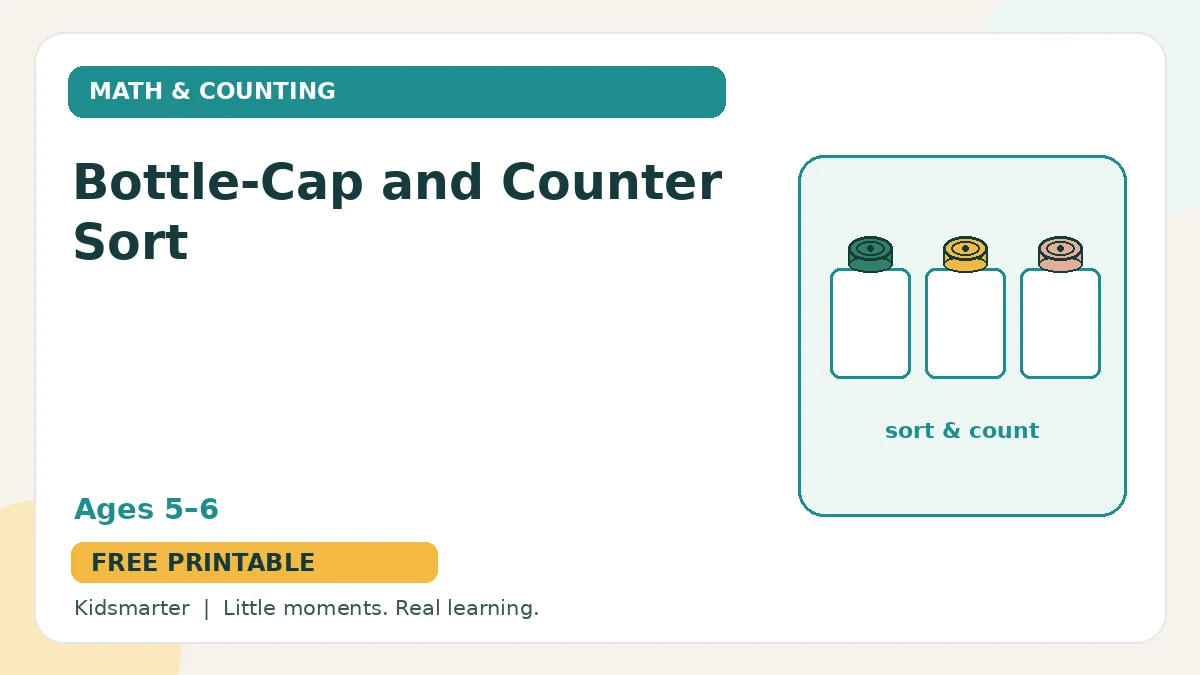
Bottle-Cap and Counter Sort
Quick Activity Snapshot
- Age Range
- Ages 5–6
- Prep Time
- 10 minutes
- Skills Built
- Sorting and counting collections
- Materials
- Large bottle caps or other counters, Two or three cups, Paper and pencil
A small pile of large bottle caps or counters can become a careful sorting-and-counting job. First the pieces are grouped by kind, then each group is counted, and then the totals are written down. The writing remembers what the cups already show; it does not replace the counting.
Materials You’ll Need
- Large bottle caps or other counters
- Two or three cups
- Paper and pencil
Set out two or three cups, a pencil, and a modest pile of large bottle caps or counters. Ten to twenty pieces is plenty. Sit at a table with a tray underneath. Do not use coins as the ordinary set: they are a choking hazard, and supervision does not make them a safe everyday material.
Step-by-Step How to Play
-
Look at one cap or counter together and notice a feature you can sort by, such as color, size, or a mark on its face. Say, ‘All of these belong in this cup.’ Place two or three examples, then invite your child to continue. If a piece is uncertain, put it on a ‘not sure’ saucer rather than guessing quickly.
-
When the pile has been sorted, choose one cup and line the pieces in a row or in groups of five. Count slowly, touching each piece once. If the count is interrupted, begin that cup again. Say the final number clearly: ‘This cup has eight.’
-
Show your child where that total can be written on the recording sheet, beside a simple label or drawing of that kind. You may write while they dictate, or they may write a number you have just modeled. The point is to connect the counted cup with a mark on paper.
-
Count the remaining cups in the same way. Then look across the sheet and compare: ‘Which cup has more? How can we tell?’ You can check by lining two groups side by side, or by looking at the written numbers and then returning to the pieces to confirm.
-
Invite your child to pour one cup back and recount it to see whether the same total appears. End by putting the pieces into a jar or box together. A second recount of a single cup is more useful than opening a much larger collection today.
Small Details That Make This Activity Work
Watch how your child keeps track: a line, stacks of five, or moving each piece out of the cup. Support the method that helps them avoid double-counting. Save the sheet to repeat the same small collection another day.
Why This Activity Helps
Sorting requires a consistent rule, and counting a collection requires tracking each item once. Recording totals helps children see that a written number can stand for a group they have already counted. Comparing cups then gives a reason to look back at the objects.
Easy Ways to Adapt by Age
Make It Simpler
Sort only two kinds and keep each cup under ten. You can drop caps in while you count together, and you may write all of the numbers yourself. A child can also sort bottle caps by color if sizes or marks are hard to tell apart.
Ready for a Challenge
After the cups are recorded, combine two groups on a tray and count the new total. Ask whether that total matches adding the two written numbers, then check with the objects. Keep the combined set small enough to count accurately.
Parent Tip & Safety Note
Use bottle caps or other large counters. If an adult later chooses to show a few real coins to a child who does not mouth objects, the adult should keep control of every coin, count at the table, wash hands afterward, and put the coins away immediately. Never leave coins in a cup on a low table.
The age range above is a suggested starting point for this setup, not a developmental milestone or a standard your child must meet. Count bottle caps or other large counters as the ordinary set, and put any optional coins away as soon as the session ends.
Find another small invitation to play in Math & Counting, or explore our free printable games. Choose one that fits your child’s interests, available materials, and energy today.