Opposite Picture Cards
Quick Activity Snapshot
- Age Range
- Ages 3–4
- Prep Time
- 3 minutes
- Skills Practiced
- Matching everyday opposite pictures
- Materials
- The printable opposite cards, or homemade picture pairs
Age ranges are suggestions, not developmental milestones or standards. Choose the setup for this child, and stop whenever needed.
Some everyday ideas come in pairs that are not the same: open and closed, day and night, full and empty, wet and dry. These cards give those words a simple pointing or matching job. This is not a same-and-different photo game, not a size-sorting cut-and-paste, and not an in, on, and under position game.
Materials You’ll Need
- The printable Opposite Picture Cards, or eight homemade cards with the same four pairs: open and closed, day and night, full and empty, wet and dry
- A clear table or rug space
- Optional, for the cut version only: adult scissors, used in advance and then put away
Print the page at actual size. You may leave the sheet whole and point to partners, or an adult may cut the eight cards apart and mix them. The child does not need to cut. If you make homemade cards, use large, simple pictures and keep them too big to swallow.
Step-by-Step How to Play
-
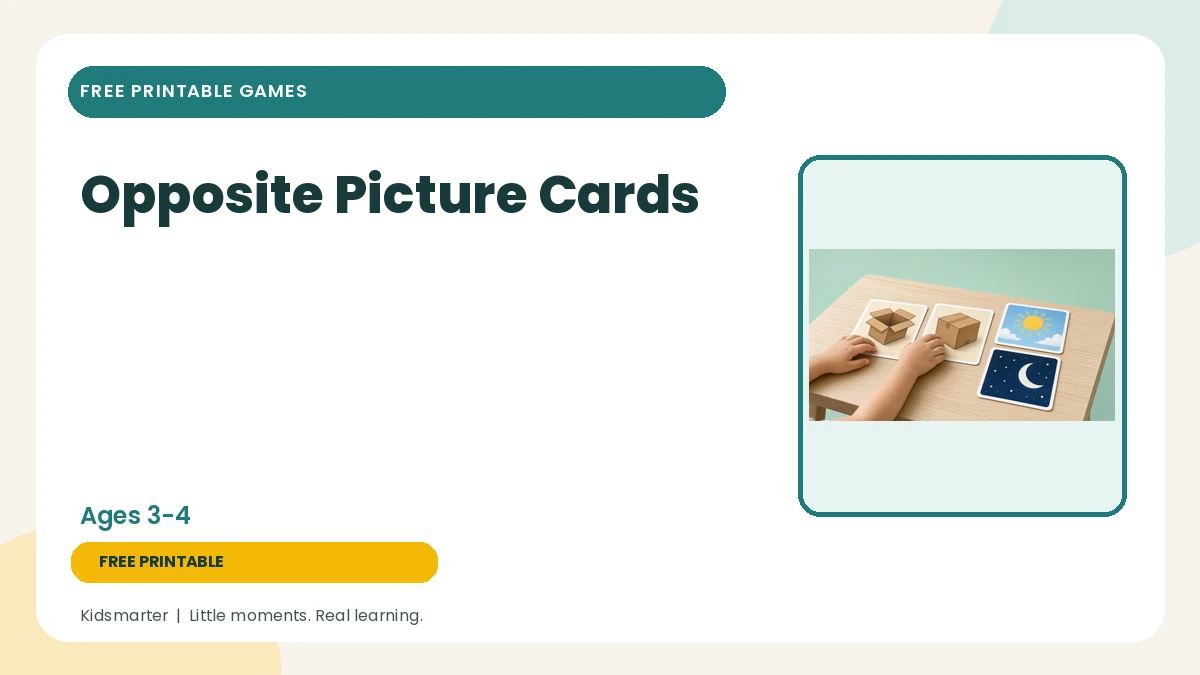
Sit together with the sheet where both of you can see it. Point to one picture and name it: “This box is open. Which picture shows closed?”
-
Invite your child to point to the opposite picture. If they point somewhere else, name what they chose and try again, or model once: “This one is closed.” There is no score.
-
Find the other pairs if your child still wants a turn. You may leave the page whole the entire time. Talking about the two pictures is enough; your child does not have to explain a rule or use the word opposite.
-
If you like a hands-on version, an adult can cut the eight cards, mix them, and invite your child to place partners side by side. Keep any scissors out of reach once the cutting is done. The child does not cut.
-
When they are finished, put the page or the cards away together. One or two pairs can be a complete game. There is no required number of matches.
Small Details That Make This Activity Work
Name the pictures in ordinary words—open, closed, day, night, full, empty, wet, dry—rather than quizzing the word opposite. If your child pairs two favorites that are not a printed set, you can say what they chose and then look for one printed partner, or you can stop. These cards are not go-together pairs about things we use together, not rhyming cards, and not a memory flip.
Why This Activity Helps
Talking about comparison words is one everyday way to notice how things differ. NAEYC’s family math-talk guidance includes comparison language such as big and little, and it discusses measurement words such as full. This card game also uses everyday opposite words such as open and closed or day and night, and it has not been evaluated as a vocabulary or school-readiness program. Matching the pairs is not a developmental test, and children may enjoy pointing to familiar pictures without explaining why they are opposites.
Easy Ways to Adapt by Age
Make It Simpler
Cover all but two pictures that already form a pair, and simply name them together: “Open. Closed.” Then uncover one more pair. No cutting is needed.
Ready for a Challenge
Use the cut cards, mix them, and let your child find all four pairs. You may also look around the room for a real open or closed door after you have named the pictures, as long as the search stays short and safe. Stop if the extra hunt turns the game into a quiz.
Download Free Printable PDF
This original US Letter page is free to download. Print at actual size. Use the whole page and point to two pictures that are opposites, or let an adult cut the eight cards apart. The child does not need to cut. No email signup is required.
Parent Tip & Safety Note
Stay at the table. If you cut the cards, an adult does the cutting, then puts the scissors away before the game begins. Keep paper cards out of mouths, and do not add small decorations or coins to the cards. Supervise as you would with any small paper pieces if a baby is nearby. This is a picture game about words; it is not a lesson in leaving a child near a real full tub or a wet floor. Stop when your child is finished or wants to talk about the pictures in another way.
Explore more activities in this category or free printable games.
For everyday comparison and measurement language, such as big and little or full, see NAEYC’s Math Talk With Infants and Toddlers. That page offers family conversation examples; it does not test this opposite-card game, and it does not treat matching partners as a developmental screening.