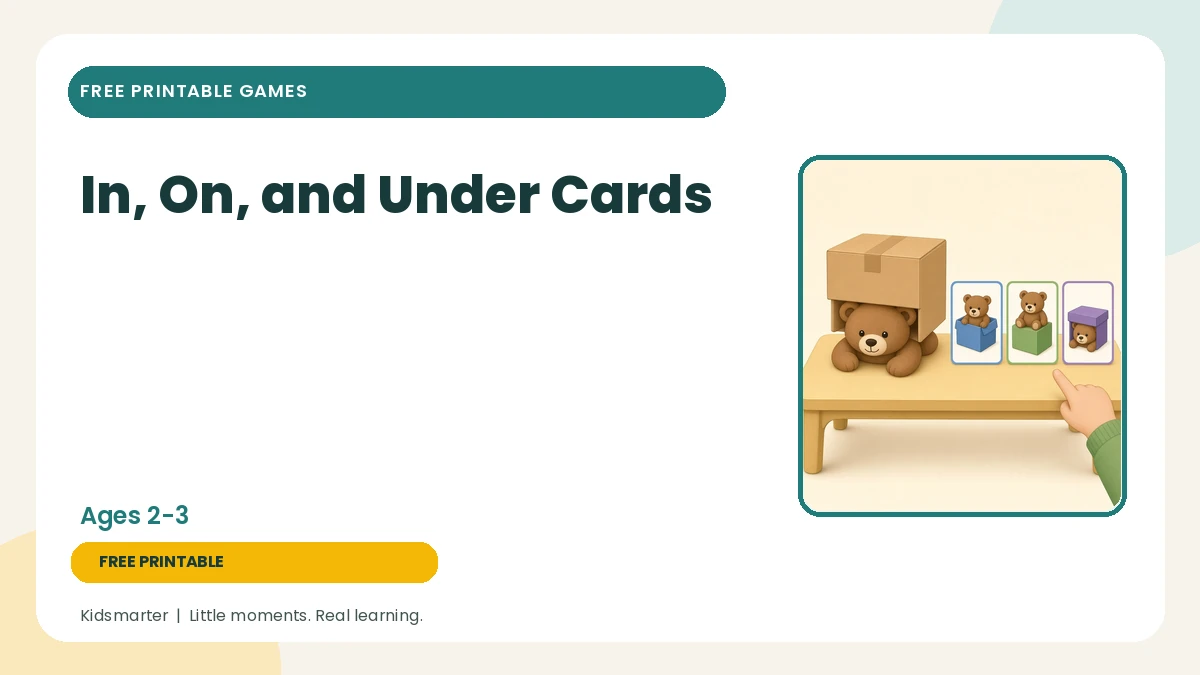
In, On, and Under Cards
Quick Activity Snapshot
- Age Range
- Ages 2–3
- Prep Time
- 3 minutes
- Skills Practiced
- Position words at the table
- Materials
- The printable cards, a small box or cup, and one familiar toy
Age ranges are suggestions, not developmental milestones or standards. Choose the setup for this child, and stop whenever needed.
Position words are easier to talk about when a toy can move. This is a small table game with three words—in, on, and under—and a box or cup as the landmark. It is not a whole-room treasure hunt and it does not use left and right. The cards can stay on one uncut sheet or be separated by an adult.
Materials You’ll Need
- The printable In, On, and Under cards, or three homemade cards with the same words
- One sturdy, unbreakable cup, bowl, or small box
- One familiar toy that is too large to fit in a child’s mouth
- A clear table or rug space
A small box or a sturdy bowl is often steadier than a tall, narrow cup, especially for under. An adult may cut the three cards apart after printing, or leave the sheet whole and point to one panel at a time. The child does not need scissors. Do not use glass, and do not add extra small pieces.
Step-by-Step How to Play
-
Sit together and set out the box and the toy. Show each card and demonstrate slowly: “The bear is in the box.” “Now the bear is on the box.” “Now the bear is under the box.” Pause after each one so your child can look. For under, lift the box, place the toy, and settle the box on top so the toy is clearly beneath it.
-
Show one card and invite your child to place the toy so it matches. Wait. If they put the toy in a different place, name what they did: “The bear is next to the box.” Then you may show the card again and model the matching position, without calling their idea wrong.
-
Take turns. Sometimes your child shows you a card, or places the toy first while you find the matching card. Keep the pace playful. Two or three successful matches can be a complete game.
-
If your child enjoys naming the words, you can say in, on, or under and let them move the toy without showing the card. Stop as soon as interest fades. There is no required number of correct answers.
-
An optional extra, only if they ask for more, is to notice one nearby example in the room—“The book is on the table”—and then return to the toy and box. Stay with simple looking. This remains a tabletop language game, not a hunt through the house.
Small Details That Make This Activity Work
Use the same toy and the same box for the whole turn so the only thing that changes is position. If under is hard to see, use a box with a little height, or rest one edge on a book so the toy remains visible underneath. If your child’s home language uses different position words, play in that language and treat the English cards as an optional extra, or write the words you actually speak on homemade cards. A child who is not yet talking can point to a card or place the toy while you supply the word. Do not slip into a quiz with a score, and do not add left and right in this first version; those words belong to a different kind of game.
Why This Activity Helps
Words such as in, on, and under describe spatial relationships between objects. NAEYC’s math-talk guidance includes everyday examples such as noticing that someone is under a climber or on top, and it treats spatial relationships as a basic early math idea families can talk about in ordinary moments. This three-card table game has not been evaluated as a language intervention or a mathematics program. Matching a card is not a test of language development, and a child may understand a position in play before they say the word.
Easy Ways to Adapt by Age
Make It Simpler
Use only in and on at first. Model each one yourself, then let your child copy. You can also keep the sheet uncut and cover the unused panel with your hand so only one picture is visible.
Ready for a Challenge
Let your child be the teacher and show you where to put the toy. You can also add one new word they already use, such as next to, with a homemade fourth card. If they like a story, the toy can “hide under the box and come out on top,” as long as the game stays short and friendly.
Download Free Printable PDF
This original US Letter page is free to download. Print at actual size. Use the whole page and point to one card, or let an adult cut the three cards apart. The child does not need to cut. No email signup is required.
Parent Tip & Safety Note
Stay at the table with your child. Choose a toy too large to swallow and a lightweight, unbreakable box or cup. Never place the box, cup, or a bag over a child’s head or face. Do not ask a child to crawl under furniture that could tip. Keep any adult scissors used to separate the cards out of reach once the game begins. Stop when your child is finished or wants to play with the toy in another way.
Explore more activities in this category or free printable games.
For everyday spatial language, see NAEYC’s Math Talk With Infants and Toddlers, which includes examples such as under and on top. That page describes family conversation, not this card game, and matching a card is not a developmental screening. This activity is also distinct from a whole-room left-and-right treasure hunt; it stays with three tabletop positions.