A Label for This Chair
Quick Activity Snapshot
- Age Range
- Ages 3–4
- Prep Time
- 5 minutes
- Skills Practiced
- Environmental print with homemade labels
- Materials
- Paper, a marker, and tape for two or three familiar objects
Age ranges are suggestions, not developmental milestones or standards. Choose the setup for this child, and stop whenever needed.
A familiar chair can give a word a real home. You write one simple label, tape it to the object it names, and then you and your child can point to it and read it when you pass by. Two or three labels are enough. This is not a letter hunt in print that is already around the house, not a list about the day, and not a test of reading a new word alone.
Materials You’ll Need
- Two or three small strips or cards of paper
- A washable marker or a thick crayon
- A little tape, used by an adult
- Two or three familiar, movable or easy-to-reach objects, such as a child-sized chair, a door your child can see safely, or an unbreakable cup
You write the words in large, clear letters. Choose short, familiar names you already say, such as chair, door, or cup. You do not need store-bought labels, a label maker, or a printed set. Keep tape in adult hands, and do not tape anything to glass that could fall and break.
Step-by-Step How to Play
-
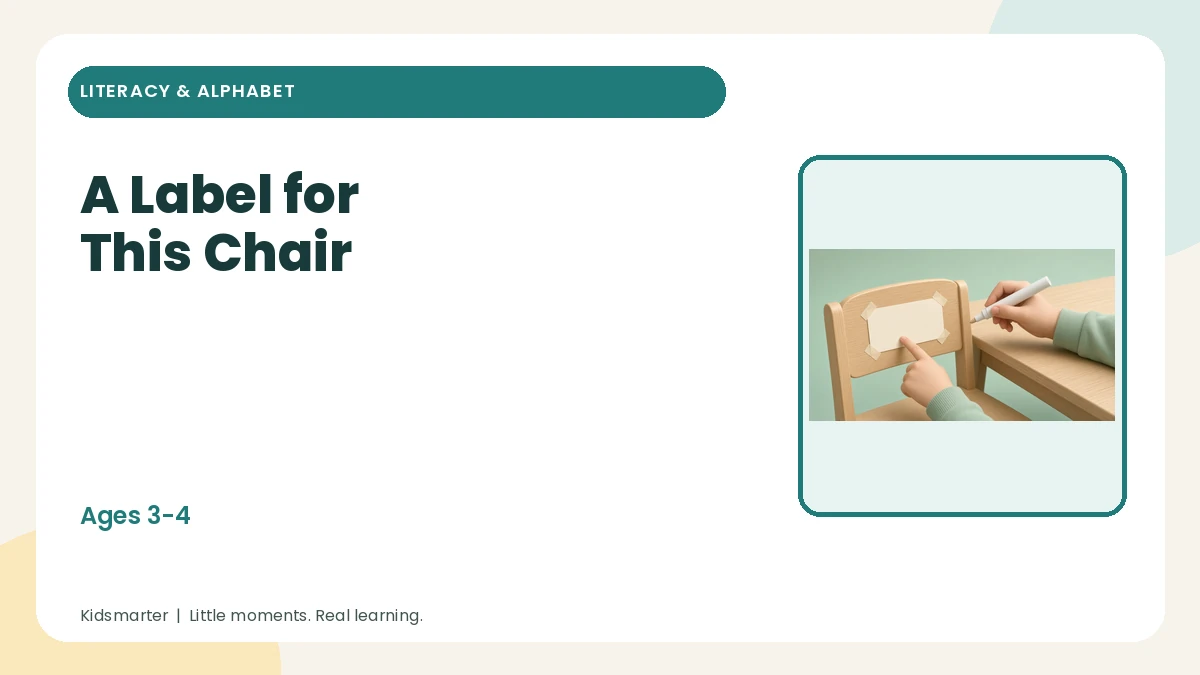
Sit so both of you can see one object, such as the chair. Show a blank paper and say, “We can make a label for this chair. The word will stay with the chair.”
-
Write the word slowly, saying it as it appears. Invite your child to watch, or to add a scribble mark of their own beside your letters if they wish. They do not have to form adult letters.
-
An adult tapes the label onto the object so it is easy to see and will not fall into a mouth. Point under the word and read it together: “This says chair.”
-
Make one or two more labels if your child is still interested. Later in the day, you may walk past the objects and point to a label again. Two or three labels are a complete activity. There is no required tour of the whole house.
Small Details That Make This Activity Work
Write words you already use for those objects, so the print is matching talk you share. Keep the letters large, and tape the label where a child can see it without climbing. If they want only to decorate the paper, you can still write the word and stop after one label. Avoid turning later pointing into a quiz (“What does this say?”) until they have heard you read it. This is not an I-spy letter walk, not a junk-mail letter hunt, not a three-word day list, and not a song-line pointing game: the print belongs to this real object in the room.
Why This Activity Helps
Everyday labels are one way to show that print can name something you can see and touch. Reading Rockets’ guidance on print awareness includes the idea that print carries meaning, and a related guidelines page suggests labeling objects with words (and, in a classroom, pictures) so children can notice print in the environment. Those pages describe print awareness in general; they do not evaluate this homemade chair-label activity, and rereading two or three labels is not evidence of later reading achievement. Children may enjoy helping to tape a label without being able to read the word alone.
Easy Ways to Adapt by Age
Make It Simpler
Make only one label, such as chair, and read it together each time you sit down. You can do all the writing and taping while they watch and point.
Ready for a Challenge
After a few times pointing to the labels, invite your child to lead you to “the one that says cup.” Some children like to help you make a fourth label for another familiar object. Keep the set small, and stop if the extra labels start to feel like a reading test or a decorating project you cannot stay with.
Parent Tip & Safety Note
Stay with your child. An adult handles the tape and keeps it away from mouths and hair. Use paper labels, not glass frames or anything that could fall and break. Put the marker away when you are finished. Do not tape labels where a child would need to climb, and do not block a door or a window. Stop if your child is finished, wants only to draw, or would rather sit in the chair than look at the word.
Explore more activities in this category or free printable games.
For the idea that print carries meaning, and for labeling objects as one way to notice print in the environment, see Reading Rockets’ Print Awareness and Print Awareness: Guidelines for Instruction. Those pages describe print awareness in general, including classroom labels; they do not evaluate this homemade chair-label activity, and they do not promise later reading achievement.