Is It Longer Than This String?
Quick Activity Snapshot
- Age Range
- Ages 3–4
- Prep Time
- 5 minutes
- Skills Practiced
- Comparing length with a string
- Materials
- A short piece of yarn or string, one familiar object, and a few things to compare
Age ranges are suggestions, not developmental milestones or standards. Choose the setup for this child, and stop whenever needed.
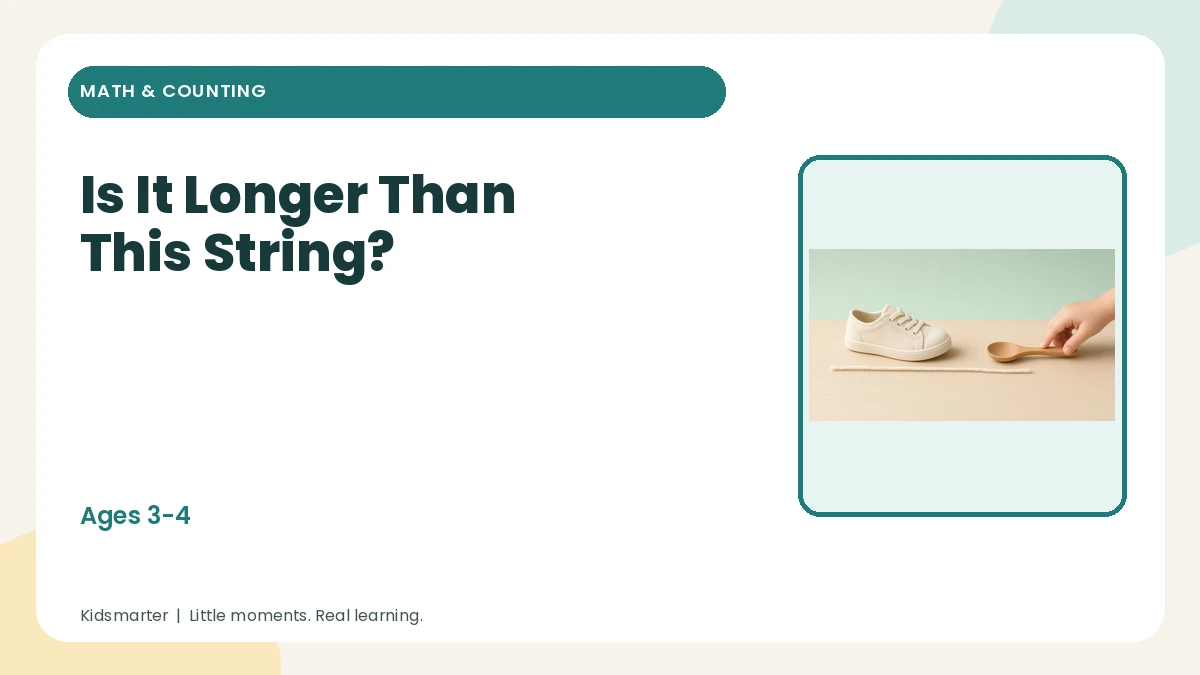
A short string can become a helper for length: you make it as long as a familiar object, such as a shoe, then lay another object next to the string and see whether it is longer or shorter. This is everyday talk about length, not a lesson with a ruler, and not a walk around the room counting footsteps.
Materials You’ll Need
- A short piece of yarn, string, or ribbon, cut in advance by an adult to about the length of a shoe or a book
- One familiar object to match first, such as a child’s shoe or a picture book
- Two or three other objects that are clearly longer or shorter than the string, such as a wooden spoon, a crayon, or a scarf
An adult cuts the yarn before the game begins, then puts the scissors away. Use a short piece, not a long loose cord. Choose objects that are too large to fit in a child’s mouth, and skip anything sharp, glass, or easy to swallow. You do not need a ruler, a tape measure, or numbers on the string.
Step-by-Step How to Play
-
Sit at a clear table. Show the shoe or book and the yarn. Say, “We can make this string as long as the shoe. Then we can find out whether other things are longer or shorter.”
-
Lay the yarn along the object and adjust it so the two ends line up as closely as you reasonably can. A close match is enough; you do not need a perfect measurement.
-
Set the first object aside, leaving the string in place. Invite your child to choose another object and lay it next to the string. Name what you see: “The spoon is shorter than the string,” or “This scarf is longer.”
-
Try one or two more objects if your child is still interested, then stop. A surprising result is useful, not a failing. When you are finished, put the yarn away together so it is not left out.
Small Details That Make This Activity Work
Keep the string still on the table while you compare, so the length does not quietly change. Compare one object at a time. If your child wants only to coil the yarn, you can stay with that for a moment and then try one comparison, or you can stop. This is not footstep measuring around the room, not a lid-size line-up, and not a game about which cup holds more: the question is whether something is longer or shorter than this one string.
Why This Activity Helps
Everyday comparing can make measurement words visible. NAEYC’s family math-talk guidance includes measurement ideas such as size, and it encourages comparison language in daily life rather than a rapid quiz. That page offers language and everyday examples; it does not evaluate this string-and-shoe routine, and finishing a few comparisons is not evidence of school readiness. Children may enjoy lining things up without explaining why one is longer.
Easy Ways to Adapt by Age
Make It Simpler
Do the lining-up yourself, and compare only two objects that are obviously different in length, such as a crayon and a scarf. You can simply say longer or shorter as you point.
Ready for a Challenge
After a few comparisons, ask, “Can we find something that is about as long as the string?” Some children like to help you make a new string as long as a different object. Keep the yarn short, and stop if the extra measuring turns the game into a tangle you cannot stay with.
Parent Tip & Safety Note
Stay at the table for the whole activity. Use a short piece of yarn, and do not wrap it around a child’s neck, wrist, or finger. Put the yarn away as soon as you finish, and do not leave a long cord or a loose loop out. An adult cuts the yarn in advance; the child does not need scissors. Choose objects that are too large to swallow, and skip glass or sharp tools. Stop if the yarn becomes a tug toy, if anyone is frustrated, or if your child is finished.
Explore more activities in this category or free printable games.
For everyday language about measurement and comparison, see NAEYC’s Math Talk With Infants and Toddlers. That page describes math talk in daily life, including measurement ideas such as size; it does not test this string-comparison game, and it does not treat finishing a few comparisons as a developmental screening.